HTW Universal Building - New teaching and laboratory building
Andreas-Schubert-Straße 6, Dresden, Germany
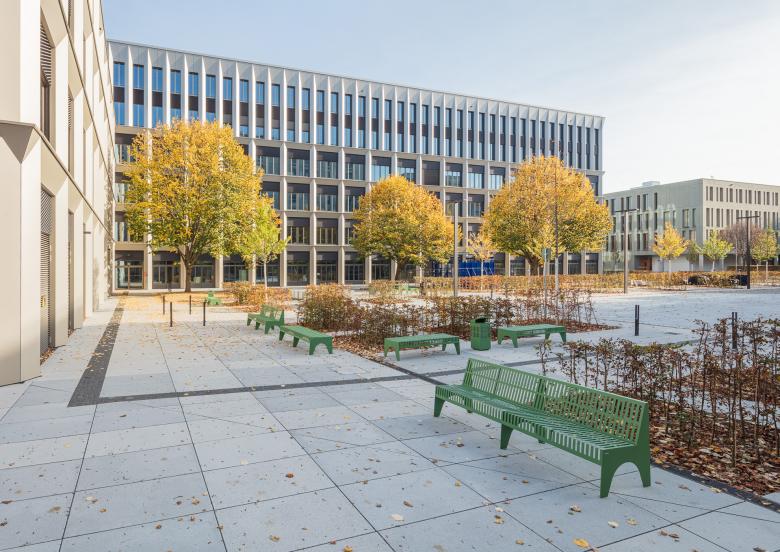
There are a wide range of requirements for the outdoor facilities of the new teaching and laboratory building. These range from maintaining the necessary infrastructure functions on the plot of land, to the spatial and functional requirements of the laboratories in terms of open space, to sustainability criteria and consideration for the valuable existing tree population.
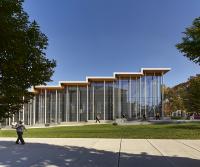
The aim is to integrate the existing and new functional areas into a high-quality campus design that is representative of the university buildings as a whole.
The ground floor of the new teaching and laboratory building houses laboratories for the departments of Water Management and Building Materials Technology with direct access to the courtyard area, as well as other HTW research laboratories. These users have different requirements for the outdoor facilities, all of which have been integrated into the design.
The building materials technology department will have accessible areas with a smooth surface on which various materials can be stored and processed, in close proximity to the concrete laboratory.
The railway construction department, on the other hand, needs easily accessible and visible exhibition areas for models and railway sleepers.
The hydraulic engineering laboratory has been allocated a test area with a water connection in the immediate vicinity of the building.
An area for a test setup has been prepared for the geotechnical engineering department.
In addition, seven parking spaces for construction waste containers ranging in size from 3 to 5m³ are required to dispose of building materials and samples of all kinds. These areas are suitably robust and accessible for collection by lorry.
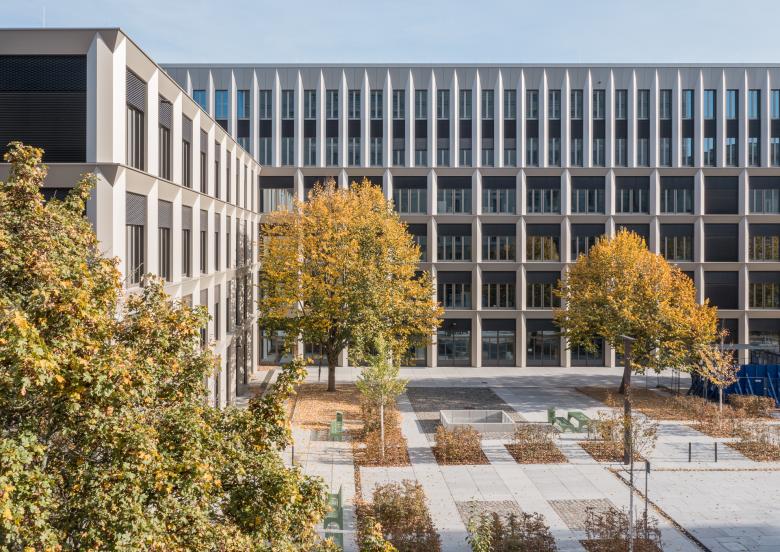
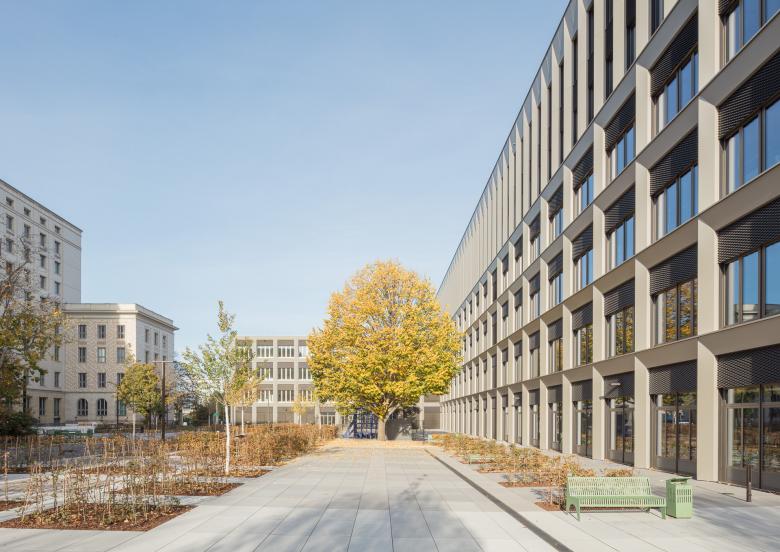
In order to meet the different requirements of the teaching areas housed in the new teaching and laboratory building in a sensible location in relation to the laboratories on the ground floor and upper floor, and at the same time to create an attractive inner courtyard with a varied range of outdoor recreation options, a concept has been developed that structures the open spaces with a strong reference to the building.
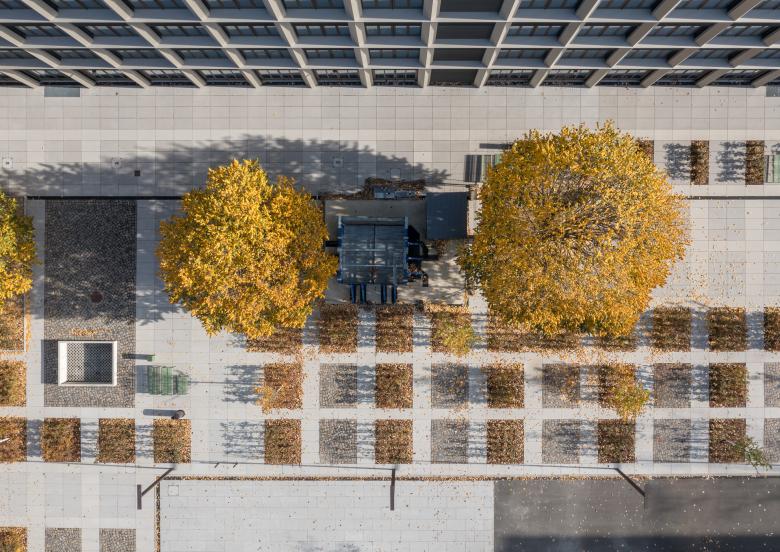
Based on the axes of the façade, a grid of green spaces and paving slabs has been created, into which the various uses are integrated.
Cubes of trimmed hedges form a basic spatial framework. Dense blocks of hornbeam and hedges create manageable sub-spaces, like cabinets, in which the various uses are contained.
The ‘exhibits’ consist of the railway construction models, the geotechnical testing area, the area for water management infiltration testing, as well as the bulk material storage areas of the building materials laboratory and the construction waste containers.
The hedges form a filter approximately 1.10 metres high along the courtyard façade and rise to approximately 1.50 metres at the central square, integrating the containers well into the space without creating areas that are difficult to see into.
The outdoor areas, the connecting square and the connecting paths are paved with a smooth, low-vibration surface made of large concrete slabs. These are particularly suitable for use with pallet trucks. The use of two different shades of grey means that the structuring grid is also visible in the large areas.
The parking spaces for the containers, as well as the area for the water test, have a natural stone paving surface. This is robust against the particular stress caused by parking the construction waste containers and also has good drainage properties.
For the women's parking spaces and bicycle parking spaces along the façade facing Strehlener Straße, paving with gravel joints has been chosen to significantly reduce surface sealing.
The tactile elements of the guidance system are laid over the different surfaces. The guidelines connect the entrances of the new building with the Z building and the flow of students from the public space.
Between the two buildings is a large open space that can be used for events. The access roads and open space also serve as staging and emergency routes for the fire brigade. The cafeteria garden near the large poplar trees by the Z building has been created as an additional recreational area with several bench and table combinations.
Although numerous trees had to be felled for the new building and the extensive media installation, individual large existing trees in the courtyard were preserved. These include a large black locust tree and three silver lime trees. Together with the green cubes of the hedge blocks and the new plantings, they enhance the courtyard in a sustainable manner.
A large maple tree and several tree of heaven trees were preserved along Strehlener Straße. The valuable avenue of horse chestnut trees along Andreas-Schubert-Straße was protected from the construction work with the aid of a root curtain.
The new plantings in the outdoor areas include a row of columnar oaks on the former Lindenaustraße and eight loosely spaced elms in the inner courtyard and on Strehlener Straße. The new plantings are native solitary trees or cultivars that are very well suited to the inner-city location. As it was not possible to plant all the replacement trees required for the fellings on the property, a green corridor with 19 new trees was created on Franklinstraße.
Along the façade facing Strehlener Straße and at the entrance, a mixed planting of ground-covering shrubs, perennials and grasses has been created.
It forms a buffer to the busy road and integrates the archive's light wells, which run across the site.
The inner courtyard is closed to vehicular traffic by barrier systems; access is only possible for the fire brigade and waste disposal services, as well as for residents in consultation with the gatehouse. However, the property is freely accessible to pedestrians. The absence of a fence creates a smooth transition to the public space.
A total of 274 bicycle parking spaces are arranged as double or single-sided row stands at the entrance to the former Lindenausstraße and along Strehlener Straße. The bicycle parking spaces are no more than 33 metres from a building entrance and offer good opportunities for locking the bicycle frame and sufficient distance between the individual stands, in accordance with the requirements of the BNB Gold Standard.
- Landscape Architects
- r+b landschaft s architektur
- Year
- 2024
- Project Status
- Built
- Client
- Freistaat Sachsen SIB Niederlassung Dresden II