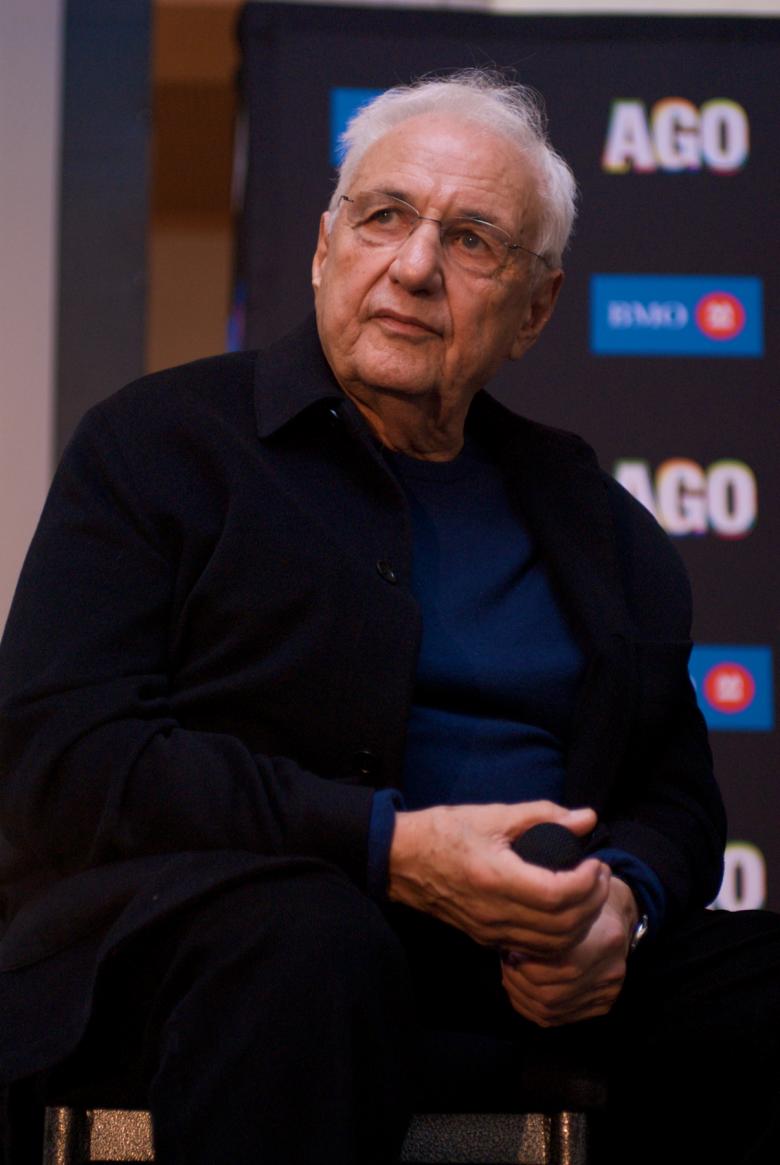
Frank Gehry, 1929–2025
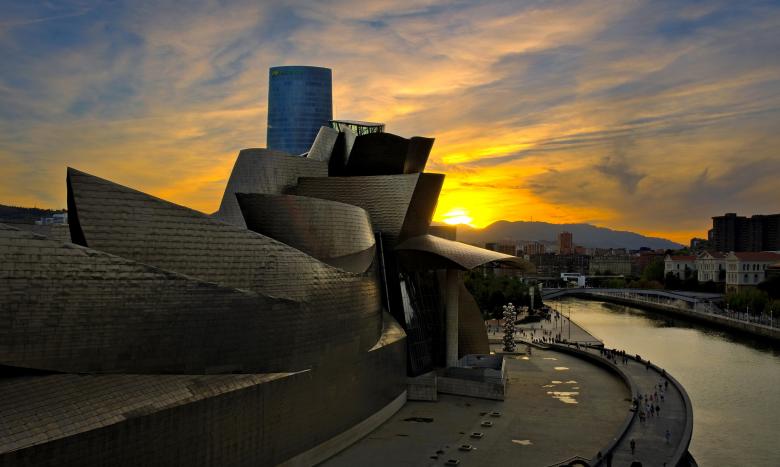
Frank Owen Gehry, the most famous architect in the world since the opening of the Guggenheim Museum Bilbao in Spain in 1997, died on Friday, December 5, 2025. He was 96.
When the Guggenheim Museum Bilbao opened to the public on October 18, 1997, Frank O. Gehry was 68 years old. The museum, with its flowing titanium skin on the banks of the Nervión, was a media sensation, drawing international tourists to the Basque city in droves, leading to the so-called “Bilbao effect,” in which contemporary architecture was used to reinvigorate post-industrial cities, and making Gehry a household name. In other professions achieving such a success at that age would have been a crowning achievement and made retirement that much sweeter. But 68 is far from old in architecture—and Gehry still had much to do in his career. If anything, the museum in Bilbao was just part of a new stage in Gehry's boundary-pushing architectural career.
Born Frank Owen Goldberg in Toronto on February 28, 1929, Gehry moved with his family to California in 1947 and attended architecture school at USC, graduating in 1954. That same year he changed his name to Gehry, spurred by his first wife, Anita Snyder, out of fears of anti-Semitism (they divorced in 1966). Gehry then ventured to Harvard University for a master's degree but dropped out, returning to Los Angeles and working with Victor Gruen, the Austrian-born architect who is attributed as the inventor of the modern shopping mall and whom Gehry had interned with while at USC. After a short stint in Paris working for architect Andre Remondet, Gehry returned once again to LA, establishing his own office in 1962. Early projects consisted of houses, apartment buildings, and shops, but the first notable work was the Danziger Studio and Residence built in Hollywood in 1965. Although the boxy stucco-covered building is a far cry from the flowing titanium in Bilbao, seeds of Gehry's design approach can be grasped all these years later, namely in breaking up programmatic elements into different volumes, in this case one for the studio and one for the residence.
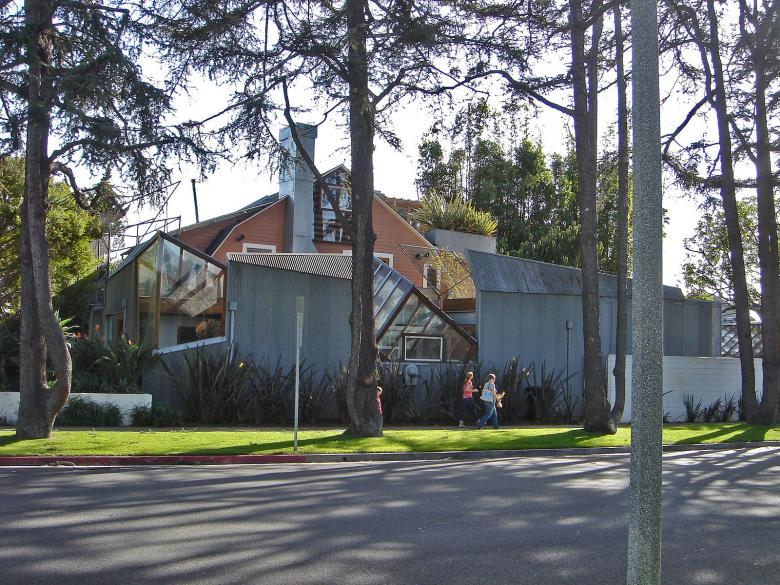
The project that brought Gehry to the attention of architects outside of Southern California was not a new building, but his transformation of a two-story bungalow on a corner lot on 22nd Street in Santa Monica that he bought with his new wife, Berta Isabel Aguilera, in 1977. Gehry had been working with cheap materials like plywood, corrugated metal, and chain link—the last notably on the parking garage of Santa Monica Place—but he used them on his house in wholly unexpected ways: “an assemblage and collage of familiar materials with new connotations,” per Francesco Dal Co and Kurt W. Forster's 1998 monograph on the architect. At that time, Gehry decided to move away from developer projects like Santa Monica Place; he downsized his office and used his house as a place of experimentation. It apparently struck a chord, and Gehry's novel use of chain-link fencing and corrugated metal found their way into other projects in the late 1970s, among them the Cabrillo Marine Museum (1977–79) and Spiller Residence (1978-79).
But a formal playfulness was evident in larger commissions, most notably the Loyola University Law School (1978–1990) and California Aerospace Museum (1982–84). These projects and others, including the Winton Guest House in Minnesota (1982–87), saw Gehry continue to break up programmatic pieces into separate volumes, but instead of boxes they took on angular and curved forms, often clashing into each other in dramatic ways. Then, in the early 1980s, Gehry found inspiration in an unlikely place: fish.
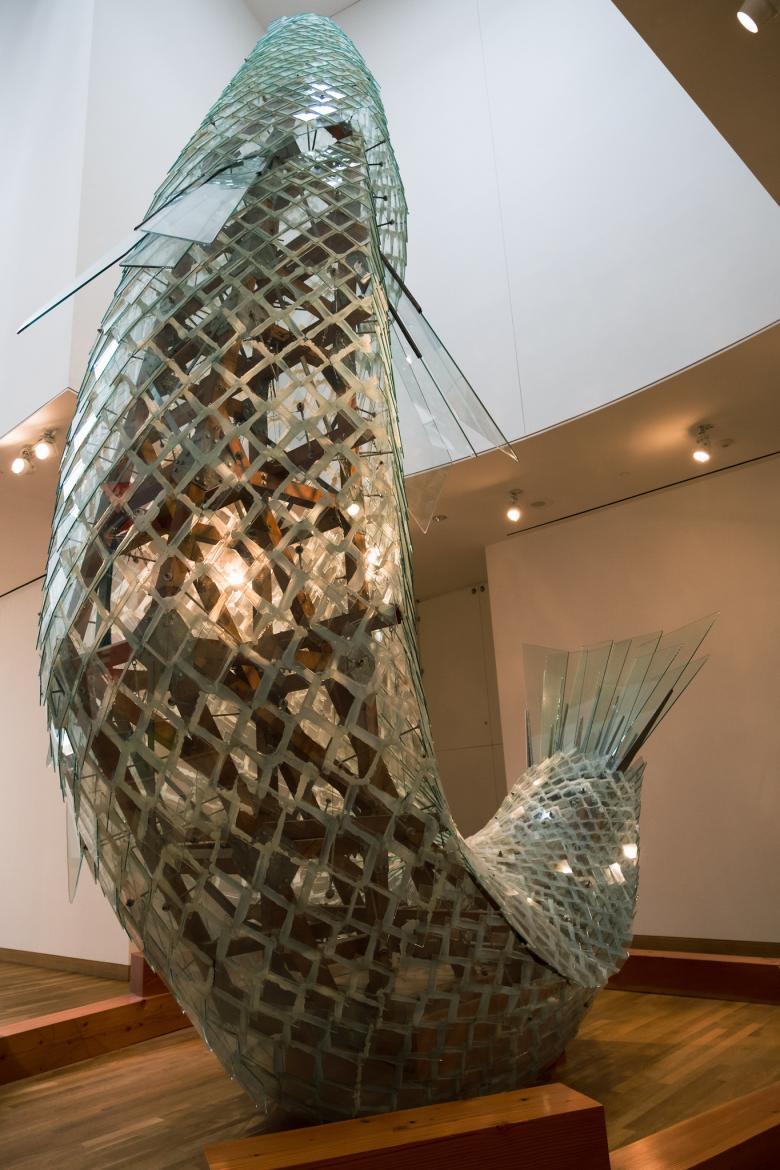
Paul Goldberger, in his 2015 biography of Gehry, Building Art, wrote (naturally in the “Fish and Other Shapes” chapter) that Gehry saw fish as “an inspiration for architecture that would be more sensual and more geometrically complex than the conventional modernist box.” Gehry was fascinated by the double curves, the skeleton, and even the scales—the last appealing to him “as a reminder that such a sensuous shape can be made up of many little parts that come together…” In hindsight, it's impossible to see the Guggenheim Museum Bilbao, the Walt Disney Concert Hall, the Fondation Louis Vuitton, or any other Gehry building this century happening without the lamps, sculptures, and other fish experiments. But at the time Gehry was basically noodling around, being as much an artist as an architect.
One result of projects such as the Fishdance Restaurant (1986–87) in Kobe, Japan, which found Gehry appropriately designing an architecturally scaled fish; the project pushed Gehry and the architects in his employ to figure out how to structure and clad such a complex form. The fish component of the restaurant was an outdoor sculpture that did not need to be watertight, and therefore could be covered in chain-link “scales.” A similar circumstance applied to El Peix, the large fish sculpture Gehry designed for the retail portion of the Vila Olimpica hotel built for the 1992 Olympics. Faced with an unrealistic timeline for such a complex construction, this project is notable as being the first project in Gehry's office that used computer software. The firm opted to use CATIA, a program originally developed for fighter jets, but it was used in Gehry's office to turn complex design forms into standardized components that would be relatively easy to build.
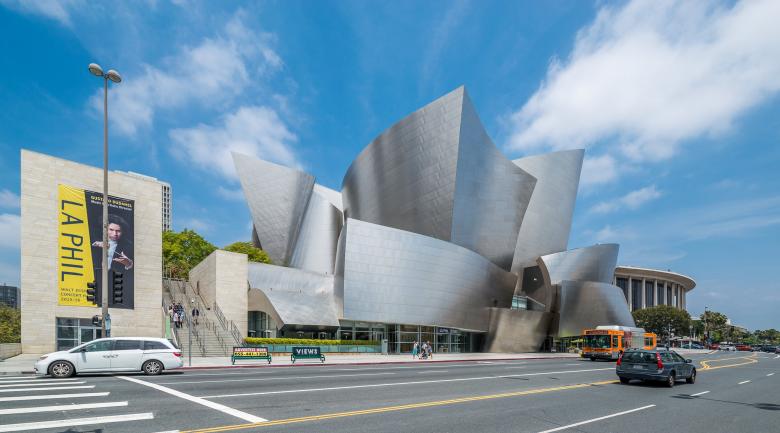
The impact of Gehry's “discovery” of CATIA in 1989 on the buildings he would design from then onwards cannot be overstated. Just about any building that is recognizable as “Gehry” was developed and built using the software. Even the Walt Disney Concert Hall, which opened in 2003, five years after the Guggenheim Museum Bilbao, began that fateful year of 1989 (the same year that he won the Pritzker Prize), two years before the office started designing the Guggenheim. Neither project would have been achievable without the expanded role of computers in the office, without software that could turn Gehry's own models—which still started as stacks of programmatic boxes and gained their form through the application of sometimes crumpled-up paper facades—into steel, metal, and stone constructions.
The buildings exhibiting Gehry's signature in his post-1989 CATIA career are many, but none were more famous than the Guggenheim Museum Bilbao, of course. It was the right building at the right time. Images of it circulated widely in print and online media, attracting millions to Bilbao and spurring other cities to invest in cultural constructions that would hopefully do the same. Even big cities that didn't need to be saved by the so-called “Bilbao effect” saw developers and institutions tapping Gehry for important commissions, among them the Jay Pritzker Pavilion (2004) at Millennium Park in Chicago, 8 Spruce Street (2011, aka New York by Gehry) in NYC, and the Fondation Louis Vuitton (2014) in Paris.
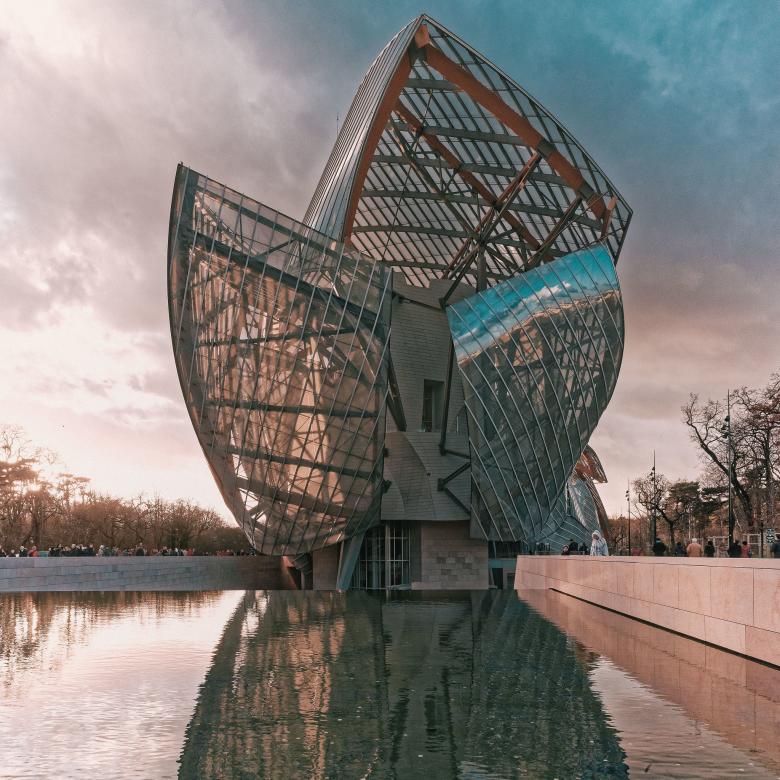
A couple recent large-scale projects at Gehry Partners, which numbers somewhere around 150 employees, saw Gehry making his mark on the skyline of Toronto and Los Angeles, the cities where he was born and he emigrated. Forma, previously known as Mirvish+Gehry, is a mixed-used development in Toronto with towers of 74 and 84 floors that is under construction and expected to be done in a few years. Directly across the street from the Disney Concert Hall, The Grand LA is a full-block mixed-use project that was built in phases, the last completed in 2022.
In early 2011, the transplanted Angeleno bought a house and property in Santa Monica to built a new Gehry house. Although there was an old pink house reminiscent of the bungalow he had renovated decades earlier, he saw it as a tear down and, working with his son Sam, designed a whole new complex of Gehry-like forms in its place. Completed to little fanfare in 2017, the house on Adelaide Drive is where Frank O. Gehry died on Friday, December 5, 2025, following a brief respiratory illness.