Architect Presents White House Ballroom Plans to National Capital Planning Commission
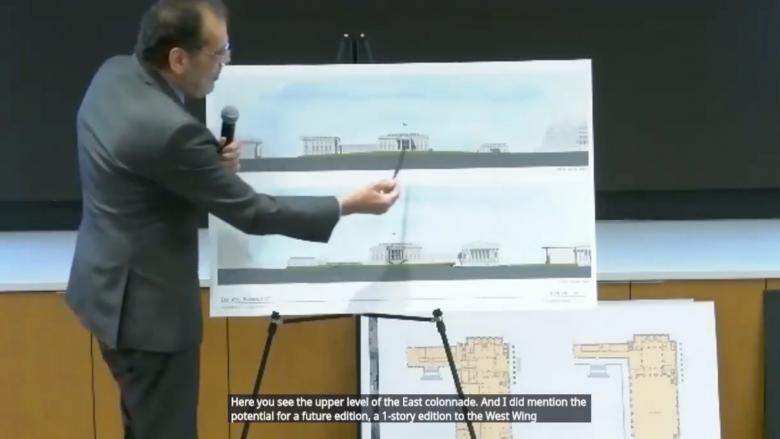
Three months after the East Wing of the White House was bulldozed by US President Donald J. Trump to make way for a new ballroom, and two months after Shalom Barnes replaced James C. McCrery as architect of the addition, the “East Wing Modernization Project” was presented to the National Capital Planning Commission on January 8.
The informational presentation to the National Capital Planning Commission (NCPC) on Thursday was notable not only because it was the first public appearance of architect Shalom Baranes in his capacity as architect of the new White House ballroom, but because it was the first instance of the administration apparently adhering to the normal review process for federal buildings, a process it seemingly sidestepped with the demolition of the East Wing in October. While the design of the rather banal-sounding East Wing Modernization Project as presented on Thursday closely resembles the design by James C. McCrery that was unveiled in August, the remarks by Baranes clarified some parts of the design yet also raised at least one issue that was not discussed previously in the context of the East Wing's replacement by the new ballroom. These comments include:
- Baranes decided to advance an earlier scheme, not a later enlarged scheme mentioned by Trump.
- The ballroom itself will be 22,000 square feet, serve up to 1,000 seated guests, and have a ceiling height of approximately 40 feet.
- The total area of the new East Wing will be 89,000 sf across two floors (ballroom on second floor; kitchen, offices, etc. on first floor).
- The roof of the East Wing will align exactly with the roof of the White House.
- Portions of the existing East Wing were preserved (colonnade, gardens, movie theater), with plans for the movie theater to be reconstructed on the first floor of the two-story colonnade.
- The architects are exploring a second-story addition to the West Wing's colonnade, to balance the East Wing's proposed two-story colonnade.
The last bullet point, a revelation, is related to the way the NCPC is focused on the appearance of the White House from public places, specifically from Pennsylvania Avenue on the north and from The Ellipse on the south. While existing clusters of trees block views of the two wings and frame views of the White House, portions of the colonnades would also be visible, leading to the justification for a second-story colonnade for the one-story West Wing. Yet it also gives pause: Is Trump looking to expand the West Wing by adding a second floor, aligning its size closer to that of the proposed East Wing?
The presentation can be watched below, starting at approximately 1 hour, 22 minutes:
While the NCPC needs to provide approval on the East Wing Modernization Project, the January 8 presentation was purely informational and preliminary, with “a more detailed and fully developed submission” to be presented at a subsequent monthly hearing. (The next meeting of the NCPC will take place on February 5 at 1pm ET.) Nevertheless, the 12-member commission—consisting of three Trump appointees, two commissioners appointed by the Mayor of Washington, DC, and seven ex officio members—was able to ask questions or provide comments (five of the commissioners were represented by designates during the meeting). Yet only one member of the commission, Phil Mendelson, was vocally critical of the process and the design.
Mendelson, the Chairman of the Council of the District of Columbia, questioned the logic of presenting the project to the NCPC after the East Wing was already demolished. Concerned that the addition will overwhelm the White House, he also asked Baranes if construction has already started and if that would constrain reducing the footprint of the East Wing, and he asked if the height of the ballroom and the overall building could be reduced as well. Lastly, he expressed concern that the second-floor addition to the West Wing colonnade, among other potential future changes mentioned by Baranes, indicate that the ballroom is part of a larger plan, but the commission will only see and comment upon it in a piecemeal fashion, not as a whole. Baranes replied that it was not too late for changes to be made, but given the nature of the informational presentation and the fact the eleven other members of the commission had no qualms with the design, it's unlikely the design would incorporate such comments before it is officially submitted in the near future.