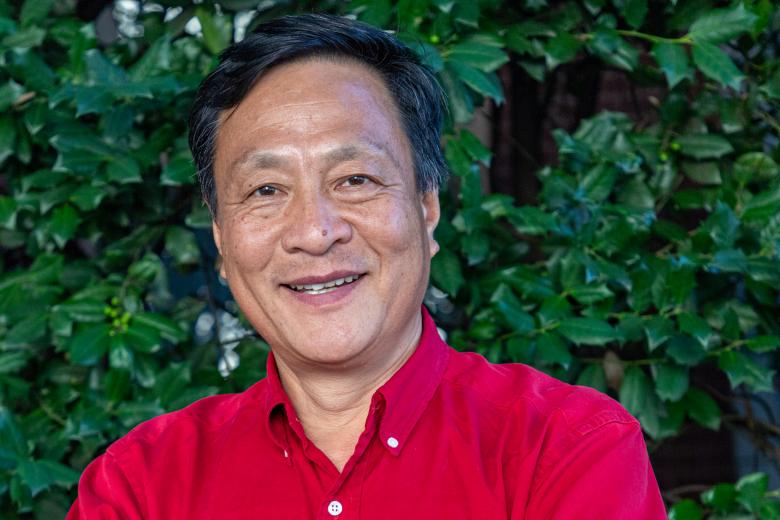
Chinese landscape architect Kongjian Yu was in Brazil making a documentary film when, on September 23, a small plane he was in with the filmmakers crashed, killing all on board. Eduard Kögel, curator of the Chinese-Architects platform, penned an obituary on the architect who was a true visionary.
Education and trainingKongjian Yu grew up in an agricultural commune, where, as a child and teenager during the Cultural Revolution (1966–76), he experienced firsthand the importance of landscape productivity. This was a formative lesson for his later professional career. In this agro-cultural landscape, functional design was necessary to ensure water distribution and management, but a deep understanding of ecological relationships was also essential for survival. The ability to “read” the landscape and the relationships between form and productivity, which he had acquired in his childhood and youth, had developed over centuries and was lost after the end of the Cultural Revolution with radical industrialization and urbanization.
Kongjian Yu was one of the few students from rural areas who studied agronomy at Beijing Forestry University in the 1980s. After completing his bachelor’s degree, he continued his studies in landscape architecture at the same faculty, where he obtained his master’s degree. In 1992, Yu became the first Chinese landscape architecture student to attend the Graduate School of Design at Harvard University, where he studied under Carl Steinitz, among others, and graduated with a doctorate in 1995. His role models were Frederick Law Olmsted and Ian L. McHarg, whose plans on a regional scale were based on the analysis of natural resources. After completing his studies, Yu spent the next two years gaining practical experience at SWA Group before returning to China in 1997.
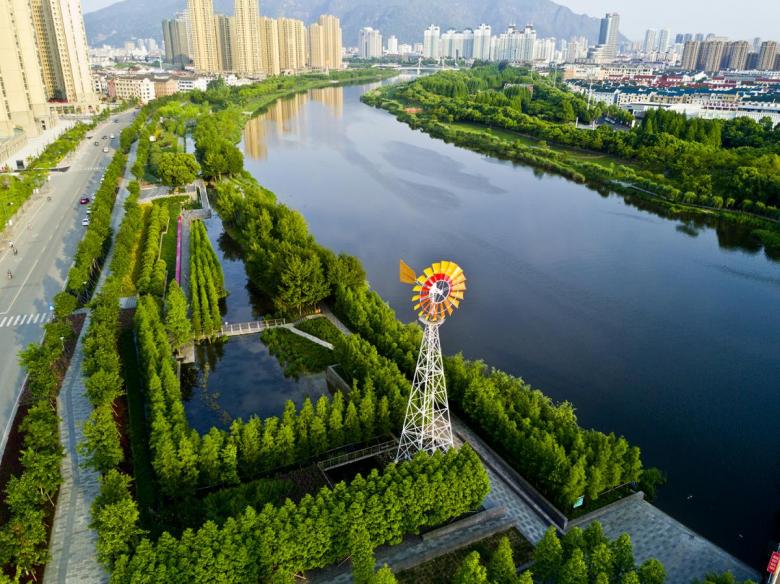
After his return, Yu founded the company Turenscape in Beijing, which now has around 600 employees. The name itself reflects what was important to him. The Chinese character tu (土) stands for earth, while ren (人) refers to people. Added to this is the English suffix “-scape,” which comes from landscape and refers to a comprehensive view in the sense of a cityscape or similar. Together, this results in the concept of people living in the context of the environment. He also demonstrated the fusion of English and Chinese in the name in his conceptual approach, highlighting the cross-fertilization between cultures.
Yu wanted to restore China’s environment, which had been brought to the brink of collapse by rapid urbanization, to the poetic “land of peach blossoms” described in classical literature. In Chinese culture, the “land of peach blossoms” is a metaphor for an idyllic, harmonious community that has its origins in a famous fable by the 5th-century poet Tao Yuanming. The landscape associated with this term represents a society that lives in harmony with natural resources. He lamented somewhat melancholically that both the historic gardens and small-scale agriculture had been displaced by large-scale economic systems and radical industrialization.
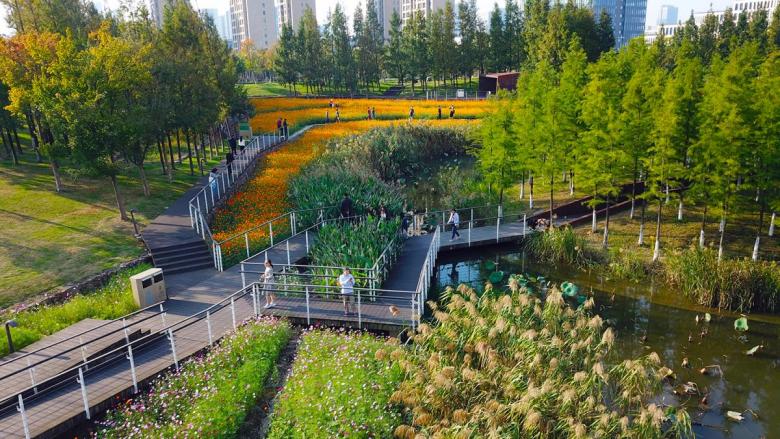
With Turenscape, Yu has implemented hundreds of projects in China. However, his even greater influence is evident in policies, where he has been able to anchor his ideas in the fundamental national framework as an advisor to government agencies. By defining high-risk areas that should be spared from urban development, he has created a tool that can be used to minimize the impact of natural disasters on human settlements.
Shortly after its founding, Turenscape began addressing the ecological challenges posed by flooding and the potential of waterways. According to Yu, a sponge city is created when landscapes are designed to retain excess water like a sponge when needed. As early as 2003, the Chinese government adopted this idea as part of a nationwide campaign to protect and restore the environment. Yu continued to promote his ideas together with colleagues, not only influencing national policy but also gaining increasing recognition in the international context of the climate crisis. In China, hundreds of projects have resulted in experimental landscapes that offer different ecological benefits in different regions and climate zones. In an already severely disturbed environment, Kongjian Yu did not shy away from creating new, functionally powerful landscapes on a large scale that shaped completely new environments through their aesthetic brilliance.
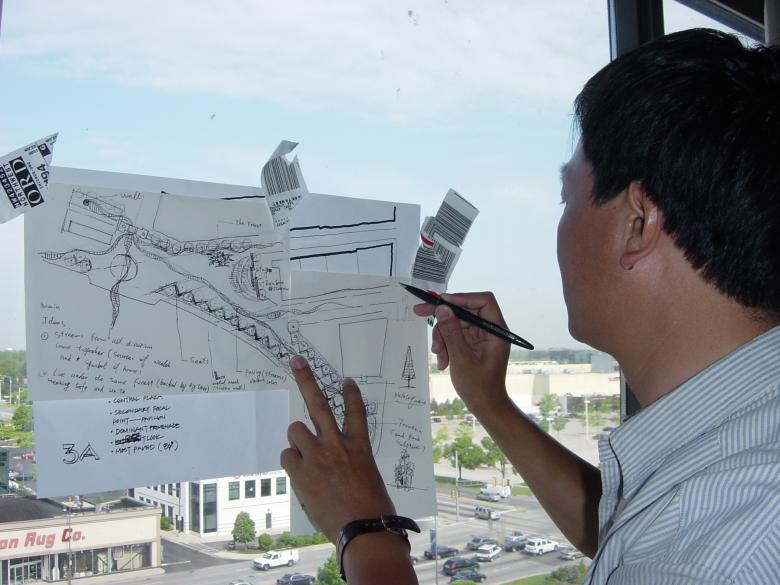
After returning from the US, Kongjian Yu established a landscape architecture program at Peking University, where he served as dean. He wanted students to learn to read the real landscape to understand its function. He wanted to educate students to become critical innovators who use experimental methods to search for new solutions. To this end, he focused on water cycles, as these often determine the fertility and productivity of a landscape. However, the industrialization and urbanization of recent years have severely impaired or even destroyed cultural landscapes that have developed over centuries. He therefore sought to understand landscape spaces through large-scale analyses to integrate new functions and aesthetic models into damaged ecosystems. To spread his ideas, Yu also founded the journal Landscape Architecture Frontiers, for which he frequently wrote editorials as editor-in-chief.
The work of Kongjian Yu and Turenscape has also attracted considerable international attention. He and his projects have been honored with numerous prestigious awards, most recently with the Sir Geoffrey Jellicoe Award from the International Federation of Landscape Architects in 2020, and the 2023 Cornelia Hahn Oberlander International Landscape Architecture Prize, the second biennial prize given out by The Cultural Landscape Foundation.
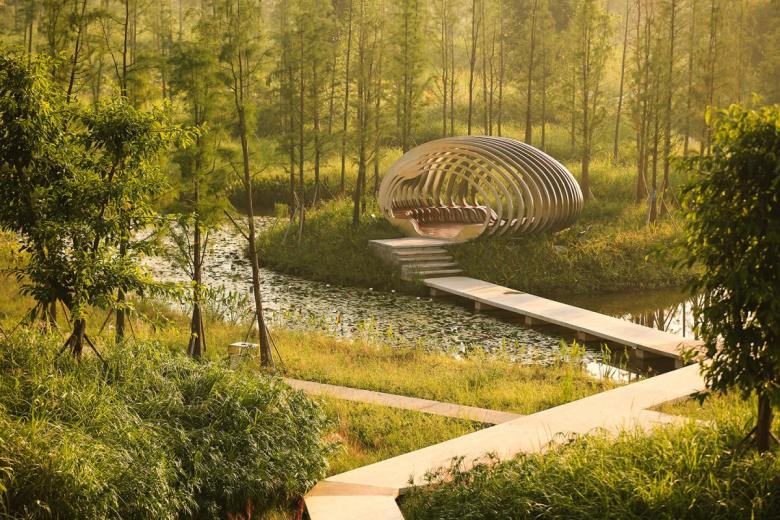
Kongjian Yu’s life and ideas represent global exchange and demonstrate that his approach can lead to new concepts, which in turn can serve as models for other contexts. The universal values inherent in a local and regional solution are evident in the completed works, which not only have practical effects but also bring with them a new aesthetic quality that, through its beauty, approaches the ideal of the “land of peach blossoms.” His work shows that rapid change is possible in China, change that has a profound impact on people’s lives and corrects dramatic environmental damage. As a teacher, publicist, designer, consultant, source of ideas, and a public speaker, he spread positive vibes because he was convinced that intelligence can be used to shape a better future. With Kongjian Yu’s death at the age of 62, the world lost a visionary whose influence extended far beyond national borders and his narrow field of expertise.