Or, Herzog & de Meuron Renovates Marcel Breuer
Sotheby's Opens in the Former Whitney
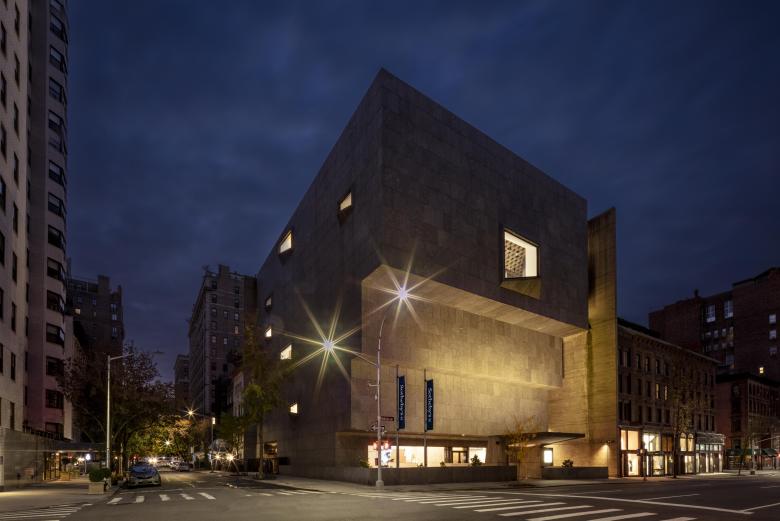
On November 8, Sotheby's New York opened its new home in the Breuer Building, the 1966 brutalist masterpiece designed by Marcel Breuer for the Whitney Museum of American Art. The renovation of the modern landmark was carried out by Switzerland's Herzog & de Meuron with New York's PBDW Architects.
After the Whitney Museum of American Art decamped from what is now known as the Breuer Building, located at Madison Avenue and 75th Street on Manhattan's Upper East Side, for a new Renzo Piano-designed building in the city's Meatpacking District in 2015, the stone-clad inverted ziggurat served as a venue for the Metropolitan Museum of Art (2016–2020) and the Frick Collection (2021–2024). While those nearby UES institutions basically rented the gallery spaces from the Whitney, which still owned the building, in 2023 the Whitney decided to sell the Breuer Building for around $100 million to Sotheby's, the global auction juggernaut headquartered in NYC. With a new owner, the fate of the interior spaces not protected by a landmark designation came to the fore, as did that of Sotheby's longtime headquarters building at 1335 York Avenue, renovated by OMA New York only in 2019.
The 2024 news of Sotheby's hiring Swiss architects Jacques Herzog and Pierre de Meuron to renovate the Breuer Building assuaged some concerns over the new owner maintaining the grid of light fixtures in the lobby, coffered concrete ceilings in the galleries, and other unique qualities of the building's interiors, particularly given their gentle hand in the preservation of the nearby Park Avenue Armory. That good news was accompanied by hearings at the Landmarks Preservation Commission, which made the Breuer Building an Individual Landmark in May 2025 (before that date, its exterior was protected by virtue of sitting within the Upper East Side Historic District) and, at the same time, designated certain spaces as an Interior Landmark: the lobby, approached by a bridge over the sunken “moat”; a portion of the lower level adjacent to that subterranean sculpture garden; and the main stairwell at the front of the building. Missing from the designation were any of the galleries on levels 2–5.
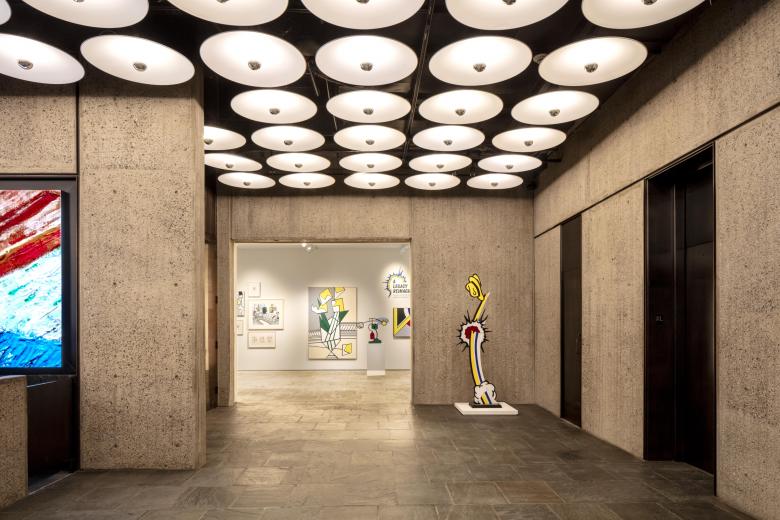
Last month, Sotheby's sold its York Avenue headquarters, which it had owned on and off again since 1980—an unsurprising move given the auction house's purchase of the Breuer Building and its need to reduce debt—though that news quickly fell by the wayside in the run-up to the opening of Sotheby's at The Breuer on November 8. This writer was out of town when a press preview was held a day ahead of the opening, but that gave me the chance to see the galleries in use upon my return, full of both potential bidders and the wider public interested in art. “Full” ended up being an accurate term, as Sotheby's happened to be overwhelmed with crowds during my visit yesterday, forcing me and hundreds of other non-VIPs (technically, “Sotheby's Preferred Members”) to wait in line for an hour or more to enter the building. At one point, I heard the a security guard at the entrance say around 5,000 people had descended on the building between its opening at 10 am and noon, around when I had arrived. Walking across the bridge and into the lobby after waiting in the cool November air for nearly one hour, I was eager to see how much Sotheby's Breuer Building has departed from the Whitney's Breuer Building.
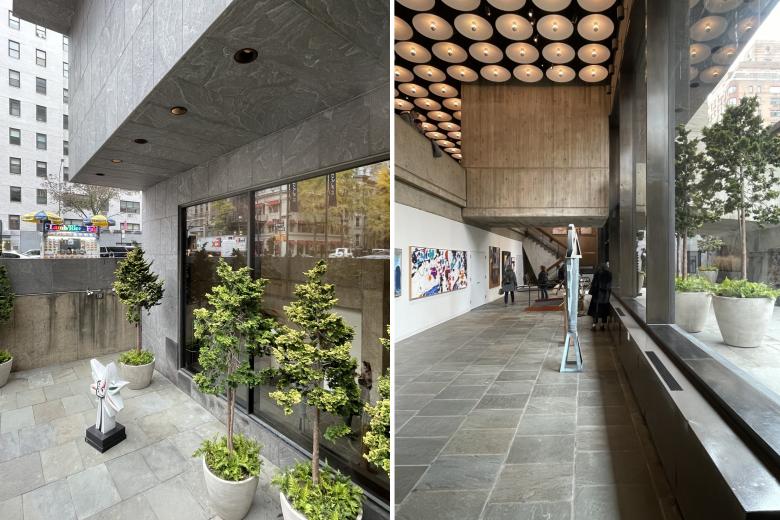
The lobby is the largest portion of the Interior Landmark designation so it is suitably intact, more or less, with the original materials—bush-hammered concrete walls, bluestone floors, and ceiling with dome—preserved. New features include vitrines highlighting upcoming sales, a large LED screen behind a long desk with catalogs and other books for sale (including a “collector's edition” of Robert McCarter's 2024 monograph on Marcel Breuer), and a gallery at the rear, where the Whitney had its gift shop.
The most dramatic difference between the Whitney (and the Met and the Frick) and Sotheby's is found at the lower level, where a wall has been added at the edge of the lobby floor slab. Previously, the lower level housed a string of restaurants, starting with a cafeteria-style restaurant in 1966, a cafe run by Sarabeth's starting in 1991, and Flora Bar when it was the Met Breuer, among others. That wall, which not coincidentally defines the edge of the Interior Landmark designation, should disappear come spring 2026, when a Roman and Williams-designed French restaurant will open in the lower level. It remains to be seen how the studio “synonymous with beauty and integrity” will tackle the brutalist setting and how many of the original materials will remain.
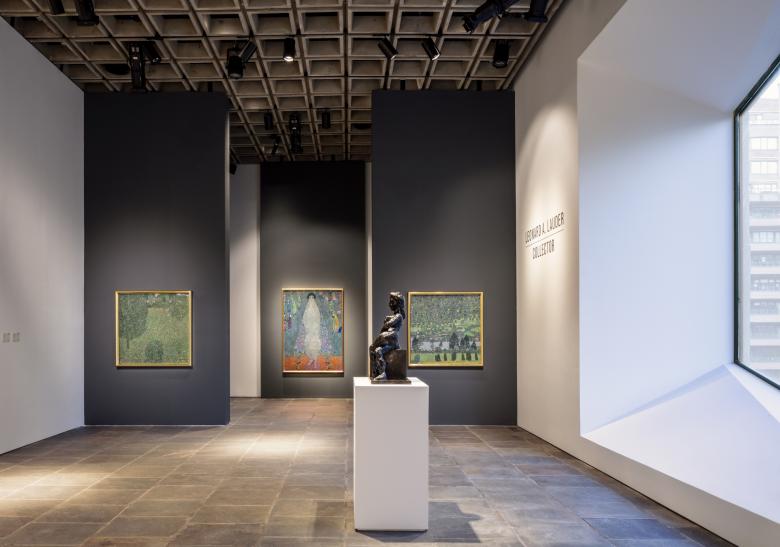
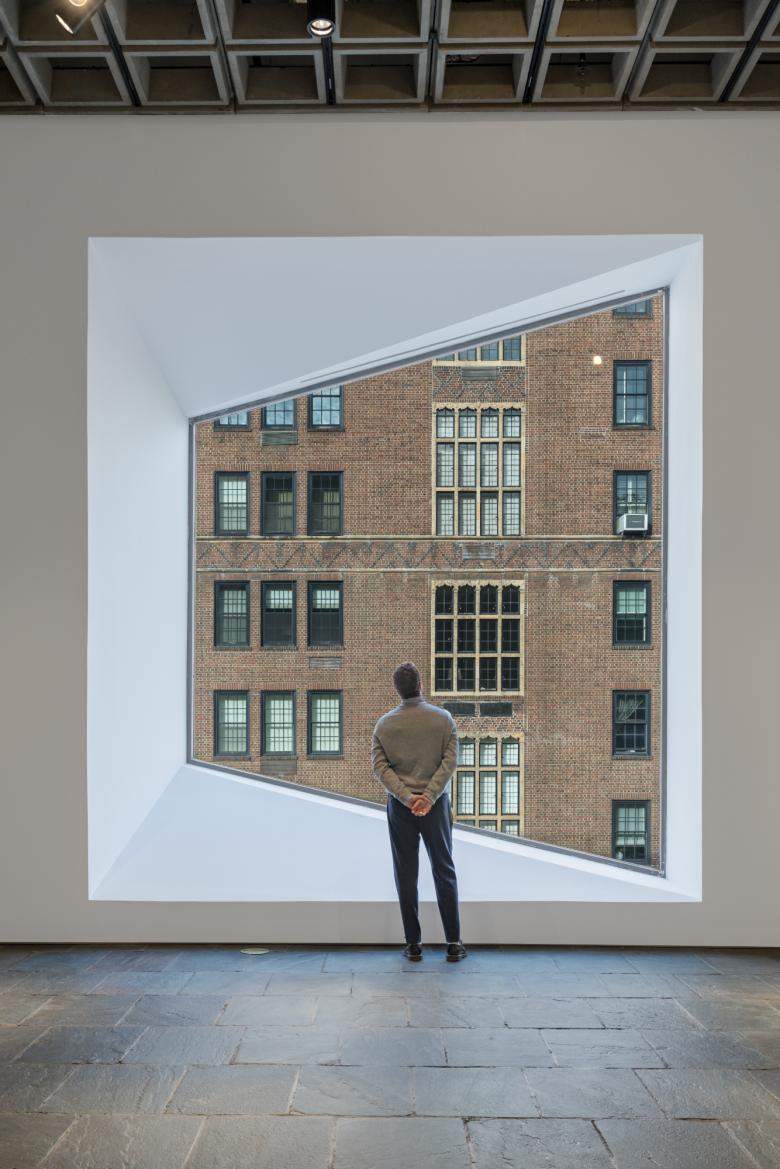
Upstairs, the changes brought on by Herzog & de Meuron (under partner in charge Wim Walschap) and PBDW Architects are practically invisible, except perhaps to people who knew the Whitney intimately. The second floor features new oak flooring and more gallery space, thanks to the removal of office spaces, while the third floor preserves the building's bluestone floors and concrete coffer ceilings. The fourth floor was—and remains—the most dramatic exhibition space in the building, with 17-foot ceilings and the large trapezoidal window facing Madison Avenue; the space's demountable walls enable it to serve as the “marquee sale room,” accommodating around 220 bidders.
The relatively low fifth floor has gained even more space for displaying art: smaller galleries illuminated by skylights and lighter wooden flooring. The building's former boardroom serves as a business center for Sotheby's, while a small workspace will be used by the auction house's team working on site. Throughout the building, new lighting “complements the building's darker palette,” per a fact sheet from Sotheby's, to brighten the galleries “while preserving Breuer's architectural intent.” There is a also a new service elevator that has been “discreetly added within the original footprint,” making it a basically invisible addition—much like the overall renovation.
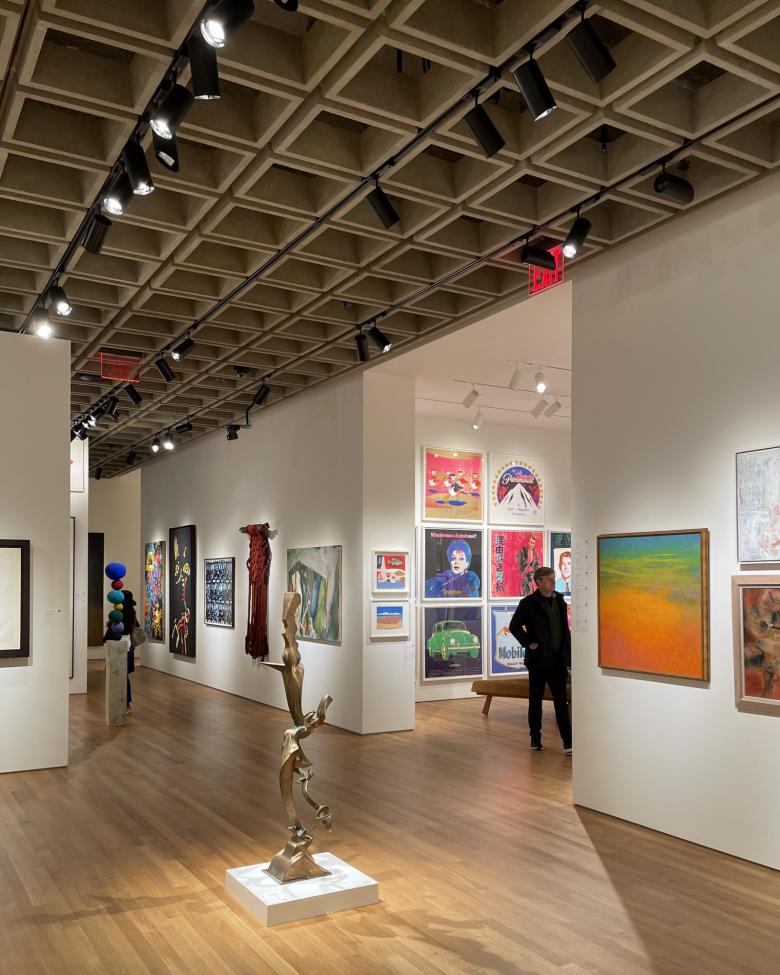
While the preservation and adaptation of the Breuer Building by Herzog & de Meuron and PBDW Architects for Sotheby's is exemplary, I noticed numerous moments where the museum-quality container was fitted out more like a store than a museum or gallery. While this makes sense, given that Sotheby's is, after all, a commercial enterprise, but instances like the photo above found the auction house cramming as much art onto the walls as possible, even at the opening between one gallery and another. Elsewhere—especially on the fourth floor and in the dark yet dramatically lit spaces for the Exquisite Corpus sales—the presentation was more fitting to the setting, not slapdash. Still, photos like the one above signal how Sotheby's is making a statement with its opening in the Breuer Building this month, when it expects to bring in between $863 million and $1.17 billion.