A Review of Philip Ursprung's 'Values and Surfaces'
Unassuming Insights

This month gta Verlag is publishing Values and Surfaces: Art, Economy, Architecture, the English translation and expansion of a collection of essays by art and architectural historian Philip Ursprung first published in German in 2017. Lynnette Widder, architect and professor at Columbia University, read the collection and sent us her impressions on it.
“It is hard to tell a really gripping tale of how I wrestled a wild-oat seed from its husk, and then another, and then another, and then another, and then another, and then I scratched my gnat bites, and Ool said something funny, and we went to the creek and got a drink and watched newts for a while, and then I found another patch of oats.”
Absent in the English edition of the essay collection Values and Surfaces: Art, Economy, Architecture (gta, 2025) is the sentence that best articulates its author’s method of analyzing some better-known and far-flung architectural works and persona, among them Joseph Paxton’s Crystal Palace, Gordon Matta-Clark’s deconstructed architectures, Peter Zumthor’s Sogn Benedetg chapel, and Peter Eisenman’s Greater Columbus Convention Center. Philip Ursprung, Professor of Architectural History and Theory at ETH Zurich, came to architecture initially as an historian of 1960s and 70s Land Art and “happenings” and a curator and critic of contemporary art practice. In what is perhaps his best-known publication since then, the 2005 exhibition and book Natural History, on which he collaborated as curator and editor with Jacques Herzog and Pierre de Meuron, Ursprung used various paradigms of knowledge to reframe the way iteration and referentiality had characterized that firm’s architecture. Along with that abiding interest in knowledge structures is the precision Ursprung brings to what, in his recent essay collection, might be described as an associative method of history writing. His knowledge, both broad and deep, of contemporary art, architecture, history and critical literature, underpins his ability to elide disciplinary boundaries. By the accounting of Goodreads, he is now affiliated with close to ninety books and editions, all more or less equally divided between contemporary art and architecture.
But Ursprung is no less an active and inventive teacher than he is a prolific writer. That is evident in “Echo-Logy: Working with Allan Kaprow,” a chapter in Values and Surfaces that describes Kaprow’s art practice from the 60s through the 90s; its gravitational center is Ursprung’s reenactment of Kaprow’s 1975 piece, Echo-logy, with students during a study trip to Greece in 2013, at the height of the Greek financial crisis. It’s in this context that Ursprung tips his hand to his method: “Drawing upon the ‘performative writing’ of Feminist theoreticians such as Judith Butler and Amelia Jones,” he writes in the original German version but omits in the new English translation, “I want to bring the ‘I’ of the historian to bear … [within] a field in which critical, academic and curatorial practices are intertwined …” (Der Wert der Oberfläche, p. 194, reviewer’s translation). His is a writing practice no less affiliated with generative work, and no less creative than those he teaches and studies. His is a practice that clearly supports innovation.
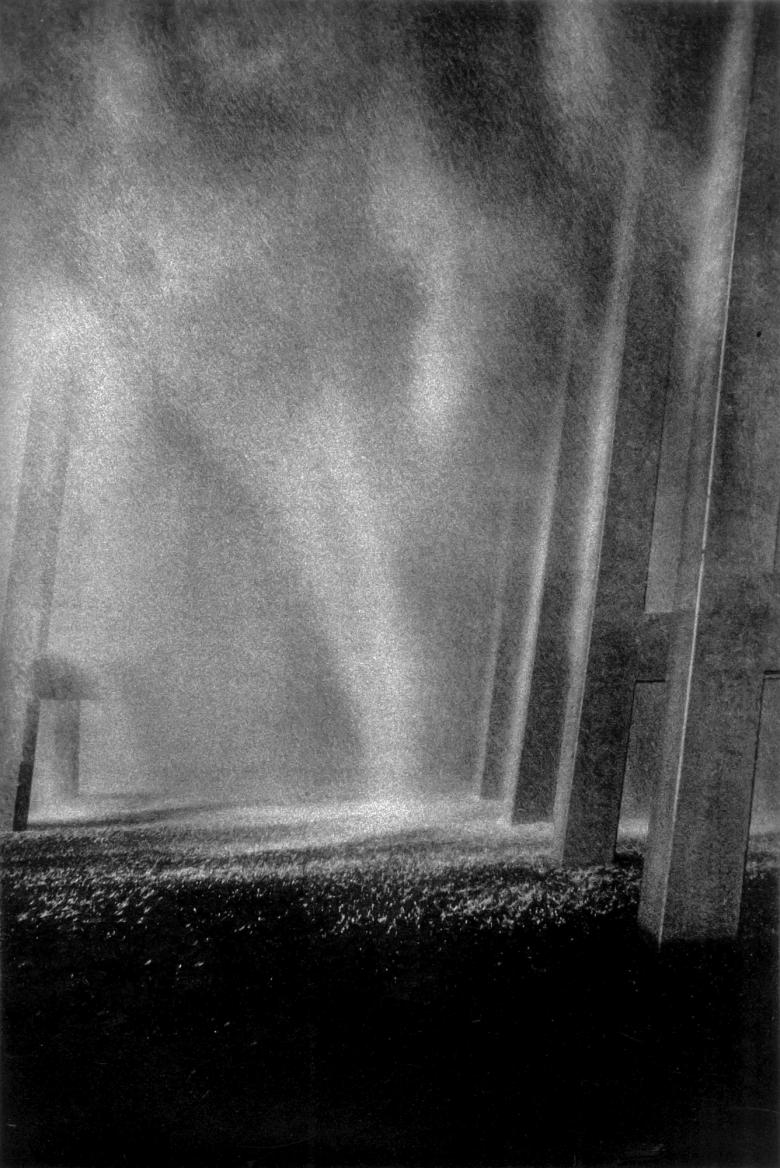
The initial section of the book, entitled “Expansion,” opens with a text that studies the pervasiveness of the adjective “white” to describe vastness newly perceived in two contemporaneous 19th-century works, Herman Melville’s Moby Dick and Paxton’s Crystal Palace. Among most architecture historical accounts of the Crystal Palace, the emphasis has been on its technology, which places the exhibition pavilion as a first demonstration of the glass-and-metal idiom that would drive the imagination of early Modernism; or on the sociological, colonial, aesthetic and above all consumerist nature of the objects collected and displayed there. Ursprung instead draws upon the testimonies of visitors, who seem to have felt overwhelmed by the weight of the overcast sky above their heads and the vastness before their eyes, as they struggled to apprehend the enormous area beneath the translucent glass spandrels. Owen Jones’s brightly colored arabesque banners, more often read relative to exoticism and eclecticism, appear in this account as largely futile attempts to tame whiteness. To Ursprung, the experience of the building corresponds to the predominance of white in Melville’s description of predatory seafaring and the great whale hunted. The text persuasively lays out parallels in the expansiveness expressed by these two cultural artifacts of incipient capitalism.
The next section, “Recession,” gathers essays about works of architecture and art generated in periods of sustained economic collapse: post-1929, following the social unrest of 1968 and during the OPEC embargo period, and after the now largely forgotten stock market crash of 1987, as the AIDS crisis unfolded. Ursprung begins with a quintessential site of the modern, the Bauhaus. Photos of students, taken by their teenage classmate Lux Feininger, attest to an everyday life that included team sports and spontaneous flirtations. It is a Bauhaus where, as Ursprung writes, “a new lifestyle is evolving” rather than a site of didactic and programmatic dictates. The stock market crash of 1929, which ended that experiment, is also the often-ignored context for Loos’s infamous “Ornament and Crime.” In his reading of the essay, Ursprung leaves aside the title’s well-worn tropes and instead elevates Loos’s concern for architects’ transformed professional livelihoods during this period of real estate boom and bust. For some readers this analysis might invoke an earlier chapter about the dour 1915 Wall Street headquarters of the Morgan Bank, a referent for the perversity of value extraction and representation Loos despised.
A later essay in this section, on the artist known as Absalon, expands questions of work, unemployment, depression, time, and identity. To describe Absalon’s treatment of time, Ursprung cites a 1933 sociological study on the long-term unemployed in Austria-Hungary. Here, too, in the mind of the reader, the citation will again connect themes and concepts across chapters. Ursprung’s reading of Loos is an established antecedent elsewhere, as he describes the professionalization of art and the rise of the art market relative to Kaprow, Matta-Clark and Absalon. The chapters echo one another productively, but never insist on a singular reading or framework. Here, architectural and art history are more than hermeneutic models through which an expert lays bare a singular, definitive interpretation. Ursprung’s model of history-writing as practice offers latitude, not an all-or-nothing. It is liberating for him, but also for his reader.
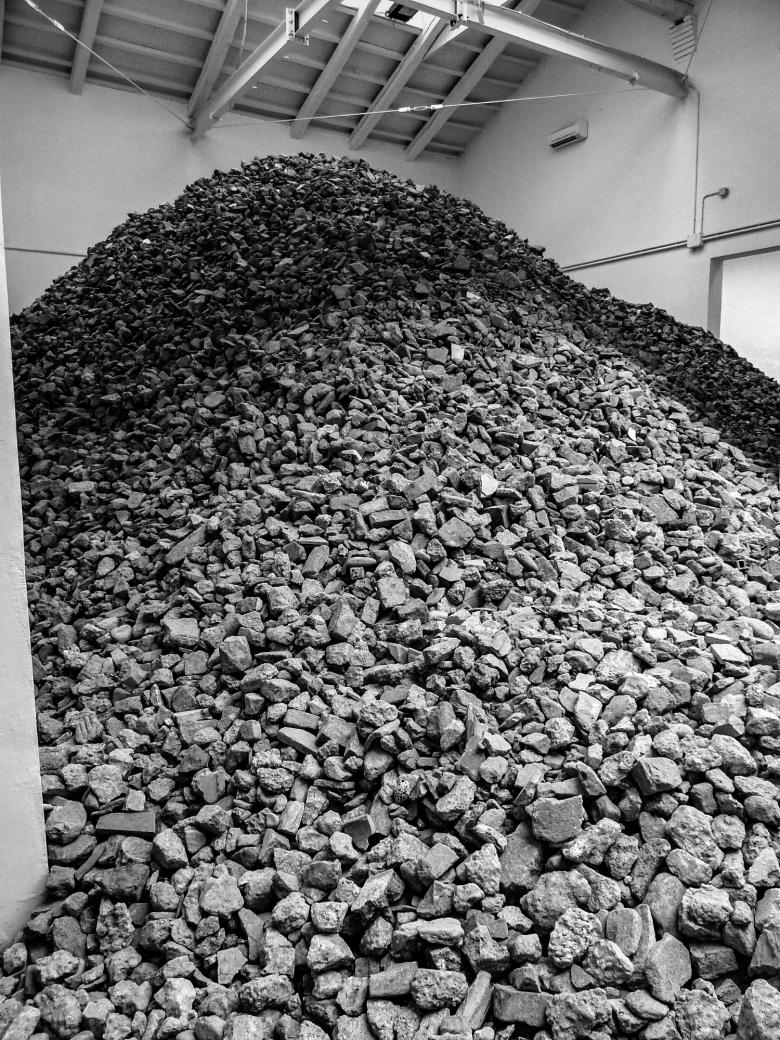
The last grouping of essays, “Gravity,” finds Urspurng as interested in the immaterial as in the weighty, as much in the surface as in what lies behind it. His chapter on installation artist Lara Almarcegui most directly embraces gravity: there it is, in the angle of repose that the color-sorted piles of building debris she places in gallery and exhibition spaces assume. In her projects, weightiness reveals the vast scope of material resources that the built environment marshals, then wastes. Elsewhere, Ursprung tracks the relationship between image and building. In his essay on Swiss architect Peter Zumthor, Ursprung admits initial skepticism about what he calls a suspect “notion of authenticity … and the ever-present Romantic undercurrent in [Zumthor’s] work” (p.186). A visit to the small chapel of Sogn Benedetg and a closer look at the photos Zumthor commissioned from photographer Hans Danuser force him to rethink those assumptions. Zumthor and Danuser have both made their life’s work in the canton of Grison, locus of Switzerland’s vital hydroelectric dams and pumping stations. Within picturesque mountains is the electrical infrastructure that underpins the country’s powerful industrial and service economy. Transcendence, whether spatial or landscape-sublime, proves to be a surface phenomenon. In Danuser’s photographs of Zumthor’s architecture, Ursprung finds evidence of this economic “unsublime” as well as proof of the interdependency between image and building. In the same way that Hans Namuth’s photo of Jackson Pollock at work is inextricable from the reception of action painting, Ursprung argues, so too are Danuser’s images now inextricable from Zumthor’s architecture: pragmatic rather than romantic.
In an essay on GSW Headquarters, the Berlin office building that Matthias Sauerbruch and Louisa Hutton realized over the course of German reunification, Urspung offers a different take on the image and architecture by referencing the “iconic turn.” By Ursprung’s account, the iconic in contemporary architecture works with both surface and embodiment, holding the attention of the passerby while solidifying the fleeting imagery that “saturates” urban experience. That definition is particularly poignant in the case of this building which, as Ursprung points out, was designed to reference two cities—West Berlin and East Berlin—which no longer exist. Here the reader can think back to an earlier chapter on the Socialist lifeworld, which Ursprung has described with reference to a cache of promotional period photographs. Here again, the book is held together, not by a single argument but by unassuming correspondences across the texts.
In her 1986 essay on the structure of narrative, Ursula Le Guin proposed an alternative to hard-driving plot enacted by heroic protagonists. She likened that alternative to the practice of gathering. Ursprung’s version of art and architectural history shares some characteristics with Le Guin’s Carrier Bag approach: it is selective, combinatory, ingenious, unexpected. But the real fun belongs to the reader-as-gatherer, for whom the book offers plenty of insights—yet only two grainy photos per chapter—to forage.
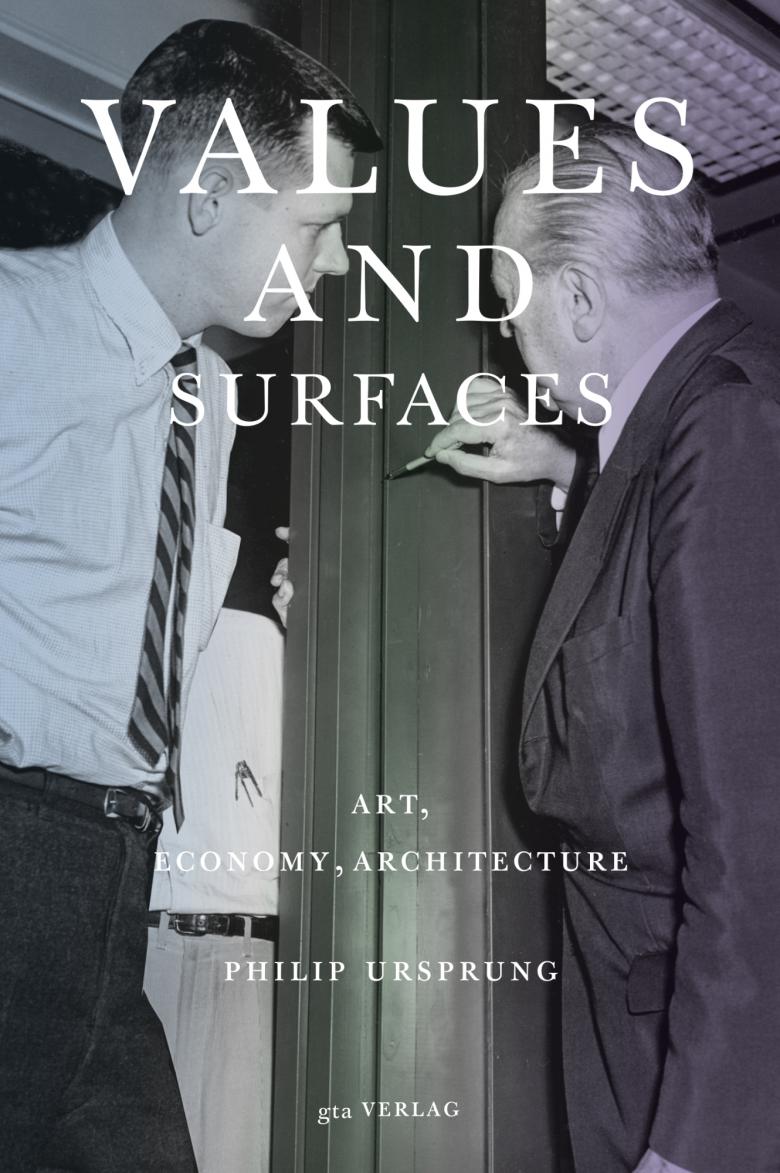
Values and Surfaces: Art, Economy, Architecture
Philip Ursprung
Translated by Fiona Elliott
15.1 × 22.7 cm
264 Pages
34 Illustrations
Paperback
ISBN 9783856764609
gta Verlag
Purchase this book
Related articles
-
-
Periphery as Method: On Architecture’s 'Dispositional Intelligence'
Guiomar Martín | 15.05.2026 -
-
-