The Doshi Retreat opened on October 25 at the Vitra Campus in Weil am Rhein, Germany. It is a refuge designed by Pritzker Prize winner Balkrishna Doshi in close collaboration with his granddaughter Khushnu Panthaki Hoof and Sönke Hoof.
The project is more of a landscape, Khushnu Panthaki Hoof revealed when I visited her in Ahmedabad in April. The Indian architect and granddaughter of Balkrishna Doshi (1927–2023) didn't want to say any more than that. The landscape part is true, as it now turns out. The newly opened Doshi Retreat on the Vitra Campus in Weil am Rhein literally blends into the ground. More on that in a moment. And if you catch a quiet moment and devote yourself entirely to the experience of walking through it, visiting this new architectural trophy on the furniture manufacturer's extensive grounds can indeed be a contemplative experience. The building certainly has the feel of a refuge, a place where you can retreat.
At the press conference for the opening, Rolf Fehlbaum spoke of Doshi's gift to us. This unusual phrase hints at the bond between client and architect. Fehlbaum and Doshi met when they were both members of the Pritzker jury. This encounter led to a friendship. Even before Balkrishna Doshi became the first Indian to receive the Pritzker Prize in 2018, more than ten years later, it was clear that the first major retrospective of the Indian architect's work would also travel to the Vitra Design Museum in Weil am Rhein. The exhibition “Balkrishna Doshi. Architecture for People” opened in April 2019; the architect, already 92 years old, attended the opening.
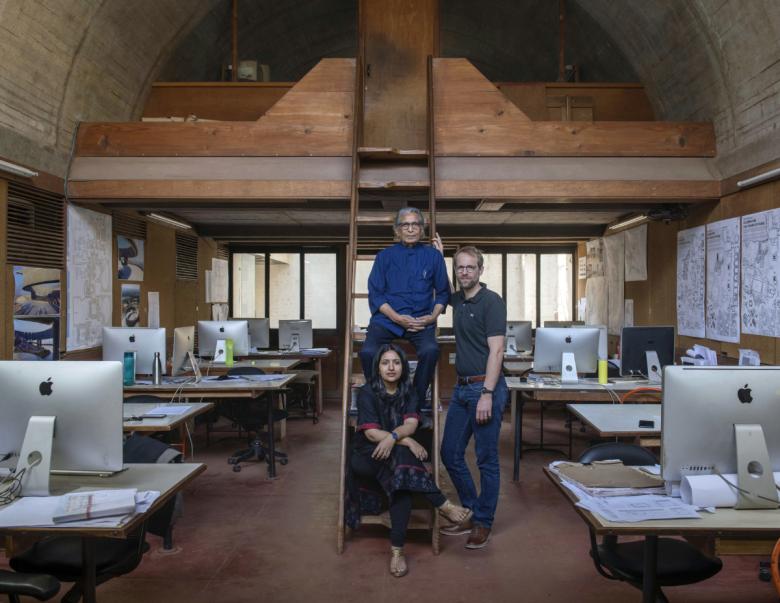
Shortly afterwards, Fehlbaum, Vitra's Chairman Emeritus, traveled to India and also visited Doshi. Impressed by the Modhera Sun Temple, or more precisely by a small shrine on the temple grounds, he showed the architect a picture of this structure and asked him if he could imagine designing such a place for the Vitra Campus. Doshi agreed. In the pandemic year of 2020, he set about implementing the project together with his granddaughter Khushnu and her husband and office partner Sönke Hoof, with whom he had worked for many years. His granddaughter described the work on the retreat as “Doshi's last masterclass.” The opening of her grandfather's last building, and the only one outside his home country, must have been a very special moment for her.
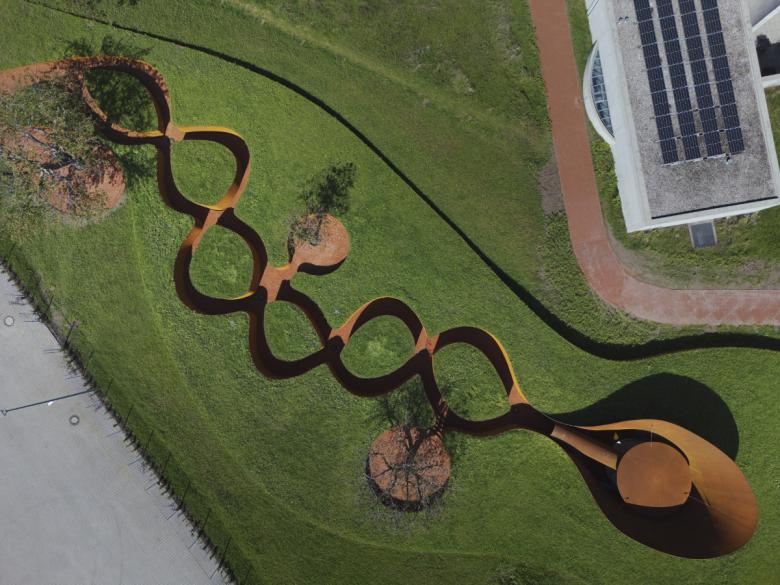
Although Doshi's built work was dedicated to secular life, he was a spiritual person who was strongly guided by intuition in his work. It is not surprising that the vision for this architecture arose from a dream in which he saw two intertwined cobras. He then made a drawing, which he showed to his granddaughter and her husband. Khushnu Panthaki Hoof noted that this sketch was not precise, but rather one that had to be deciphered. Doshi apparently loved to leave things open and develop them organically. One could understand his architecture as a form of liminal experience in the sense of Walter Benjamin—that is, as transitional spaces. This is supported by the fact that the architect repeatedly spoke of architecture as a journey in his lectures and writings. A journey is not only the genesis of this place; exploring the retreat is also like a journey.
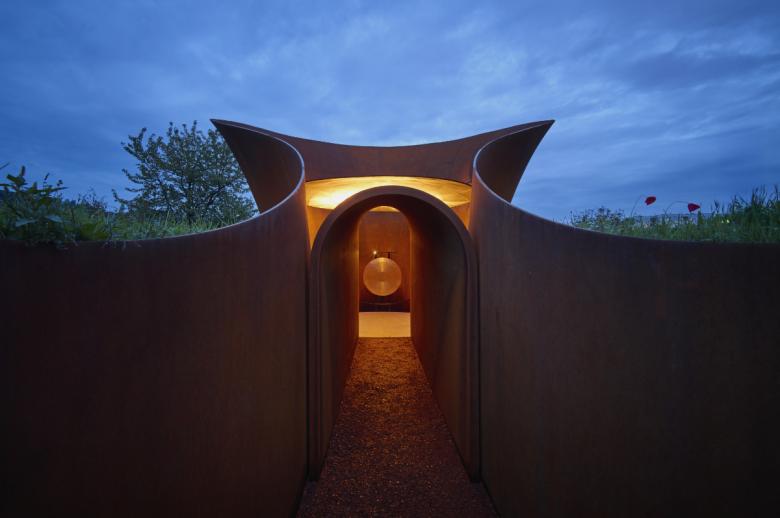
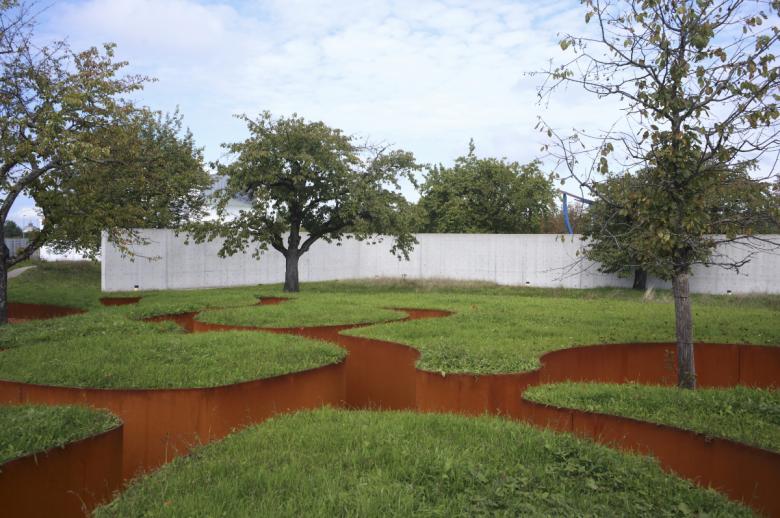
Shortly after entering the path covered with red stones, you have to decide which of the two paths to take. You soon enter the earth, flanked by rough metal walls made of XCarb®, a material consisting mainly of scrap steel. The material will develop a patina over time. The aspect of change also occurs on a figurative level with the users of the structure. On the winding paths, you are instinctively guided by sounds emanating from the recesses in the ground. The changing sequences of the audio system are AI-controlled and create an additional sensory experience.
The meandering movement through the building and listening slow down your pace. Twice, you can emerge from the depths of the paths, rest on the platforms in the shade of a tree, and gaze out at the campus around you. Or at the falling leaves. Among other things, Khushnu Panthaki Hoof recounted how her grandfather enjoyed such details in everyday life. And how he incorporated this childlike wonder into his work as an architect.
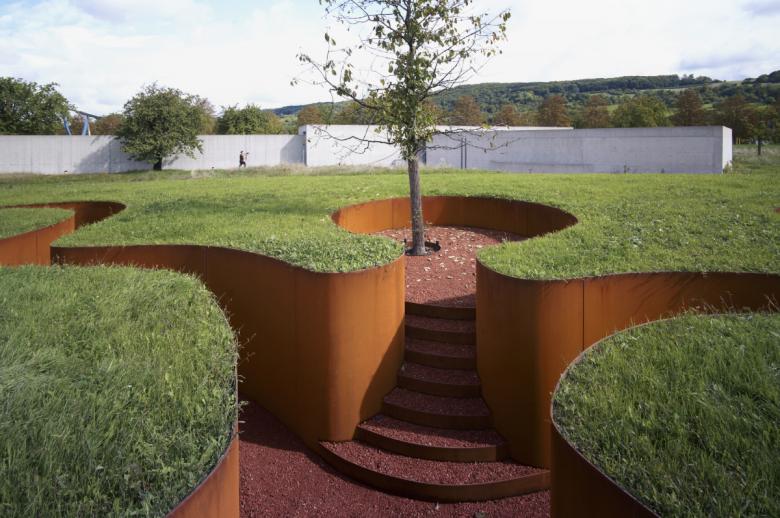
The building acts as a membrane between its surroundings and the intimate spatial structure—but that's not all. It also has an effect on visitors. Because the interaction between people and the structure primarily takes place on a sensory level, its impact transcends purely visual perception. This is usually the first way that people, oversaturated with and simultaneously addicted to visual stimuli, approach architecture. With this kind of evaluation, it is easy to forget that spaces are more than “just” a beautifully designed form.
Buildings in which people feel comfortable create this feeling through other parameters. Doshi was well aware of this. The strength of the Doshi Retreat lies precisely in its formlessness or, rather, the incomprehensibility of its form—after all, we do not yet have integrated drones in our bodies. Unlike in a traditional labyrinth or maze, the feeling of disorientation does not arise from deliberate misdirection. The intertwined paths are much more a gentle preparation for the space they lead to.
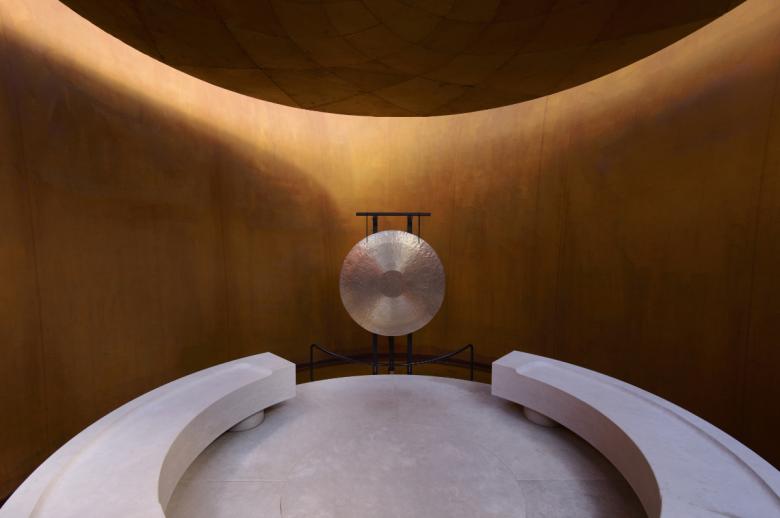
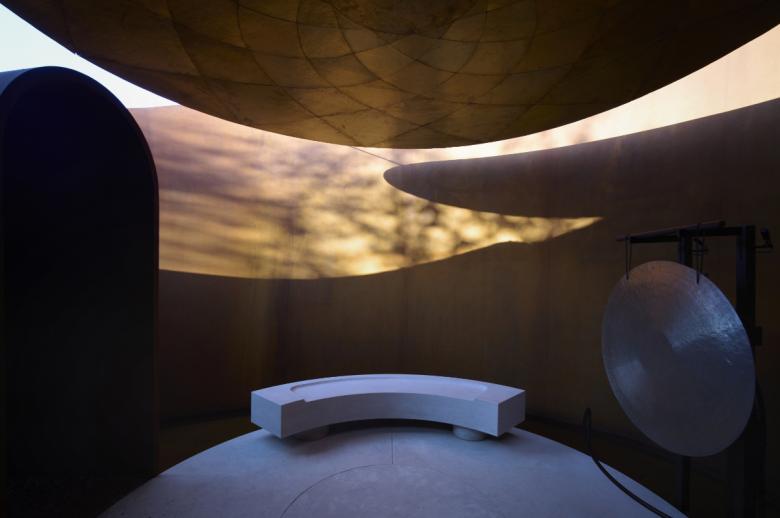
The actual contemplation space effectively closes off the two winding lines, as it were. You realize: Now I have arrived. You sit down on a semicircular stone bench. Then the journey can continue. Perhaps by letting the play of light work its magic. Looking up, you can see the celestial landscape surrounding the brass mandala crafted in India. Turning your gaze back to the tunnel-like archway through which you entered the sanctuary, you discover yet other forms. It'ss as if the viewer could redraw the building through these different shifts in perspective. Each glance creates fresh images; yet these are not remembered as Instagram-worthy snapshots, but as fleeting moments that will likely be renewed with every visit.