Inside Fondation Cartier's New Home
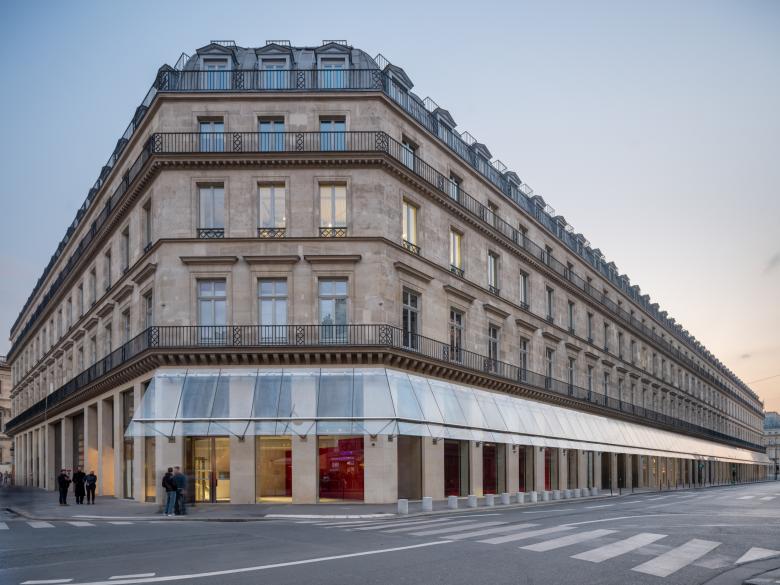
The Fondation Cartier pour l’art contemporain, 2 Place du Palais-Royal, Paris. © Jean Nouvel / ADAGP, Paris, 2025. Photo © Martin Argyroglo
The Fondation Cartier pour l’art contemporain opens its new premises at 2 Place du Palais-Royal in central Paris, across the street from the Louvre, on October 25. The institution is housed inside a Haussmannian building from 1855 that has been renovated by Jean Nouvel with five mobile platforms that aim to “reimagine the possibilities of exhibition making.” Take a look inside.
Last year, coinciding with its 40th anniversary, Fondation Cartier announced its plans to depart from the standalone glass building Jean Nouvel designed for the institution in 1994. That initial news had a tinge of sadness, given the quality of the building on Boulevard Raspail and how much it was a symbol of the arts institution. But in the ensuing months, as with the exhibition held in Venice earlier this year, the audaciousness of Nouvel's vision for the interior of the 170-year-old building at 2 Place du Palais-Royal became apparent, and the idea of it started to settle in. Fondation Cartier was departing one notable work of architecture for another, with the new home adding flexibility to the mix via five platforms that can be adjusted to eleven different heights, “allowing for numerous combinations of volumes, verticalities, and modulations of light, multiplying the possibilities for programming,” per the institution. Below is a slideshow of photographs of Fondation Cartier's new home, the first half as an empty shell and the latter half displaying its inaugural exhibition, Exposition Générale, which is on display until August 2026.
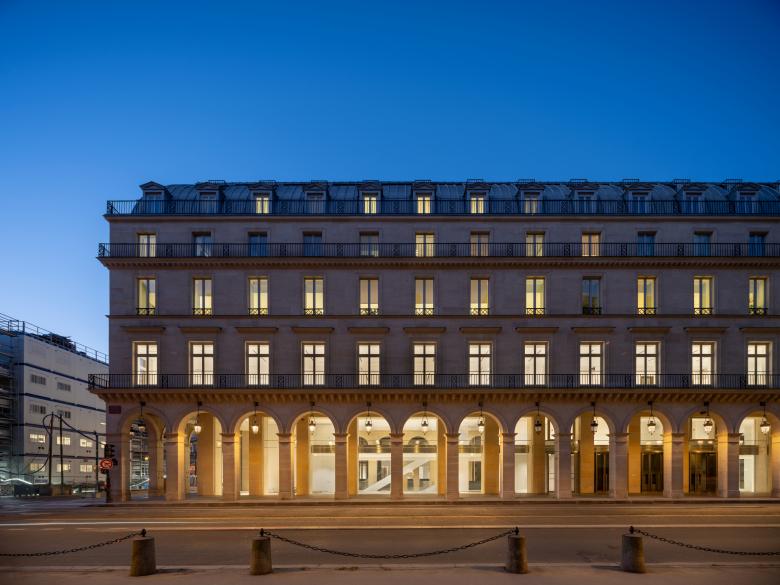
Fondation Cartier occupies three levels in the full-block Haussmannian building at 2 Place du Palais-Royal: the first two floors and a basement level.
(The Fondation Cartier pour l’art contemporain, 2 Place du Palais-Royal, Paris. © Jean Nouvel / ADAGP, Paris, 2025. Photo © Martin Argyroglo)
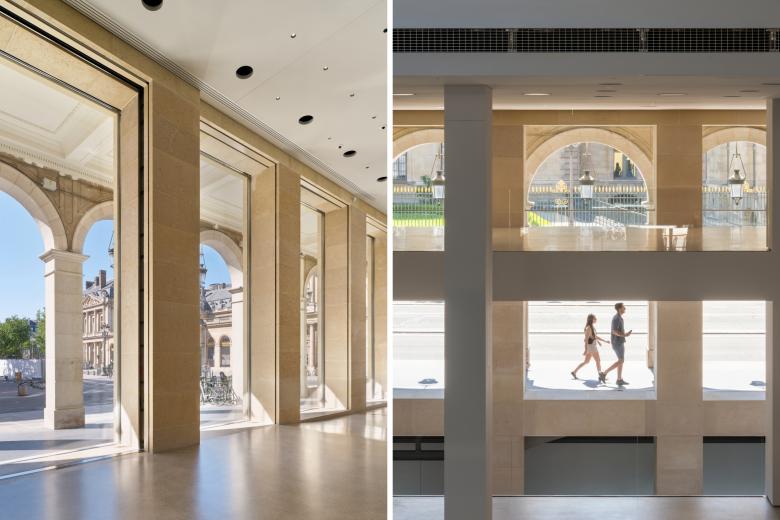
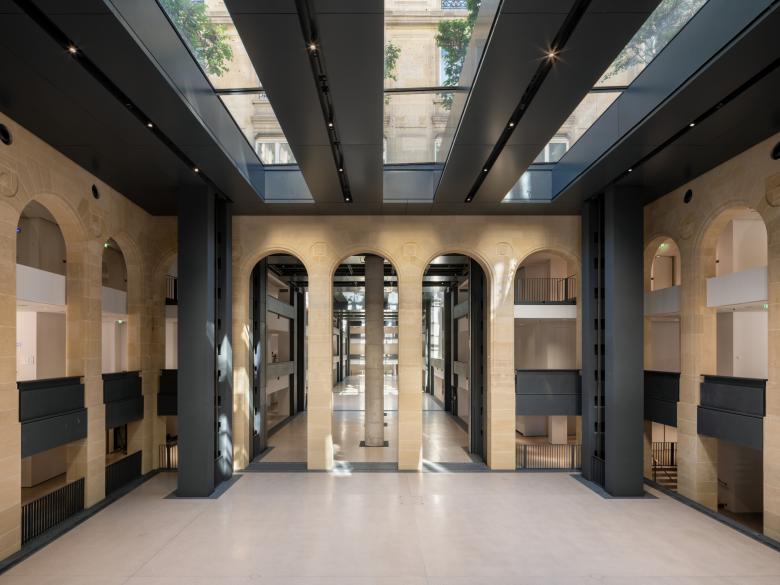
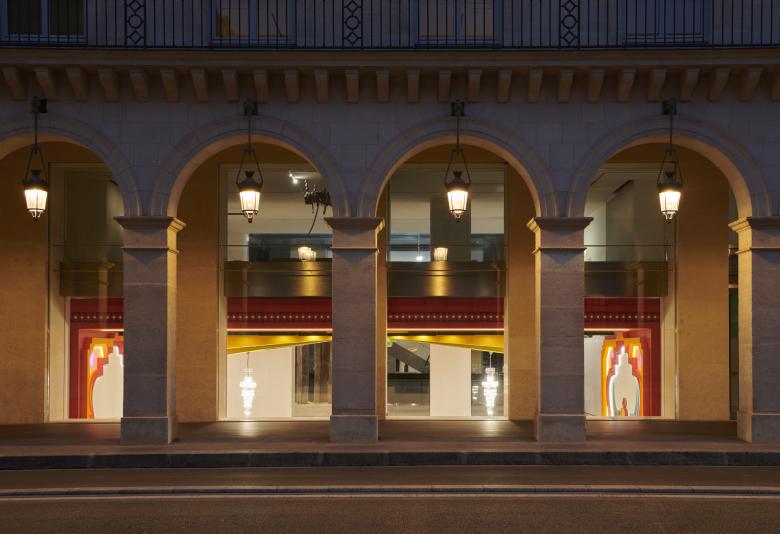
Continuous arcades around almost the whole building allow glimpses into the gallery spaces such that, per Ateliers Jean Nouvel, “the sidewalks outside seem to be an intrinsic part of the exhibition spaces.”
(The Fondation Cartier pour l’art contemporain, 2 Place du Palais-Royal, Paris. © Jean Nouvel / ADAGP, Paris, 2025. Photo © Martin Argyroglo)
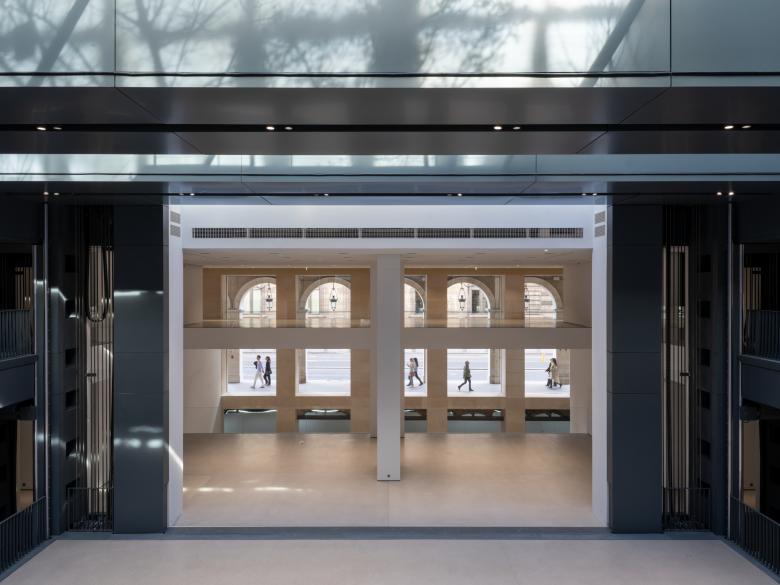
“The focus of the architectural approach,” in Jean Nouvel's words, “was to unveil the void—its depth, its height, its presence.”
(The Fondation Cartier pour l’art contemporain, 2 Place du Palais-Royal, Paris. © Jean Nouvel / ADAGP, Paris, 2025. Photo © Martin Argyroglo)
“The concept is no longer about constructing a space,” Nouvel continues, “but of building inside space itself. This void becomes the place for expression—the promise of endless possibilities.”
(The Fondation Cartier pour l’art contemporain, 2 Place du Palais-Royal, Paris. © Jean Nouvel / ADAGP, Paris, 2025. Photo © Martin Argyroglo)
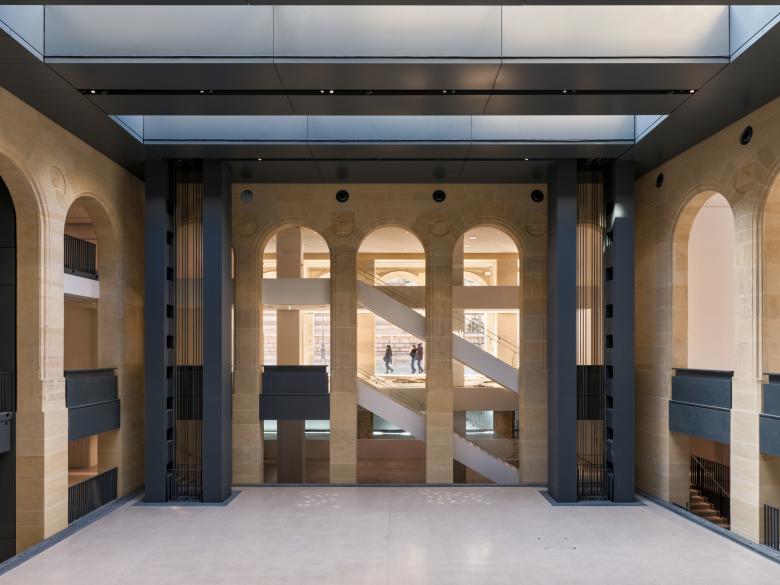
“In this architectural space, which retains only the characteristic facade and a few structural elements from the 19th century,” Nouvel says, “one feels as if enveloped by an industrial cathedral distinguished by an airy yet expansive framework.”
(The Fondation Cartier pour l’art contemporain, 2 Place du Palais-Royal, Paris. © Jean Nouvel / ADAGP, Paris, 2025. Photo © Martin Argyroglo)
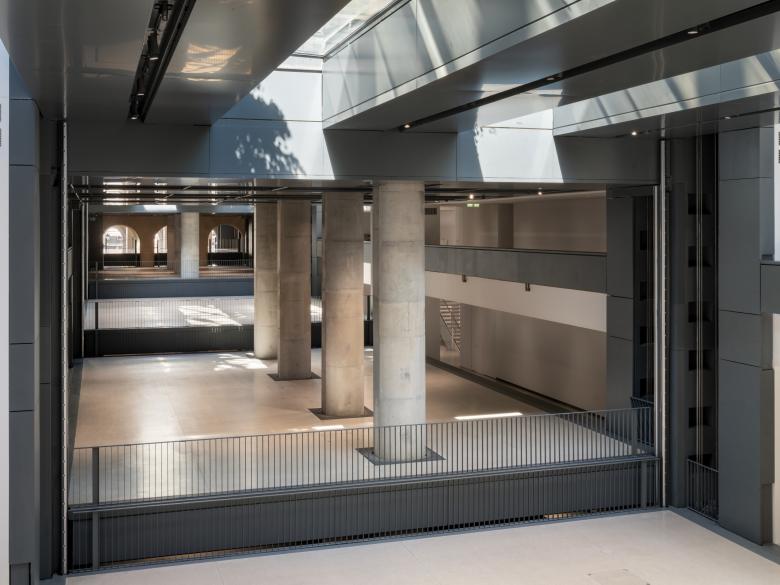
“It emanates a strong presence and power through its five steel platforms,” he continues, "with their evident mobility, which contrast
starkly with the building’s Haussmannian exterior." The adaptability Nouvel is striving for can be grasped in the stepped arrangement of the platforms seen here.
(The Fondation Cartier pour l’art contemporain, 2 Place du Palais-Royal, Paris. © Jean Nouvel / ADAGP, Paris, 2025. Photo © Martin Argyroglo)
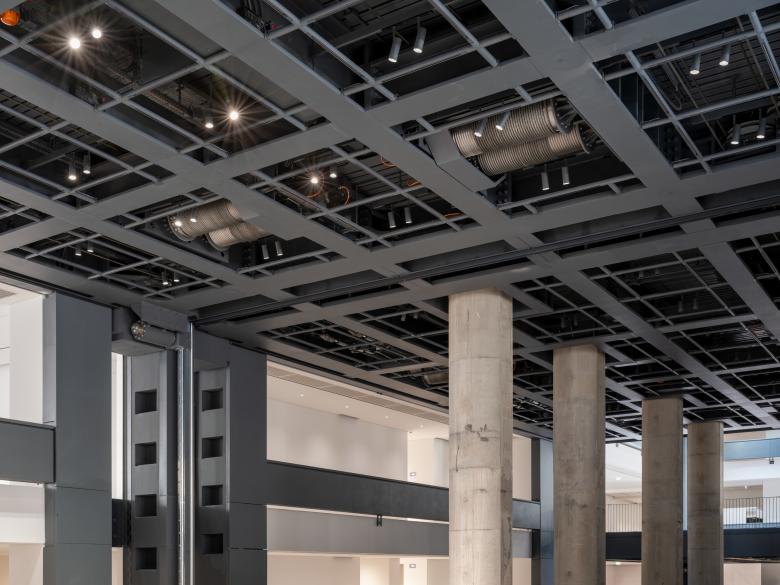
The cable and pulley system needed to lift and lower the floors can be seen tucked into the ceilings and columns.
(The Fondation Cartier pour l’art contemporain, 2 Place du Palais-Royal, Paris. © Jean Nouvel / ADAGP, Paris, 2025. Photo © Martin Argyroglo)
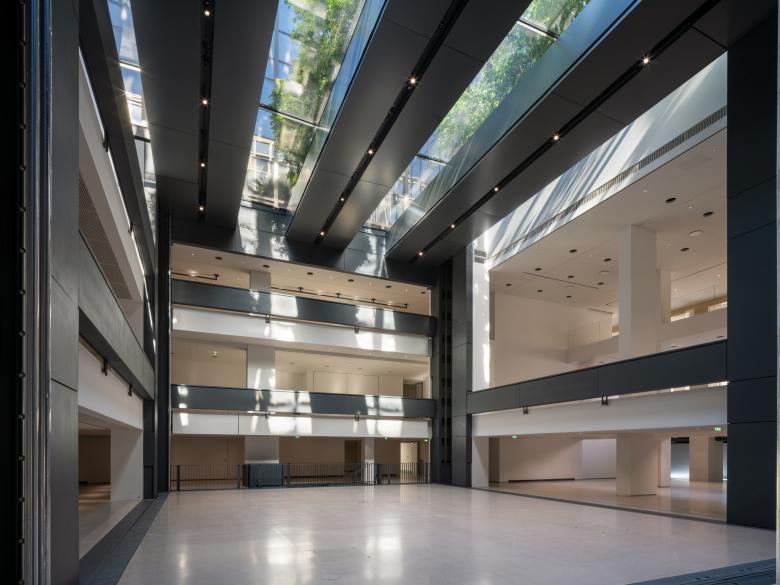
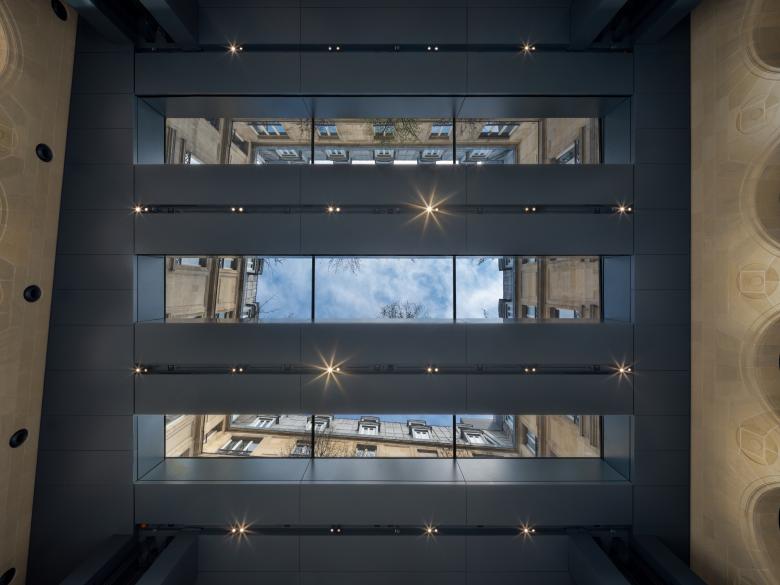
Three of the five moving platforms are located at courtyards, and are therefore capped by skylights alternating with trees. (The Fondation Cartier pour l’art contemporain, 2 Place du Palais-Royal, Paris. © Jean Nouvel / ADAGP, Paris, 2025. Photo © Martin Argyroglo)
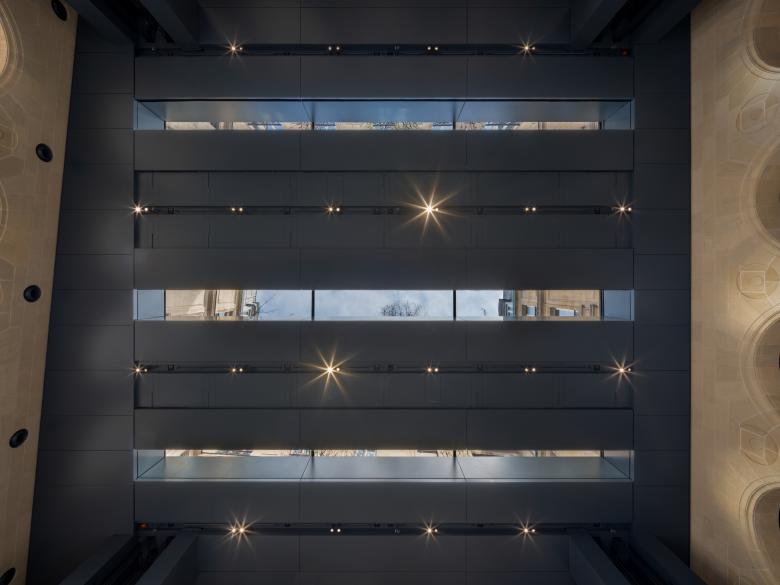
The parallel rows of skylights bring natural light to the exhibition spaces. (The Fondation Cartier pour l’art contemporain, 2 Place du Palais-Royal, Paris. © Jean Nouvel / ADAGP, Paris, 2025. Photo © Martin Argyroglo)
But retractable shutters beneath the skylights can filter the light… (The Fondation Cartier pour l’art contemporain, 2 Place du Palais-Royal, Paris. © Jean Nouvel / ADAGP, Paris, 2025. Photo © Martin Argyroglo)
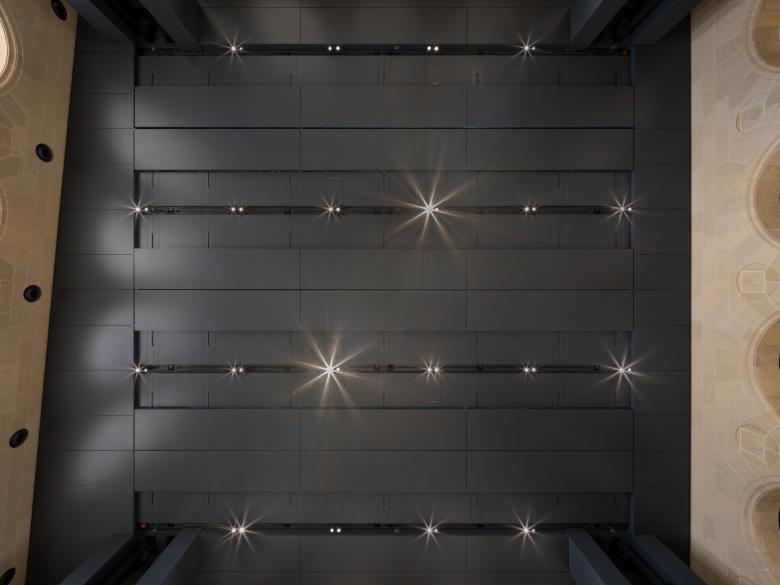
…or completely block it out when closed. (The Fondation Cartier pour l’art contemporain, 2 Place du Palais-Royal, Paris. © Jean Nouvel / ADAGP, Paris, 2025. Photo © Martin Argyroglo)
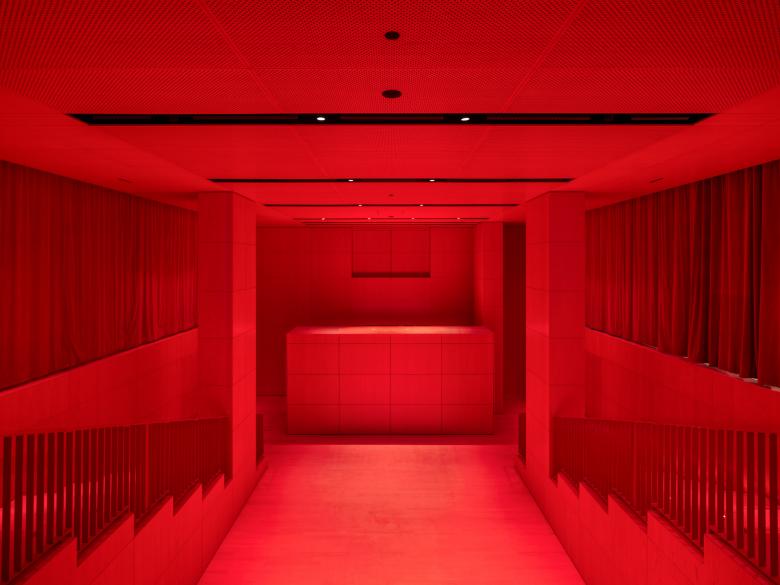
The Studio Marie-Claude Beaud, named for the Fondation Cartier's first director, is a deep red space with retractable seating that can accommodate between 110 and 300 audience members. (The Fondation Cartier pour l’art contemporain, 2 Place du Palais-Royal, Paris. © Jean Nouvel / ADAGP, Paris, 2025. Photo © Martin Argyroglo)
Outside view from rue de Rivoli. (Fondation Cartier pour l’art contemporain, 2025. Photo © Marc Domage.)
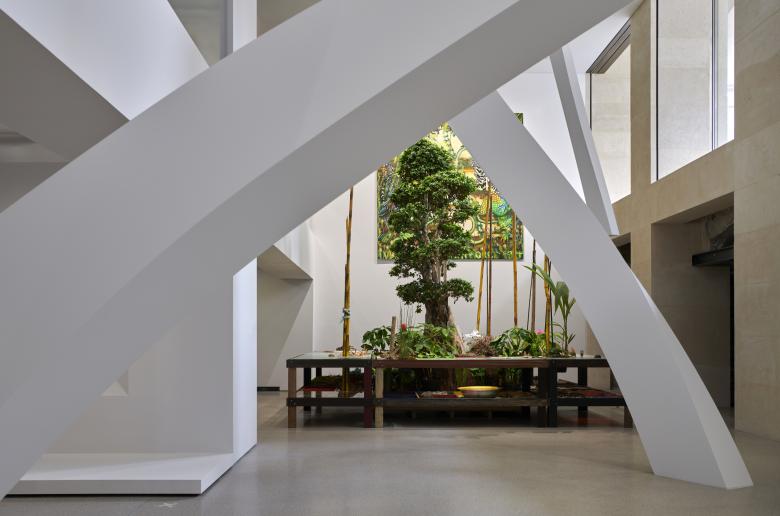
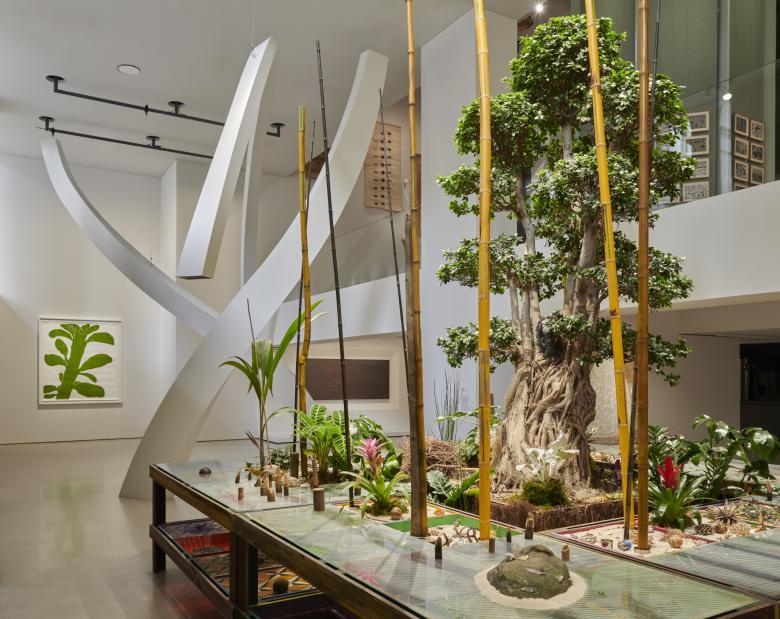
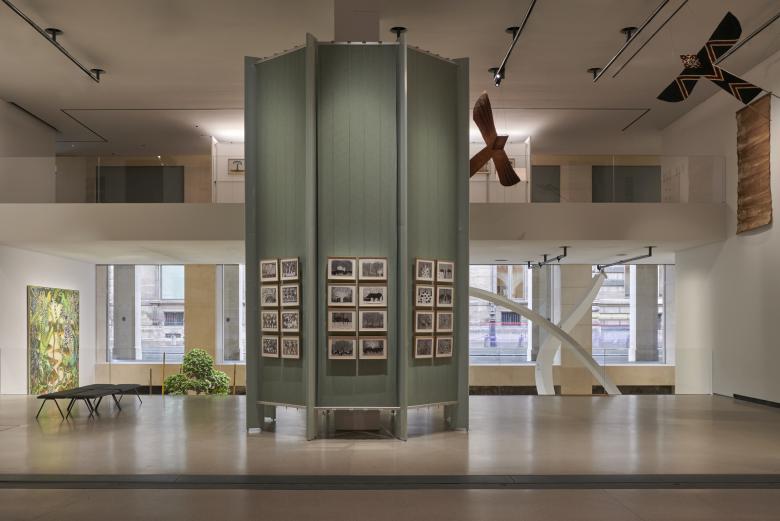
Junya Ishigami, Sydney Cloud Arch, 2015. Luiz Zerbini, Natureza Espiritual da Realidade, 2012, Version 2025. (Fondation Cartier pour l’art contemporain, 2025. Photo © Marc Domage.)
Santídio Pereira, Untitled, 2021. Junya Ishigami, Sydney Cloud Arch, 2015. Luiz Zerbini, Natureza Espiritual da Realidade, 2012, Version 2025. (Fondation Cartier pour l’art contemporain, 2025. Photo © Marc Domage.)
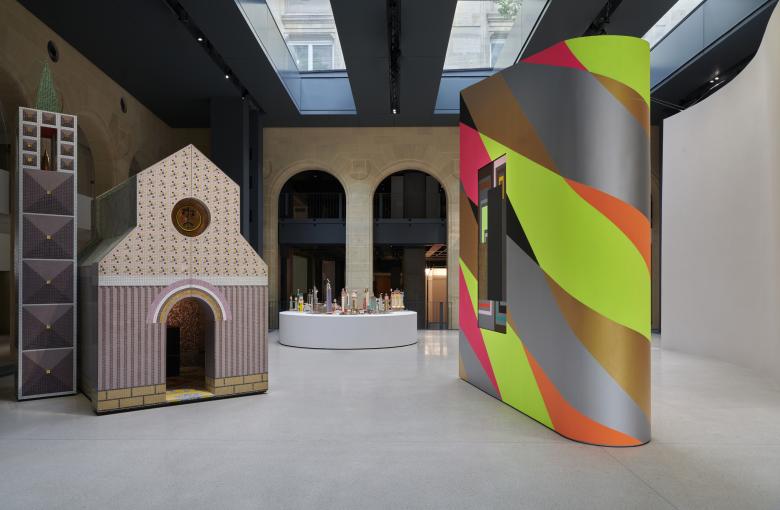
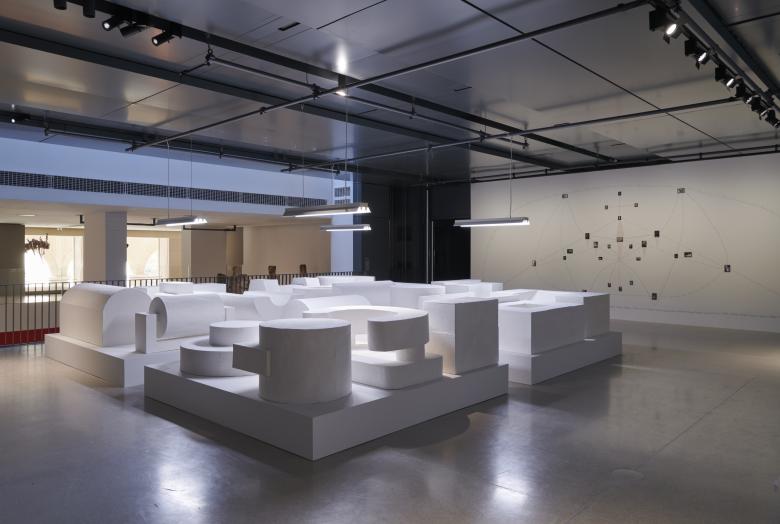
View from platform 1: Alessandro Mendini, Visage archaïque, 2002; Petite Cathédrale, 2002. Alessandro Mendini & Peter Halley, Code Warrior, 1997; OMG!, 2014. Bodys Isek Kingelez, Projet pour le Kinshasa du troisième millénaire, 1997. Junya Ishigami, Chapel of Valley, 2016. (Fondation Cartier pour l’art contemporain, 2025. Photo © Marc Domage.)
View from platform 3: Bruno Novelli, Terra Maravilhosa, 2023. Luiz Zerbini, Natureza Espiritual da Realidade, 2012, Version 2025. Chaco artists. Nikau Hindin, Aumoana – Nā Hanauna a Hina’ea, 2023-2024; Aumoana – Manu Ngārahu, 2023-2024. Junya Ishigami, Sydney Cloud Arch, 2015. (Fondation Cartier pour l’art contemporain, 2025. Photo © Marc Domage.)
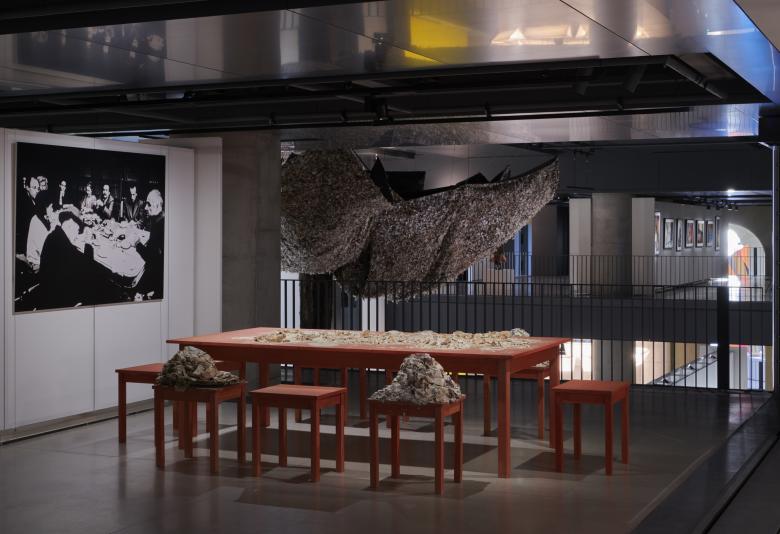
View from platform 4: Huang Yong Ping, Devons-nous encore construire une grande cathédrale?, 1991. Solange Pessoa, Miracéus, 2014–18. (Fondation Cartier pour l’art contemporain, 2025. Photo © Marc Domage.)
View from platform 4: Absalon, Propositions d’habitations, 1990. Christian Boltanski, Les Éphémères, 2018. (Fondation Cartier pour l’art contemporain, 2025. Photo © Marc Domage.)
View from platform 5: Absalon, Propositions d’habitations, 1990. Annette Messager, Mes Ouvrages, 1988. (Fondation Cartier pour l’art contemporain, 2025. Photo © Marc Domage.)
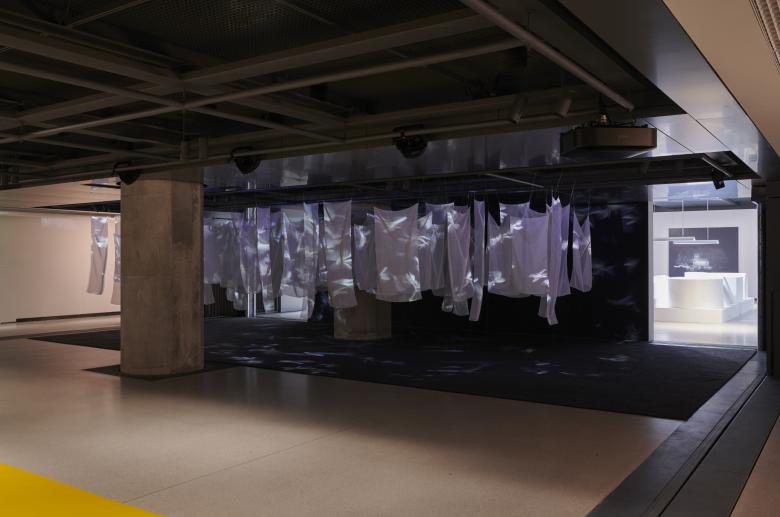
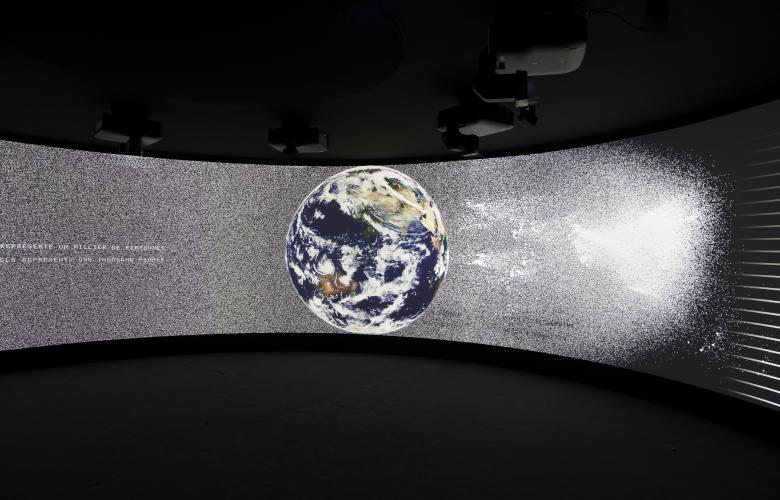
EXIT, 2008-2025 Diller Scofidio + Renfro, Mark Hansen, Laura Kurgan and Ben Rubin, in collaboration with RobertGerard Pietrusko and Stewart Smith (Fondation Cartier pour l’art contemporain, 2025. Photo © Marc Domage.)