Paid content
The productive facade
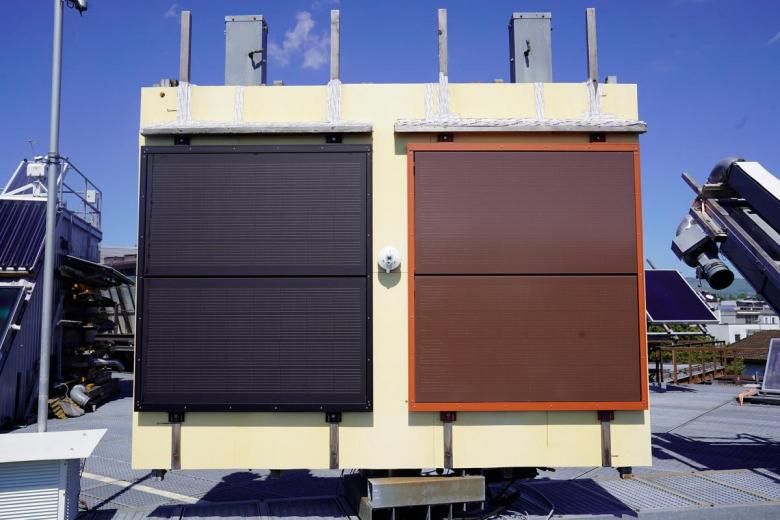
The SPF Institute for Solar Technology OST in Rapperswil and Griesser demonstrate with their joint research project "PowerSlide" why solar shading is no longer merely heat protection, but increasingly an energy component.
At the SPF Institute for Solar Technology OST in Rapperswil, work is underway on a component that brings together two current debates. It is designed to protect buildings from overheating in summer and simultaneously generate electricity. The name of the project sounds almost technically restrained: "PowerSlide". However, the motorised sliding shutter with integrated PV modules represents a major shift. The building envelope is no longer thought of merely as a conclusion, but as a filter, regulator, and energy surface.
In conversations with Daniel Philippen and Mario Lehmann, it quickly becomes clear that this is about more than just a new product. It is about the question of where energy efficiency begins in planning in the first place. Not only with the system engineering, not only in the certification, but much earlier: in the design, in building physics, in the logic of the facade.
Philippen first directs attention to a problem that sounds surprisingly banal and yet has serious consequences: everyday life in the building. Windows shaded during the day in empty apartments, windows permanently tilted in winter, heating curves that are never questioned, and room temperatures that have little to do with planning assumptions. Exactly here, according to his observation, a building often loses the efficiency with which it was once calculated.
"In practice, building technology is still too often understood as the solution, even though it usually only treats symptoms, says Philippen. The larger lever lies earlier: in a compact design, in the clever placement of openings, in passive solar gains, and in the question of how much thermal mass a building actually possesses. Anyone who ignores these fundamentals later forces technology to compensate for architecturally caused deficits.
For a long time, energy efficiency was almost synonymous with heating energy demand. That is no longer enough today. With warmer summers, heat protection has become an equally important issue – in office buildings with large glazing, it is sometimes even the more important one. For residential buildings, this does not mean a replacement, but a dual task: winter and summer must be considered at the same time.
"The challenge today consists of utilizing passive heat gains without losing control over the summer heat input", according to Philippen. It is precisely at this interface that the facade starts to work. It must let in light, allow for views, limit glare, prevent overheating, and yet react to changing orientations, uses, and seasons.
Especially in existing buildings, this precision is gaining weight. Many buildings that were considered properly designed just a few years ago are reacting sensitively to the frequency of hot summer. If the facade is renovated, external solar shading is often one of the most effective and at the same time low-threshold measures to limit overheating before additional Active cooling comes into play.
What looks consistent in energy certificates does not automatically prove itself in operation. Philippen refers to the "Performance Gap", i.e., the difference between calculated and actual performance. This gap is particularly evident with large glass surfaces: computationally they promise a lot of daylight, but in reality, they are often shaded more heavily than expected - not due to technical whims, but because people sit at screens, want to avoid glare, and define comfort differently than the simulation model.
“A good building must not only be well-planned but must also function in a robust manner in everyday use," remarks Philippen. These include buffers, a high-performance building envelope, sensible control of the building technology and, especially for larger systems, a coordinated solar shading system. Without observation and readjustment, even a well-conceived building remains below its potential.
Particularly in the field of solar shading, it becomes clear how closely architectural quality and energetic performance are linked. Static elements can achieve a great deal on south-facing facades. However, as soon as east and west orientations, differing user expectations, or changing climatic conditions come into play, rigid solutions meet their limits.
For Philippen, one thing is clear: "Modern buildings need external and movable solar shading.” This is the only way to react precisely to solar radiation, orientation, and interior comfort. This insight is particularly relevant for existing buildings. In such cases, summer heat protection can often be significantly improved with relatively simple means – provided that the solar shading is mounted on the exterior, solar shading system intercepts the radiation where it occurs and is intelligently controlled. Automation is useful, says Philippen, because users do not always operate the solar shading in a way that makes thermal sense.
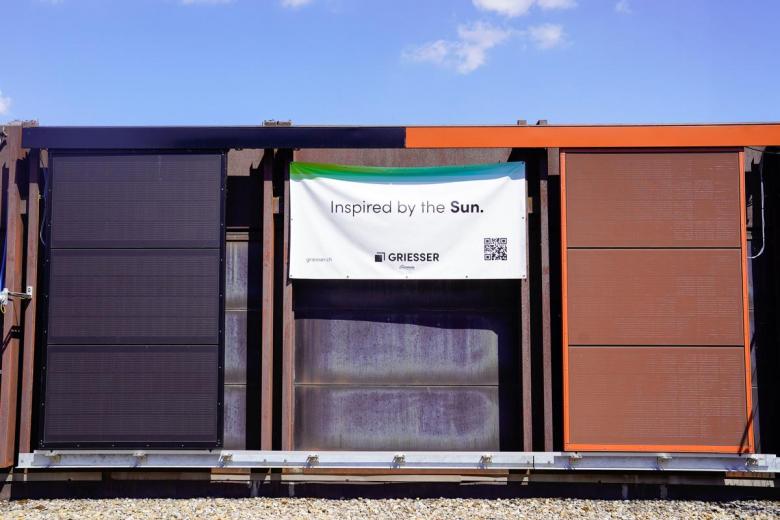
The project “PowerSlide” which the Rapperswil University of Applied Sciences develop together with Griesser begins at this point. The idea is impressively simple: a sliding shutter, which is already part of the facade, is equipped with PV modules, thus evolving from a shading element into an energy-generating component.
“The attractive aspect of this system is the simple utilization of additional facade surfaces”, says Lehmann, who is responsible for the project at OST. Vertical photovoltaics are becoming increasingly interesting because they can provide relevant yields in the months with less sunlight. While roof systems reach their peaks in summer, facades also play to their strengths when the sun is lower. In the case of the sliding shutter, there is a second benefit: the element not only provides shading but also produces electricity at the same time - thus combining comfort, climate protection, and energy generation in a single component.
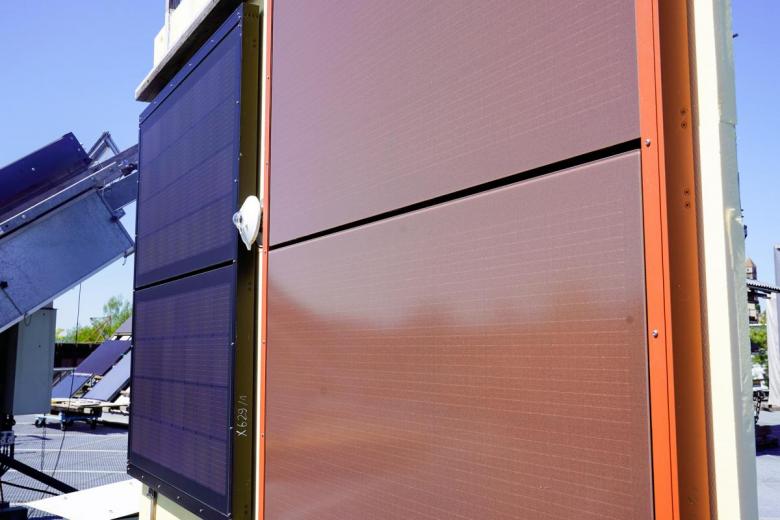
The path to getting there, however, is anything but trivial. A movable PV element follows different rules than a fixed facade system. Cables must be routed in such a way that movement and durability go hand in hand. Space is limited within the frame of the shutter; that is where the electronics, which must remain cool, are located. In addition, there are questions regarding temperature, color, angle of incidence, weight, and weather resistance.
“We are not developing a demonstration object for the laboratory, but a component for everyday building use”, says Lehmann. Accordingly, the requirements for durability, low maintenance, installation, and prefabrication are high. The product must fit into existing planning and execution processes instead of creating new complexity.
The trade-offs at the interface of technology and design are particularly fascinating. A PV-integrated sliding shutter should be lightweight, hail-resistant, mechanically resilient, and at the same time architecturally convincing. It should supply electricity without appearing like a foreign body in terms of design. And it should be possible to integrate it as elegantly as possible into various facade designs.
“Building-integrated photovoltaics (BIPV) is gaining importance. In addition to elements such as multifunctionality, aesthetics play a central role: the PV should either be as invisible as possible or deliberately act as a design element”, says Lehmann. In between lies a large field of project-related decisions. A frameless glass-glass module can sharpen the overall appearance and is convincing in terms of robustness but is associated with higher weight. Larger motors would allow for heavier elements, but would result in consequences for the product range, the construction, and the implementation. Innovation on the facade does not mean optimizing only a single component but rather rebalancing an entire system.
For architects, this is perhaps the most important lesson from the collaboration between university and industry: such solutions must not be attached to the building envelope only at the end of a project. Anyone wishing to use PV-integrated shading elements effectively must consider them during the design phase.
"When such systems are planned from the beginning, the facade logic, opening sizes, and movement spaces can be coordinated much more precisely", mentions Lehmann. In the case of the sliding shutter, this means: the facade needs shadow-free pathways, suitable window formats, and an orientation that meaningfully combines yield and utility. Planning, therefore, does not begin with technical integration, but with the basic architectural idea.
For Philippen this also means that energy performance indicators and thermal simulations should not be used merely as a formal check at the end. Especially with larger systems, it is essential to consider both shading and glare protection during the early design phases to ensure the efficiency of the solar shading system. For future projects, they should demonstrate in the early phases which spatial decisions will drive heating and cooling requirements later on.
This is precisely why the project points far beyond the specific product itself. "PowerSlide” is not only a development in the field of solar shading, but an example of how the planning culture in construction is shifting. Energy efficiency is no longer understood solely as a means of verification, but as a design parameter. The facade is no longer just a surface, but part of a building's energetic infrastructure.
Daniel Philippen formulates this as a cultural task: "Energy efficiency should not be understood as a regulatory burden, but as a quality feature of future-proof buildings." Mario Lehmann adds the product-side perspective: "If the facade potential can be tapped into with little additional effort, a very simple and at the same time future-proof form of energy production is created." Between these two sentences lies the direction in which construction is moving: away from retrofitted optimization towards houses whose shells can do more from the very beginning – protecting, moderating, and generating.
Daniel Philippen is Co-Team Leader SPF Buildings & Thermal Networks at the SPF Institute for Solar Technology at the OST and deals with issues of building physics, thermal comfort, and energy efficiency of buildings in design and operation.
Dr. Mario Lehmann is a Research Associate at the SPF Institute for Solar Technology at the OST and focuses on photovoltaics as well as the integration of energy generation into components and facades.