An Orange Thread: The Rebirth of the Sixth Pantheon
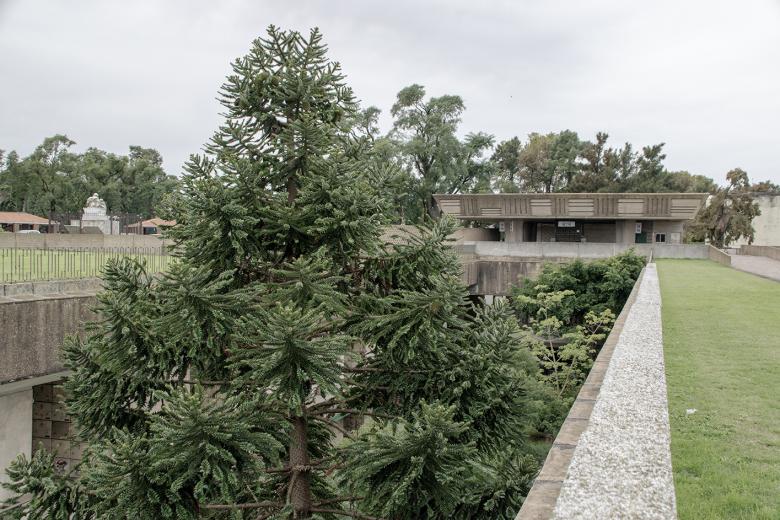
The Sixth Pantheon is an impressive work of architecture in Buenos Aires whose existence and architect, Ítala Fulvia Villa, remained silenced for decades. Completed in the 1950s, the underground necropolis received global attention after the recent publication of a monograph devoted to it. Architect, writer and photographer Milagros Sánchez Azcona, based in Mendoza, Argentina, describes the poetic attributes of the newly rediscovered masterpiece.
“An invisible red thread connects those who are destined to meet, regardless of time, place, or circumstances. The thread may stretch, tangle, or loosen, but it never breaks.”
According to the well-known East Asian legend of the red thread, every person is born with a thread tied to their little finger, mysteriously binding them to someone else’s destiny. It links people across time and distance, and is not limited to romantic love—it can refer to any bond that is profound and meaningful, to those who leave an indelible mark on another’s life.
But in this story, I choose the thread to be orange. A fusion of red (life and passion) and yellow (wisdom and power), it symbolizes humility, spiritual pursuit, and, above all, the ephemeral: the beauty that is always in flux. Here is where I pause: on change, on transience, like sunsets, autumn, or the passage between life and death.
This orange thread intertwines lives and spaces, linking Léa Namer with Ítala Fulvia Villa, restoring visibility to the Sixth Pantheon of the Chacarita Cemetery, an overlooked masterpiece of Argentina’s Modern Movement and a silent witness to countless farewells that remained hidden for decades, waiting to be rediscovered.
Ítala Fulvia Villa was born in Buenos Aires in 1913, the daughter of Italian immigrants Celestino and Santina Pasini Villa, and became one of the country’s first women architects. She graduated in 1935 at the age of 22, and two years later traveled to Europe, where she discovered the modern movement that would define her entire career.
Her beginnings were remarkably strong: She joined the Austral group, collaborated on Le Corbusier’s master plan for Buenos Aires, and entered the field of urbanism alongside the renowned engineer Carlos della Paolera. Most of her professional life unfolded in public institutions, from the General Directorate of Public Works and Municipal Planning to the Buenos Aires Master Plan Office (EPBA) and the city’s General Directorate of Architecture and Urbanism. In the 1950s she also taught urbanism at the Universidad Nacional de La Plata.
A pioneer interested in modernism at a time when historicist styles still dominated Buenos Aires, Villa was curious, a lover of literature and languages, and carried a professional ethic grounded in collaboration and collective recognition. She never married or had children, and her most active years coincided with the rise of Juan Domingo Perón. By the 1960s and 70s her presence almost vanished from the record amid successive political upheavals. She never ran her own practice, always working instead in the public sphere, perhaps a reflection of her inclination toward urbanism and collective projects.
In 1950, confronted with the need to accommodate growing cemetery populations caused by waves of immigration, the General Directorate of Architecture and Urbanism commissioned Villa to design two new public pantheons: the Gran Pantheon in Flores and the Sixth Pantheon in Chacarita. Benefiting from a climate of increasing support for women’s rights championed by Eva Perón, Villa led both projects with precision and a modern sensibility. The Sixth Pantheon was successfully completed, yet Villa’s authorship went largely unrecognized for decades, leaving her pioneering role in Argentine modern architecture in relative silence until it was finally acknowledged.
According to Ana María León, Villa’s love for Dante’s Divine Comedy seems to whisper through the lines and light of that subterranean space. Drawing on the labyrinth myth, León portrays Ítala as more than an architect with a capital “A”: She is a modern Ariadne, quietly unraveling the thread that shapes the underground labyrinth of the Sixth Pantheon. I would add that she left one end of the thread hidden, waiting for a future Theseus to find it and follow it, to untangle her story.
Decades later, that Theseus appeared in the person of French architect Léa Namer. She discovered the tip of the thread and, guided by an almost inexplicable intuition, began to follow it, connecting past and present, reshaping the history of Ítala, of the pantheon, and, above all, of herself. Ítala and Léa never met in person, yet I believe their bond transcends time, space, oceans and even planes of existence.
In 2010, Léa arrived in Buenos Aires for an academic exchange. Fascinated by the city, she discovered a place at once foreign and familiar. After graduating in France in 2012, she practiced architecture in the traditional way, but found no satisfaction there. She never broke her ties with Buenos Aires, and in 2014 returned for a personal event.
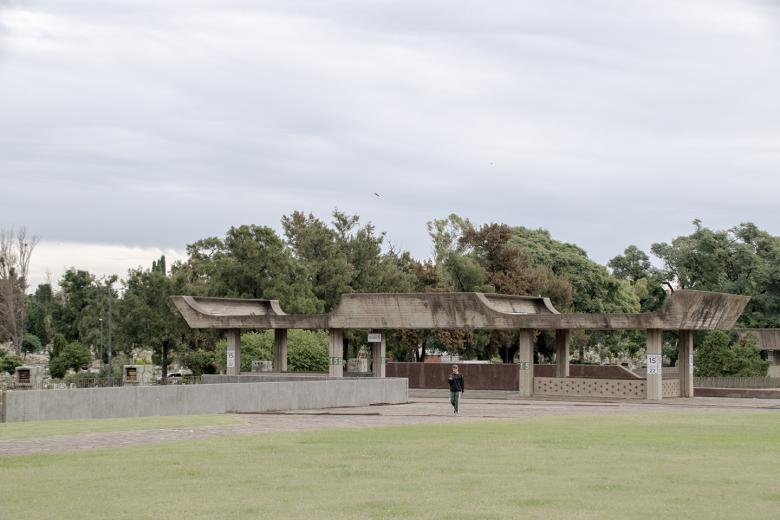
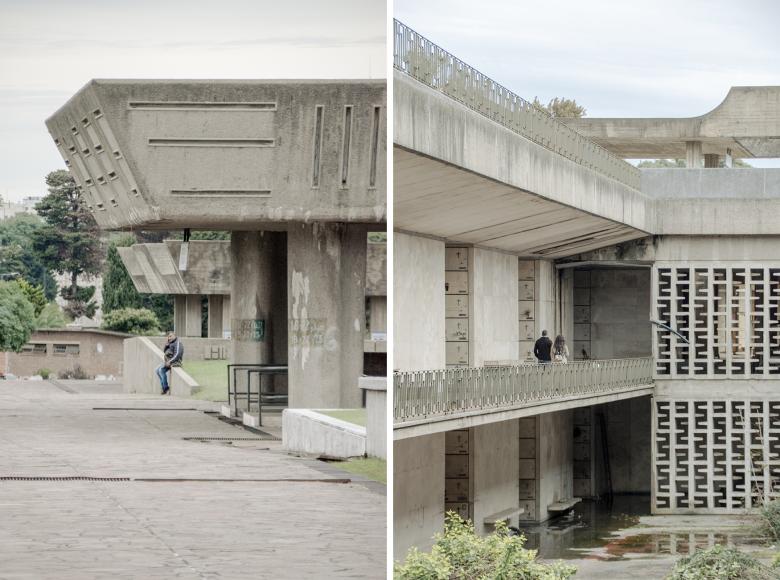
She could not have imagined—or perhaps she could—that an invitation to stroll through Chacarita Cemetery, hardly a tourist destination, would change her life. It was then that she first encountered the Sixth Pantheon face to face. It did not happen suddenly—or at least, that is how I read it in her telling—but rather as a gentle promenade, leading her to a green surface where elegant concrete roofs seemed to “levitate,” scattered across the landscape. She heard the sound of plants, perhaps stirred by the wind, and glimpsed tree canopies emerging from some hidden depth. She approached and she saw it. The work evoked an emotion she had never felt visiting any other architectural project in the world. She had the intuition that she had discovered something significant and she was right.
That intuition grew into a decade-long project of research and visibility—almost an obsession. No one around her knew of the work, and ten years later everyone speaks about it. Léa began by catching the tip of the orange thread, linking stories separated by years, and her exploration culminated in 2024 with the publication of her book Chacarita Moderna. Its pages, infused with the same orange of the thread, gather testimonies, photographs, plans, and narratives, restoring Ítala Fulvia Villa and the Sixth Pantheon to their rightful place in the history of Argentine architecture.
To understand the context of this extraordinary work, one must first immerse in the very place Léa explored: the Chacarita Cemetery. Inaugurated in 1886 as the “Cementerio del Oeste”, it is the largest burial ground in Latin America and among the biggest in the world. Originally chosen for its distance from the city, it was eventually enveloped by urban expansion and today lies in the heart of Buenos Aires, in a neighborhood currently thriving. Its toponym derives from the Quechua word for “farm,” recalling its agricultural past. In 1871, the municipality had established the first cemetery there to face the yellow fever epidemic, and between 1882 and 1886, the municipal engineer and architect J. A. Buschiazzo designed an orthogonal layout with diagonal avenues, inspired by the plan of La Plata.
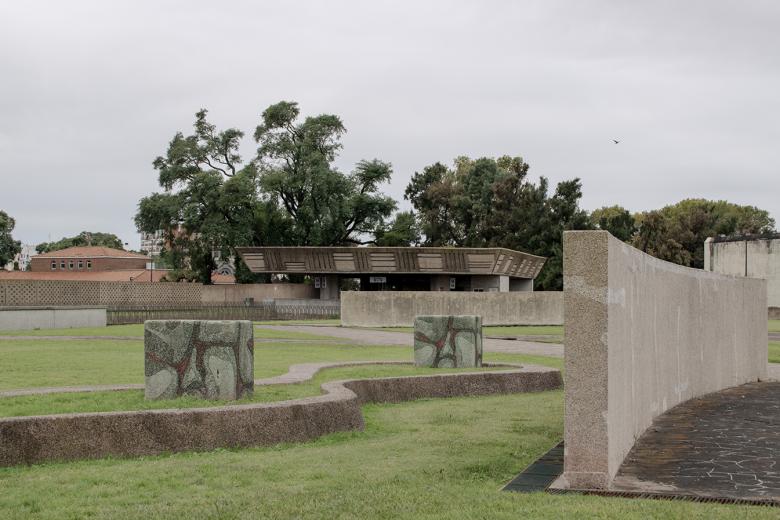
The cemetery combines vaults, mausoleums, ossuaries, niche galleries, and pantheons, functioning as a true city within the city. At its center stands the Sixth Pantheon, conceived as an underground necropolis that frees the ground level to become a park, following the vertical cemetery-park typology, unique in the world at that time. This approach reflects Buenos Aires’s modernization and the quest for optimized funeral space.
The Sixth Pantheon occupies a square plot of 300 meters (984 feet) per side, with nine underground galleries housing approximately 150,000 graves. Construction took place in three phases between 1949 and 1966: the first (1949–1953) included single-level galleries; the second (1955–1958), led by Ítala Fulvia Villa, added a second level for galleries 18, 19, and 20; the third (1958–1966) completed the remaining galleries.
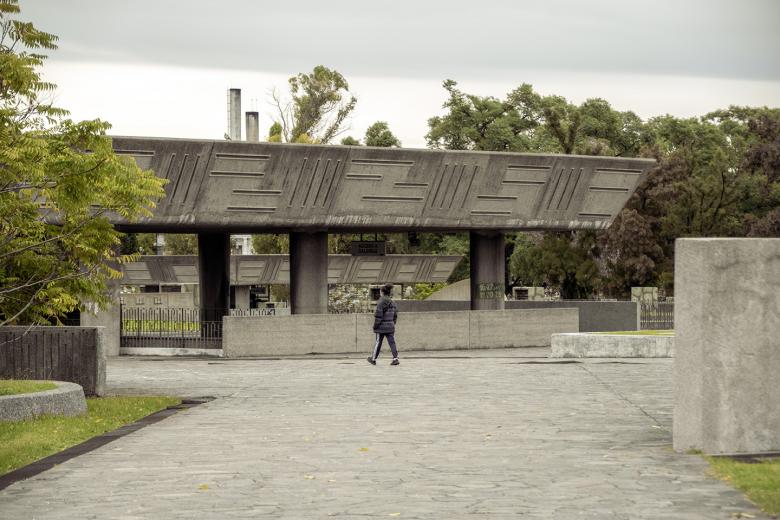
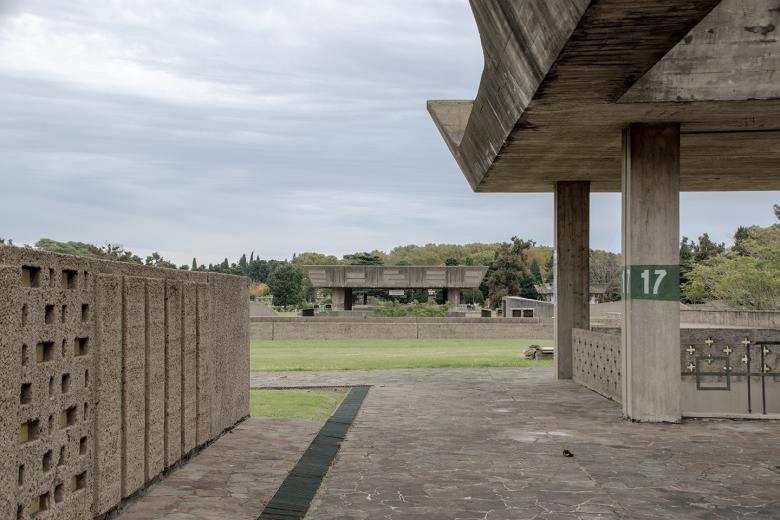
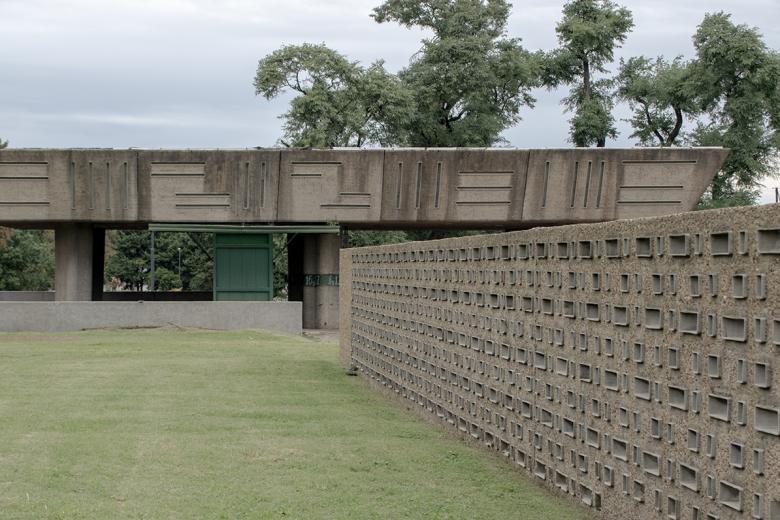
The project distinguishes between an upper level for the living and a subterranean level for the deceased. The 90,000-square-meter (22-1/4 acre) surface is covered with grass, crossed by pedestrian paths, and punctuated by twenty rectangular courtyards of varying sizes. Nine angular and central concrete pavilions serve as entrances to the underground galleries and protect vertical circulation. Concrete walls with geometric shapes, alignments of ventilation openings, and tree canopies in the courtyards create visual rhythms that reveal the subterranean organization. Ítala also designed the landscaping with a carefully selected plant palette; reflecting pools and fountains were planned but never realized for economic reasons.
The galleries are arranged around courtyards that provide light, ventilation, and spatial organization. Advanced technical systems were incorporated: visitor elevators, casket lifts, and a dual ventilation system with air ozonization, now out of service.
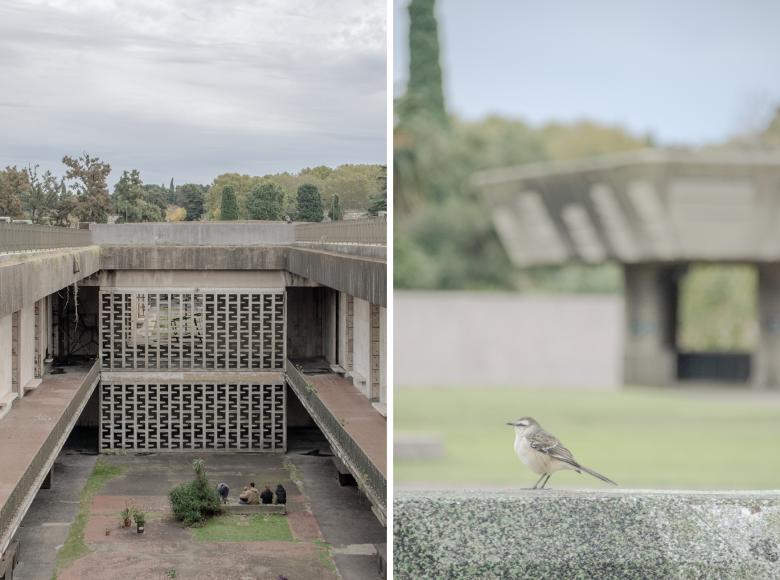
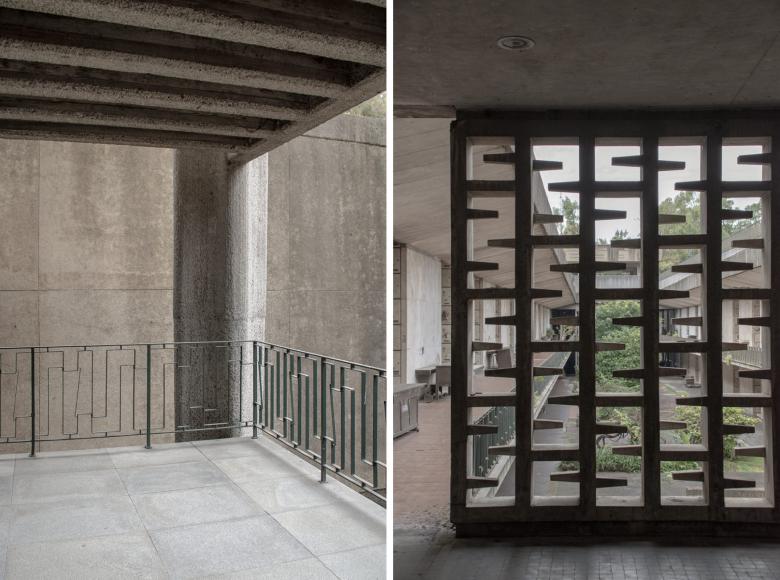
The project rejects classical funerary forms emphasizing status and individuality. All grave plaques are identical, made of travertine measuring 62 by 78 cm (24 x 30 inches), promoting an egalitarian vision. Modern monumentalism combines Spanish and Italian traditions of niches with a Brutalist language. Exposed and carefully worked concrete is used both in surface pavilions and underground structures. Notable features include rounded, hammered concrete columns, distinctive lattices, metal railings, and courtyards that demonstrate attention to detail and the visitor experience.
The Sixth Pantheon possesses a vertical structure connecting the subterranean level to the sky through large openings, evoking the underworld and salvation, in a delicate play of light and shadow that guides the visitor’s experience. Stairs, lifts, and elevators emphasize the transition between worlds and the project’s modernity, while highlighting its symbolic and sacred character. The work represents the culmination of modern architectural principles applied to the funerary realm, inventing an unprecedented funerary aesthetic for its time.
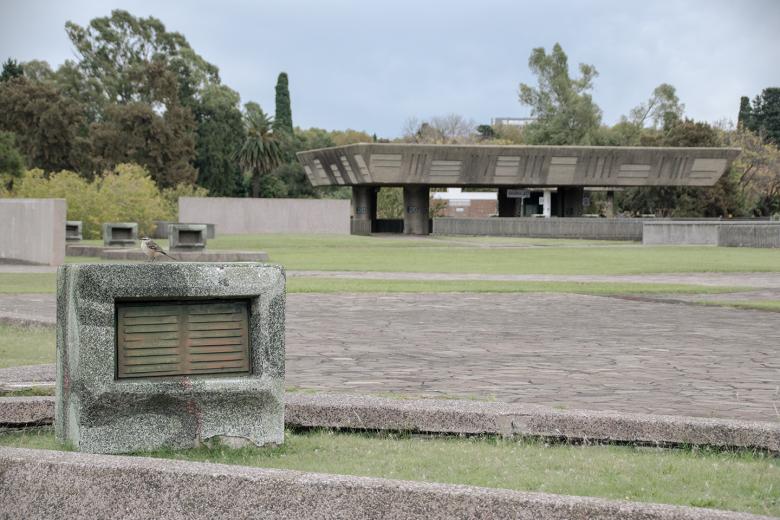
Beyond its materiality and geometry, the Sixth Pantheon connects generations and silences. The story of this place and its creators transcends architecture: It speaks of courage, memory, justice, and a passion for storytelling.
Here, narrative manifests in concrete, light, shadow, and underground courtyards, in a thread that links years and meters beneath the earth, Buenos Aires and Paris, the modernity of the 1950s and a contemporary gaze. Architecture thus reveals itself as a stage for stories, invisible encounters, and emotions that endure.
One can approach the Sixth Pantheon in silence, feel its monumentality, and understand that great architecture is not only to be observed, but to tell us something. It connects us, moves us, and reminds us that we are stories, that we inhabit stories, and that sometimes an invisible—or bright orange—thread is enough to unite them.