Grace Farms, the cultural and humanitarian center in New Canaan, Connecticut, that opened its SANAA-designed River building in October 2015, marked its tenth anniversary with a day-long celebration of art, design, music, and conversation on Saturday, October 11. World-Architects was in attendance, and catching our attention were a trio of creations in wood: sculptural benches designed by Kazuyo Sejima, the replacement of the building's half-mile-long fascia, and photographs of a sustainably managed forest in Haida Gwaii, British Columbia.
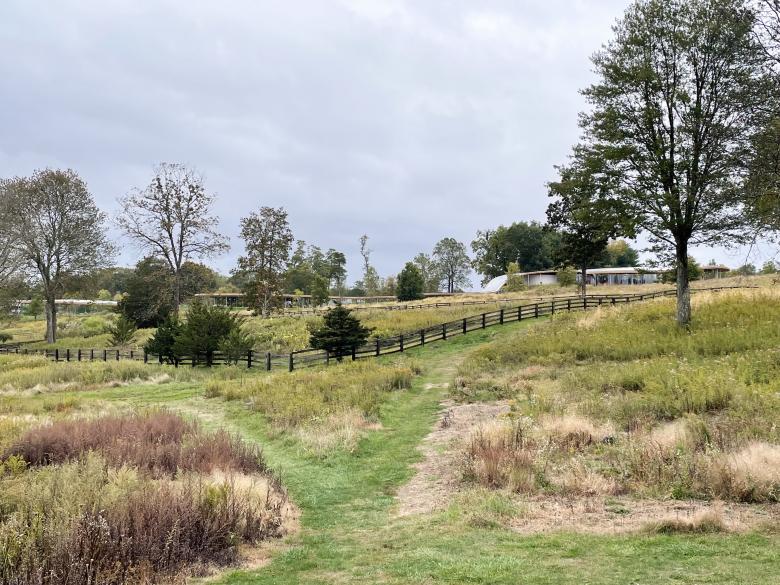
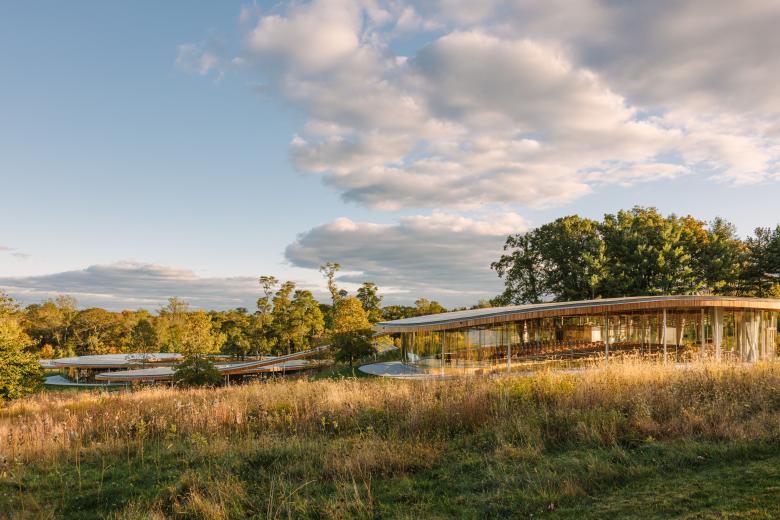
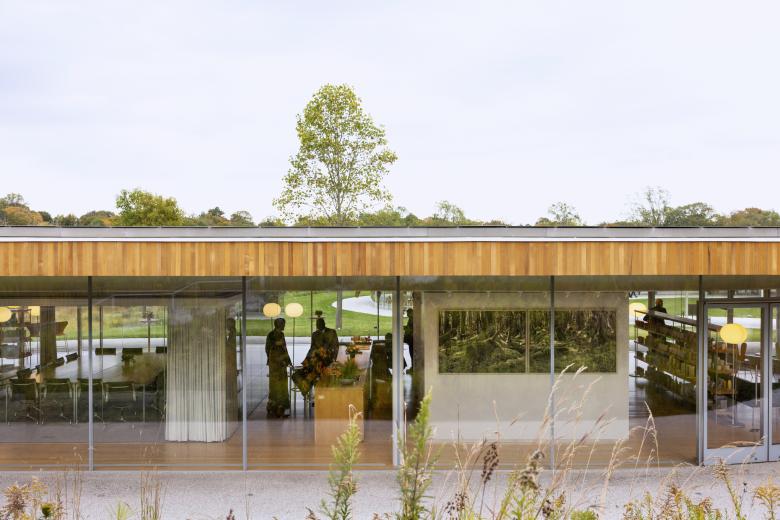
It was cool, with low, gray clouds throughout the day of celebration a week and a half ago. The weather was very much the same a decade ago, on October 9, 2015, when the nonprofit Grace Farms Foundation inaugurated the River Building designed by Pritzker Prize-winning Japanese architects Kazuyo Sejima and Ryue Nishizawa of SANAA. At first glance very little has changed at Grace Farms over its first ten years. The River Building's five glazed volumes linked by a sinuous roof following the gently sloping site are just as stunning. The building and its 80-acre landscape are still free and open to the public six days a week. And the foundation's humanitarian mission—focused on rooting out forced labor in the construction industry—continues through various efforts.
The differences between 2015 and 2025 are therefore subtle. Newly planted trees have grown and filled in, as have the restored native meadows that surround the building. The nondenominational Grace Community Church no longer uses the sanctuary, but the largest, uppermost of the five glazed volumes is still used for musical performances, lectures, and other public events, much like those held during the 10th anniversary celebration and those planned for Grace Farm's 10 year season that carries the “We all build” theme. This recent October Saturday also saw the unveiling of new artworks, a new exhibition, new sculptural benches, and the replacement of the River Building's wood fascia.
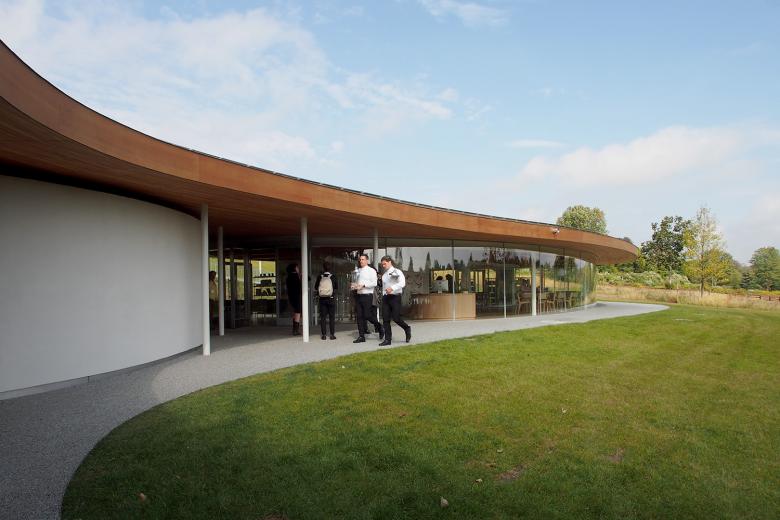
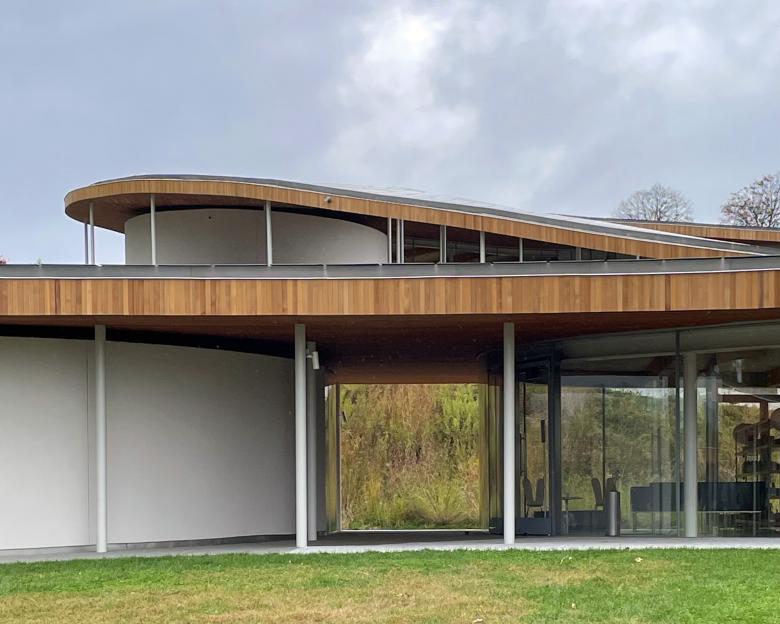
Architect Toshihiro Oki, who worked at SANAA during the design of Grace Farms before establishing his eponymous practice, and who now serves as architectural advisor at Grace Farms, explained the impetus for the replacement fascia. “Connecticut winters are quite intense,” he said “and the freeze-thaw cycle basically wore into the original Western red cedar horizontal panel boards lining the edge of the roof.” The solution by Oki, in concert with SANAA, was sticking with Western red cedar, “but this time solid boards in a vertical orientation—very narrow.” He described how the result, “quite a big departure from the original design,” came about by going with nature rather than fighting it. Appropriately, the vertical tongue-and-groove panels follow gravity and the flow of water but also, Oki said, “embrace the different colors of wood” over trying to achieve a uniform appearance. Inspired by the way the River Building's Douglas fir ceilings had aged in ten years, Oki and SANAA opted to express the diversity and age of wood; this approach enabled them to use the entire tree for the fascia, from the dark interior hardwood to the light outer sapwood.
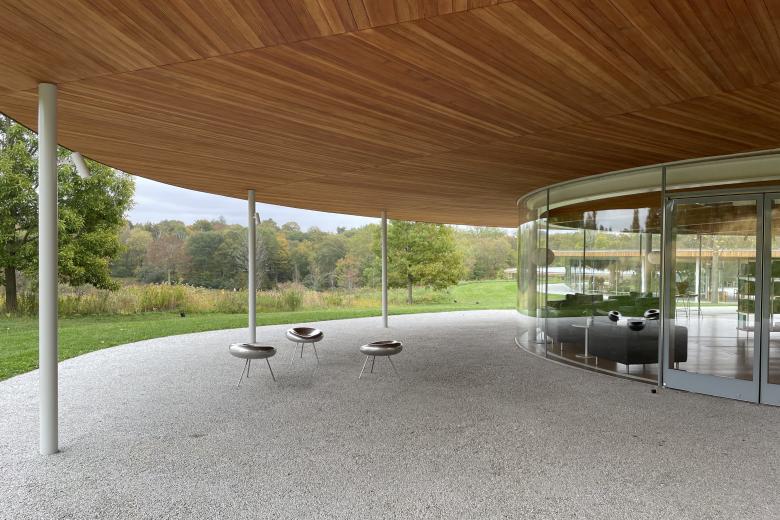
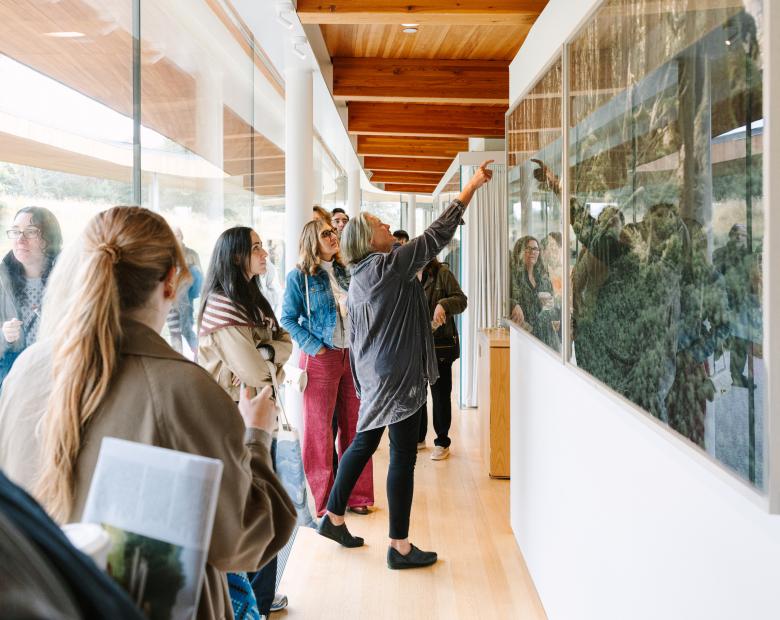
When it came time to source the wood for the fascia, Oki and Sharon Prince, the founder and CEO of Grace Farms, discovered the Taan forest in Haida Gwaii, a remote island in Northwestern Canada. Aligned with the humanitarian principles of Design for Freedom, the initiative Prince launched in 2020, the Taan forest is ethically and sustainably maintained by the Haida Enterprise Corporation (HaiCo), a company owned entirely by the Haida, the First Nations people who live there. Furthermore, the ancient cedar forests in Haida Gwaii inspired Chelsea Thatcher, creative director at Grace Farms, to commission photographer James Florio, the current artist-in-residence at Grace Farms, to create a permanent installation for the library.
Florio might be best known to architects for exhaustively documenting the work of Ensamble Studio and the installations at Tippet Rise Art Center in Montana, where he is based. In April 2025, Florio and his family traveled to Haida Gwaii, spending a week there exploring the dense Taan rainforest, discovering one place that “really called to me,” he explained, and returning to that spot with his large-format film camera to immerse himself in the dark forest and “just watch the light.” The two photographs mounted to the wall of the library were the first Florio took on that trip, but working with film rather than digital, he did not know how successful the long exposures would be until they were later developed. The results are dramatic, both as lush, immersive imagery of the forest and for the way the trunks of the trees rising from the mossy base seem to merge with the new fascia when seen from outside, making the source of the fascia's construction visible.
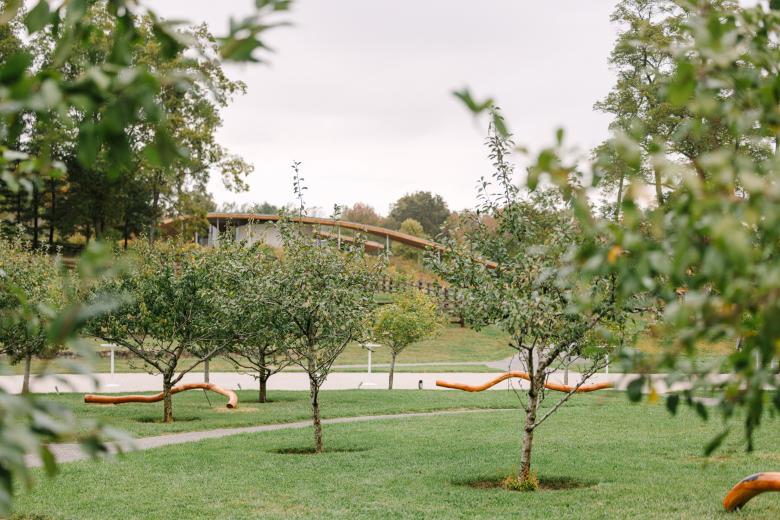
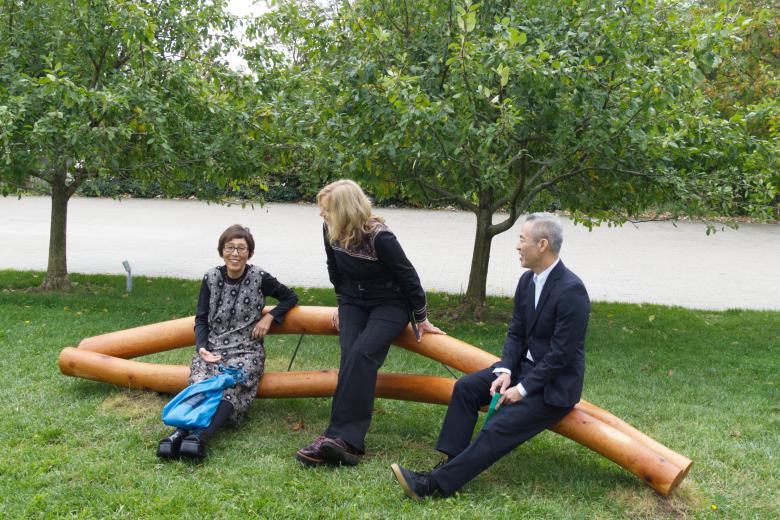
At the lowest point of the Grace Farms property are two barn buildings that were renovated by SANAA ten years ago and, between them, a landscaped plaza that is the setting for Kazuyo Sejima's new Dancing Trees. The site-specific installation consists of six sculptural benches following Sejima's intention to create “figures dancing together, each with a different form.” After considering plastic and concrete, it was decided to use wood, specifically black cherry wood from nearby forests in Connecticut. Toshihiro Oki, working with Sejima on the project, explained how “we went around with a 3D model and found the forms,” matching the trees to Sejima's designs. The figures may be “dancing” but they are stable, with the wood bolted to small concrete pads buried beneath the grass. At first glance they do not look like they would function as benches, but they do in fact work, especially the ones that are made with doubled-up logs.
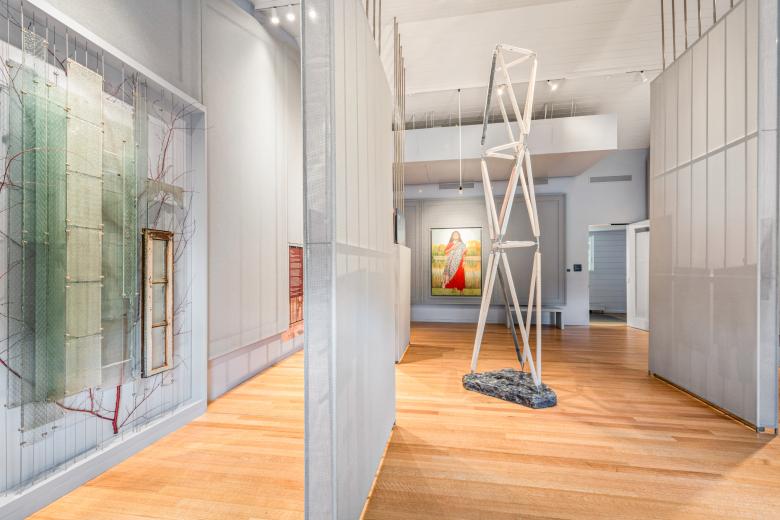
A couple more pieces from Grace Farms' 10th anniversary celebration are worth mentioning. Housed in the West Barn is With Every Fiber | Pigment, Stone, Glass, a new long-term exhibit curated by Chelsea Thatcher and designed by Nina Cooke John. “The new installation reveals the embodied suffering behind pigment, glass, and stone in the construction industry,” says a press release, “as well as new innovations within those materials that demonstrate that building ethically is possible.” Standing out among the handful of commissioned works is Stone Space Frame, a pylon designed by Webb Yates Engineers. The piece is made from ethically sourced stones that have been shaped into struts and are held together via post-tensioned steel bars. The sculpture reportedly uses 75% less steel and carbon than a comparable all-steel structure.
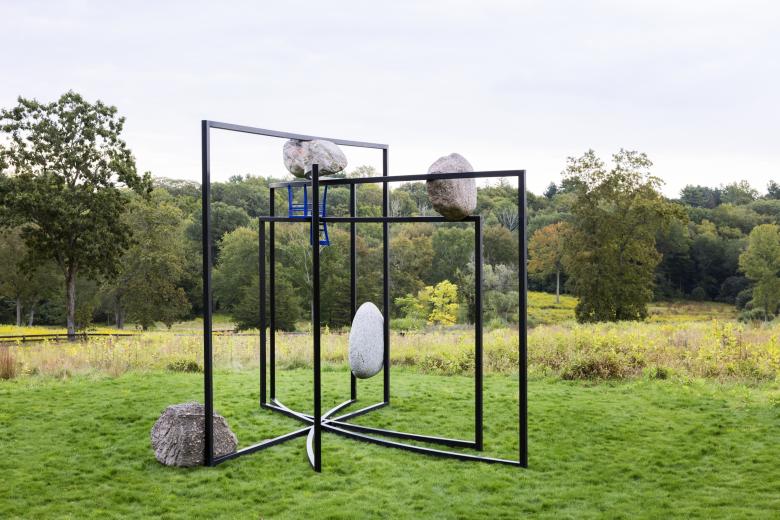
Back at the top of the property, in the north meadow close to the sanctuary, is ParaPosition, a large-scale permanent outdoor sculpture that artist Alicja Kwade created in 2024. The artwork features curved steel frames holding large pieces of stone aloft. The addition of an upside-down chair “beckons viewers to reflect on our relationship with the world and contemplate the fundamental nature of our existence,” per a press release. The piece's location also beckons visitors to explore the Grace Farms landscape beyond the River Building, something this writer heartily recommends any day of the year.