Putting the Trump Stamp on the White House
First he added gold trim to the Oval Office. Then he added two large flagpoles to the White House grounds and paved over the lawn of the famous Rose Garden. Now US President Donald Trump is set to build a 90,000-square foot, $200 million ballroom where the East Wing now stands.
In the White House's roughly 225-year history, change has been nearly constant. Designed by Irish-American architect James Hoban after winning a 1792 design competition, the President's House, as it was initially called, was first occupied by John Adams in 1800—when the building was still incomplete. Adams's successor, Thomas Jefferson, worked with architect Benjamin Henry Latrobe to renovate the house and add colonnades and other features, but then in 1814 the British set it ablaze, forcing a reconstruction that was carried out by Hoban. It's not know when exactly the building began being called “The White House,” but some historians attribute it to the whitewashing of the building's sandstone to cover charring from the fire.
Hoban added the semicircular portico on the south facade in 1824, creating the most iconic image of the White House—on what is ironically the back of the building—and five years later he added the north portico, with its recognizable triangular pediment. Fast forward to 1902, following decades of work on the grounds and minor works within the building, and Theodore Roosevelt hired McKim, Mead and White to extensively remodel the White House and add the West Wing and the East Gallery. (It was in that year that Roosevelt made the White House name official.) The West Wing, where most of the offices are located, was expanded in 1909, when the Oval Office was installed, and then again in the 1930s; in between, architect Williams Adams Delano added a third floor and new roof to the original building, often referred to as the Executive or Presidential Mansion, to distinguish it from the West Wing and the East Wing, the latter of which was added by architect Lorenzo Winslow in 1942.
The most significant work on the White House between the addition of the East Wing and today happened during the term of Harry S. Truman. Faced with major structural issues, the whole interior of the Executive Mansion was gutted between 1948 and 1952, with the original stone and wood structure replaced with steel framing. Renovations of the West Wing and north portico happened in the 1970s, but changes since have been focused on interior treatments and changed at the whims of different Presidents and their First Ladies. The White House's relative stasis is changing with Donald Trump, who announced last week that he is adding the White House State Ballroom, “a much-needed and exquisite addition of approximately 90,000 total square feet of ornately designed and carefully crafted space, with a seated capacity of 650 people—a significant increase from the 200-person seated capacity in the East Room of the White House.”

The State Ballroom is being designed by McCrery Architects, the DC firm headed by James C. McCrery, an associate professor in the School of Architecture and Allied Arts at the Catholic University of America, a member of the U.S. Commission of Fine Arts during Trump's first term, and a founding member of the National Civic Art Society. Curiously, even though McCrery works in a strictly classical architectural language, his bio at the Catholic University asserts that his undergraduate studies “were concentrated in modernist and formalist design and theory,” and his subsequent graduate studies were concentrated in “Post-modernist and Deconstructivist design and theory under Peter Eisenman,” whose office he worked at. Although McCrery might have picked up his penchant for bow ties from Eisenman, it was working in the office of Allan Greenberg where he developed an interest in classical and traditional architecture. McCrery founded his eponymous office in 2007, specializing in civic, religious, and institutional projects.
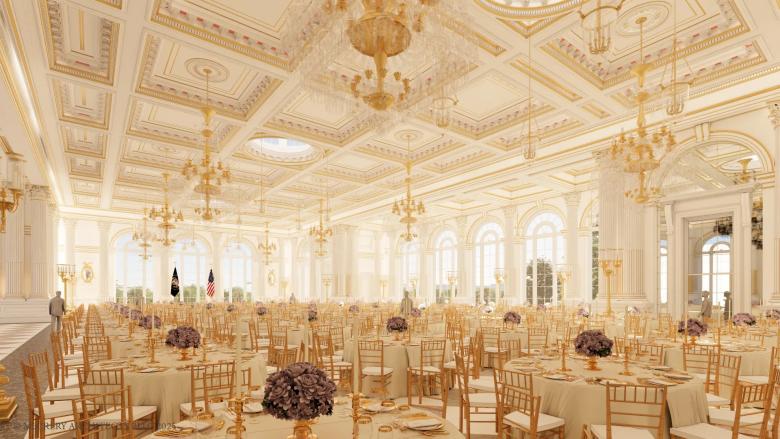
McCrery's design for the White House State Ballroom expands the footprint of the current East Wing, which it would demolish, bringing it closer in size to the West Wing. Furthermore, the ballroom would be considerably taller than the current East Wing, bringing it to about the same height as the Presidential Mansion and making it a sizable addition to the White House property. “This dwarfs everything that has been done on that property before,” Edward Lengel, former Chief Historian of the White House Historical Association, recently told a public radio station, pointing out that it “rivals the size of the Presidential Mansion itself.” The ballroom space is so large that, in addition to the large arched windows that wrap it on three sides, a series of circular light monitors run down the center of the space for additional daylighting; these elements can be seen here in the two interior renderings, which are awash in gold accents, and the exterior rendering above, which conversely turns the White House and everything around it white, including the grass, trees, and surrounding buildings, blurring the distinction between old and new.
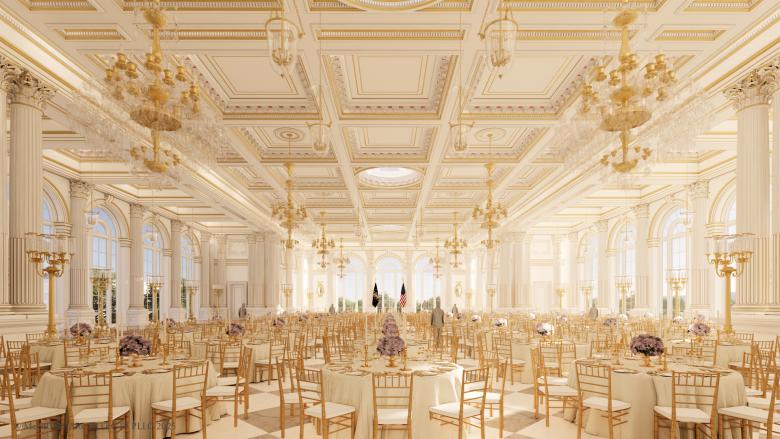
Reactions to the White House's announcement of the ballroom were fast and pervasive, focusing on such issues as the need for a White House ballroom (so temporary tents would not have to been used for large events anymore), the assertion that the $200 million price tag will be paid for by Trump and “other patriot donors” (whoever they are and what they might expect in return), and how the gold trim adorning the classical details puts a strong Trump “stamp” on the project (it's Mar-a-Lago in the District of Columbia!). Most remarkable is the speed at which Trump and his team are working—construction is set to start next month, with completion happening “long before the end of President Trump’s term”—some of which can be attributed to a disregard for norms, of both historical preservation and the democratic process. Lengels, again telling NPR, elucidates that the normal routine for such a sizable expansion would involve “going through a process with the National Park Service, working with Congress, and making the case for imperative need that these changes have to made,” rather than just saying it will be done, as Trump appears to be doing. Furthermore, the former White House historian, like other people, sees the ballroom as a necessary addition, but he also sees it as one so large and ostentatious as to “transition the whole thing into a presidential palace.” Given Trump's taste in architecture and interiors, “palace” is a fitting descriptor, but given Trump's autocratic tendencies during his second term, the term takes on other, less innocent meanings as well.