2025 Oberlander Prize to Mario Schjetnan and Grupo de Diseño Urbano
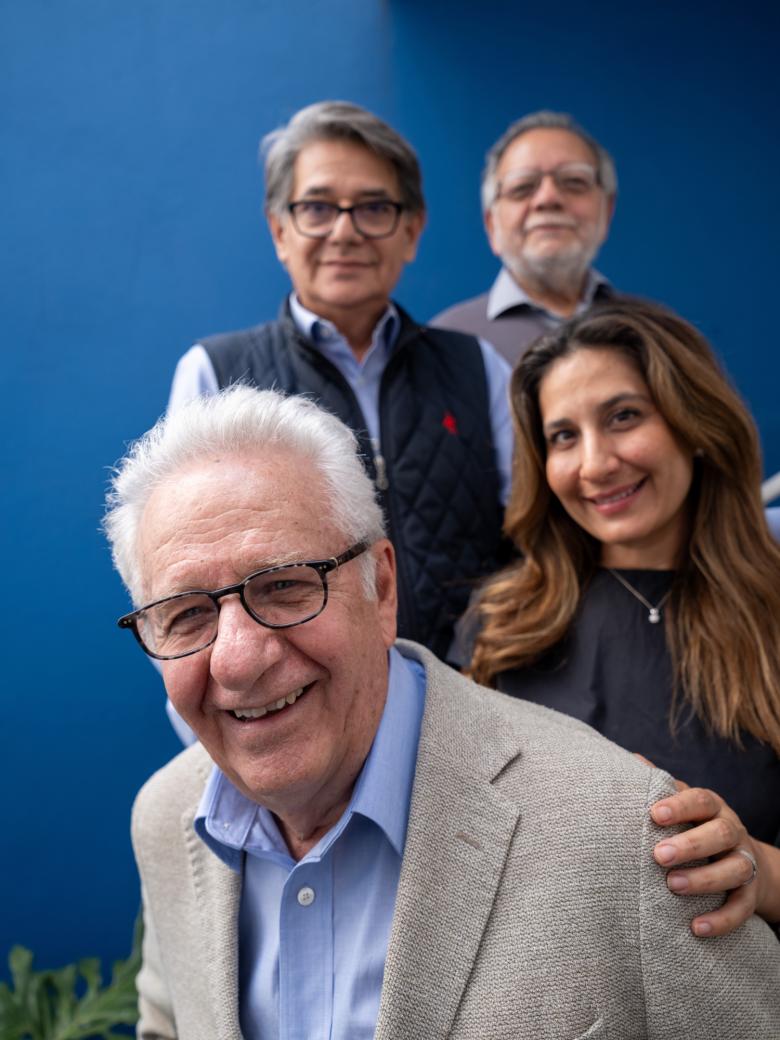
Mexican landscape architect Mario Schjetnan and Grupo de Diseño Urbano (GDU), the interdisciplinary design firm he founded in 1977, are recipients of the 2025 Cornelia Hahn Oberlander International Landscape Architecture Prize, the biennial $100,000 award organized by The Cultural Landscape Foundation (TCLF).
Today's announcement from TCLF describes Mario Schjetnan, founding partner and director of GDU, as “a strong voice for social engagement and environmental justice in tandem with the art of landscape architecture.” The jury citation further says that GDU's work “bridges the ethical and the aesthetic, advocating for access to nature in the city as a fundamental human right,” and it “delivers tangible impact and a model for delivering public landscapes as essential infrastructure in a rapidly urbanizing world—home to more than half of the world’s population.”
Working in Mexico City since 1977, Schjetnan and GDU have designed and built a large body of works in landscape architecture, urbanism, and architecture, primarily in Mexico but also in Latin America, China, the Middle East, and the United States. Many of the firm's constructed landscapes are found in ecologically and nationally significant sites, such as Chapultepec Park, Xochimilco Ecological Park, Copalita Eco-archaeological Park and La Mexicana Park. Parks account for roughly half of the firm's portfolio today, which also includes residential development, post-industrial sites, and museums, among other project types.
Schjetnan studied architecture at the National Autonomous University of Mexico (UNAM), receiving a bachelor's degree in 1968, and then he went to the University of California, Berkeley, and received a Master of Landscape Architecture degree in 1970. Schjetnan was influenced by, among others, Luis Barragán, Roberto Burle Marx, and Lawrence Halprin, the last of whom led him to study at UC Berkeley.
Following his education in the US, Schjetnan returned to Mexico and worked, between 1972 and 1977, as head of urban and housing design at INFONAVIT, the national institute of housing for workers. Traveling extensively across the country and encountering its “mosaic of cultures,” he described the five-year experience as life-changing and “like a post doctorate degree in Mexico.” Schjetnan and his team “created a series of environmental and urban design concepts different from what had been done before in housing,” he recalled, resulting in 100,000 units of housing in 110 cities, with 25,000 units in Mexico City alone.
In 1977, following his tenure at INFONAVIT, Schjetnan and architect José Luiz Pérez founded Grupo de Diseño Urbano with their respective wives, Irma Schjetnan and Letty Pérez. In 1984 Mario Schjetnan was awarded a Loeb Fellowship from the Harvard University Graduate School of Design, where he focused on advanced environmental studies. While in Cambridge, he learned about the workings of public-private partnerships, and upon his return to Mexico, where such partnerships were unknown, he applied the well-established US concept to such civic infrastructure projects as Chapultepec Park and La Mexicana Park.
“For more than 50 years, Mario Schjetnan’s unwavering commitment to the idea of a human right to have access to open space and the necessity for incorporating cultural values in his work have served as foundational requirements in shaping and managing an equitable built environment for all. For many decades, Schjetnan has held numerous academic appointments, and he and GDU have created a diverse and innovative body of projects, and advanced theories and initiated actions for creating a more just public realm.”
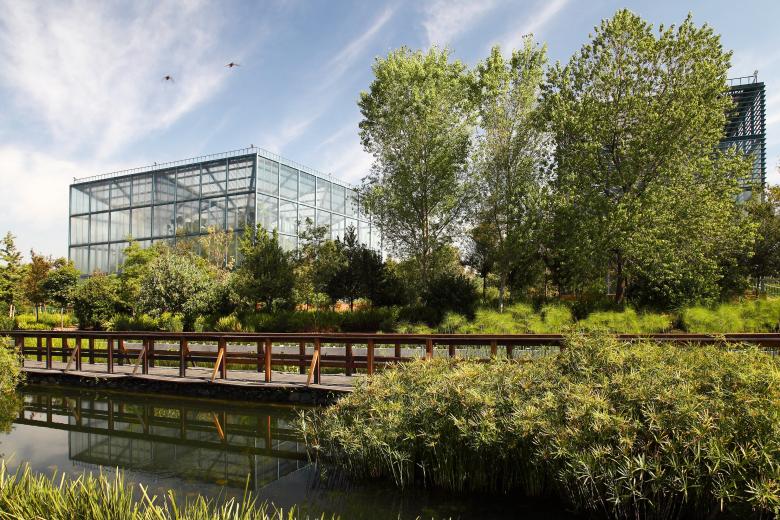
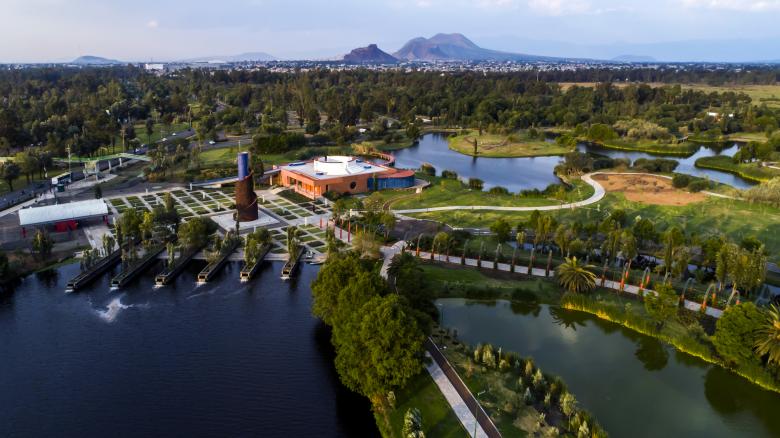
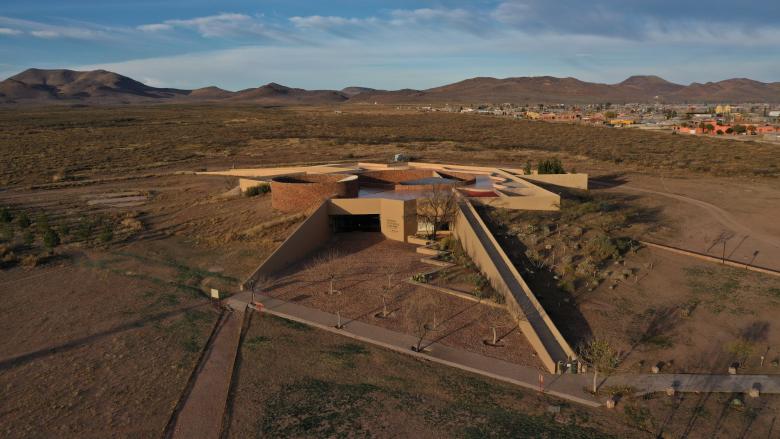
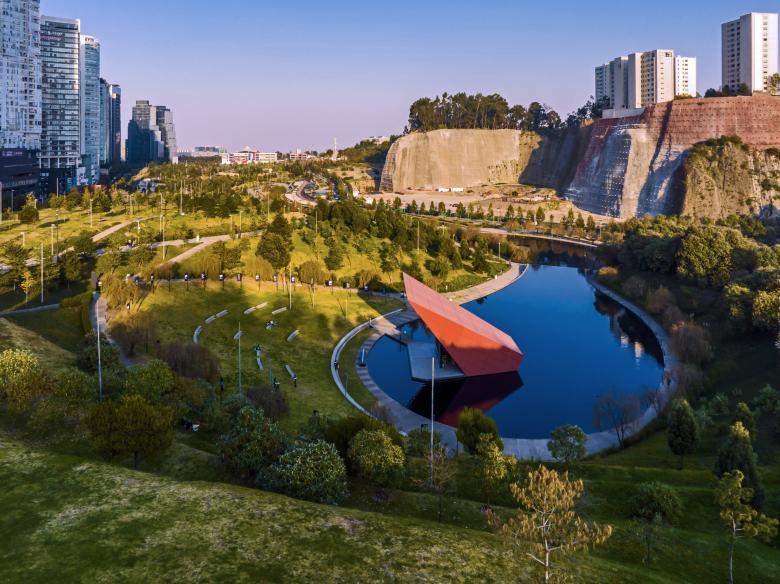
A handful of notable GDU projects are illustrated here and described below, from top to bottom:
- Xochimilco Ecological Park – A 684-acre park with large flower and plant market that is part of a larger cultural landscape, a UNESCO World Heritage Site. The park is distinguished by lagoons and chinampas, an ancient agricultural system of floating, artificial islands.
- Museum of the Northern Cultures, Paquimé – GDU designed both the building and landscape for a “topographical” museum at a pre-Columbian archeological site in northern Mexico, evoking kivas and other archeological remains in the circular forms.
- La Mexicana Park – A former sand and gravel quarry on the perimeter of Mexico City was closed following an earthquake in 1985. Through a public-private partnership, about a third of the site was given over to housing and other projects, with the rest devoted to a public park.
- Bicentennial Park Nature Garden – Comprised of a series of indoor and outdoor botanical gardens representing Mexico's various ecosystems, this project was designed to reverse the hydrological and geological damage inflicted by a former PEMEX oil refinery.
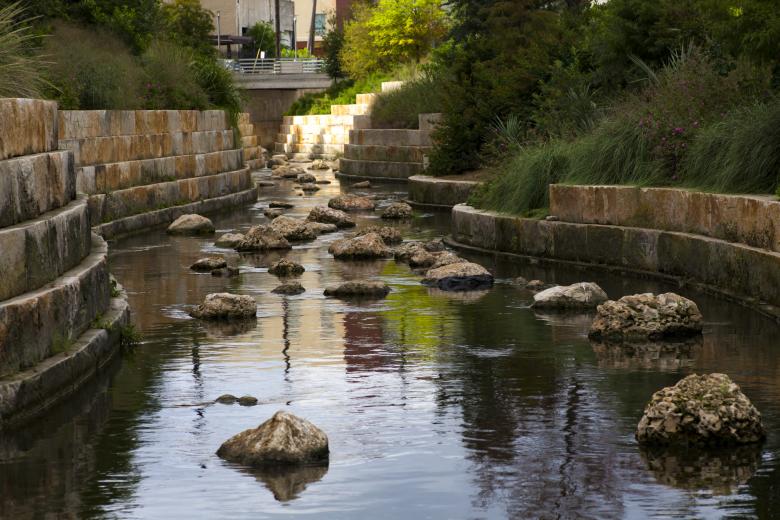
- San Pedro Creek Cultural Park – Located in San Antonio, Texas, this project saw the transformation of a former concrete-lined drainage ditch into a linear park lined
with limestone and flanked by curvilinear walkways, tiled benches, and local artists’ murals that capture the city’s history and historic figures.
Mario Schjetnan and Grupo de Diseño Urbano are the third recipients of TCLF's Cornelia Hahn Oberlander International Landscape Architecture Prize. The inaugural prize, in 2021, was given to Julie Bargmann, founder of D.I.R.T. (Dump It Right There) studio, while the second prize went to Kongjian Yu, founder of Beijing's Turenscape. (Sadly and unexpectedly, the 62-year-old Yu died last month in a plane crash in Brazil.) In addition to $100,000, the prize consists of “two years of public engagement activities focused on the laureate’s work and landscape architecture more broadly.”
- Claire Agre (chair), Partner and Cofounder of Unknown Studio Landscape Architecture & Urban Design, based in Baltimore
- Arthur Adeya, co-founder of Kounkuey Design Initiative (KDI) and Treasurer to the KDI Kenya Board in Nairobi
- Kirsten Bauer, Global Design Director of ASPECT Studios in Melbourne
- Ellen Braae, professor of landscape architecture and urbanism at the University of Copenhagen
- Margarita Jover, Professor of Architecture at Tulane University in New Orleans and co-founder of aldayjover, architecture and landscape in Barcelona
- Sameep Padora, architect and author based in Mumbai
- Dorothy Tang, PhD, a landscape architect and assistant professor in the Department of Architecture at the National University of Singapore
- Elizabeth Mossop (Oberlander Prize curator), Dean of the University of Technology Sydney (UTS) School of Design, Architecture and Building and founding principal of Spackman Mossop & Michaels in Sydney