Periphery as Method: On Architecture’s 'Dispositional Intelligence'
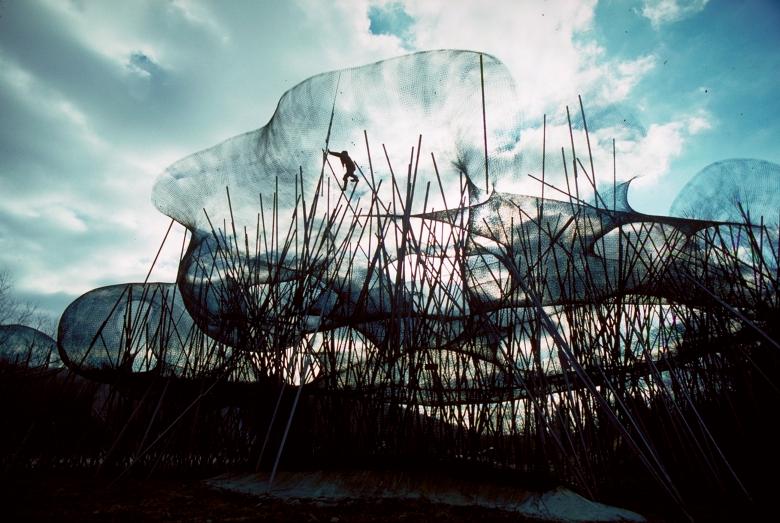
Dispositional Intelligence in Architecture is the third book by architect and educator José Aragüez. Published in 2025, the book follows The Building (2016) and Spatial Infrastructure (2022). In it, Aragüez analyzes the work of three figures whose hybrid architecture-engineering approaches incorporated scientific thinking and offer potential lessons for practice and discourse today. Guiomar Martín, an associate professor at ETSAM Madrid, sent us her in-depth review of Dispositional Intelligence.
As Alan Colquhoun noted in his celebrated essay “Frames to Frameworks” (1977), the 1960s were marked by a tendency to seek the laws of architecture outside architecture itself. From the moment the classical orders came to be seen as arbitrary conventions to the eventual collapse of functionalism as a valid justification for form, architecture had long wrestled with what Rafael Moneo later termed the “phantom of arbitrariness.” In an effort to confront the persistent difficulty of securing lasting legitimacy, the search for external grounds to validate formal decisions acquired particular intensity in the postwar decades, premised on the conviction that architectural authority must rest in domains beyond the designer’s subjectivity. Within this context, nature regained a renewed epistemic supremacy—not as an aesthetic model to be copied and judged by perception, but as a reservoir of generative principles to be deciphered in terms of rules of (trans)formation. Filtered through a pervasive structuralist lens, complex phenomena became legible as the materialization of hidden relational patterns, opening a territory of exploration where scientific procedural rigor intersected—sometimes uneasily—with architecture’s spatial ambitions.
José Aragüez’s Dispositional Intelligence in Architecture positions itself within this episteme by foregrounding three idiosyncratic figures at the periphery of the architectural canon: the Italian Vittorio Giorgini, the Israeli Michaël Burt, and the British–Sri Lankan Cecil Balmond—each situated within what he terms the “architecture-engineering hybrid tradition.” Distinct in their professional and cultural contexts as well as their mindsets—the first closer to that of an artist, the second to that of a geometer, and the third to that of a polymath—these figures refused to play the architectural game from the center while remaining fixated on one of the discipline’s most pivotal and elusive concepts: form. For Aragüez, their work embodies a mode of “subversive disciplinarity”—a calculated assault on architecture’s core from its margins, propelled by a strong, partly unwitting impulse to disentangle form from shape; that is, to distinguish architecture’s underlying spatial order from its perceptible outline and stylistic appearance.
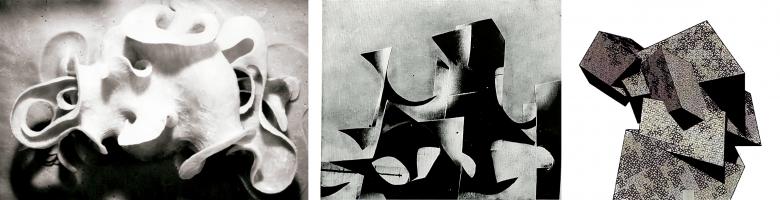
The book unfolds across three chapters, one for each figure, framed by an introduction and a fourth, concluding chapter; the last is self-contained and substantial enough to stand as an independent essay. The introduction provides the historical and conceptual backdrop to the project. It traces the lineage of the architecture-engineering hybrid while critically reviewing earlier conceptions of form, here regarded as a fundamental category in architectural thought. Each of the three subsequent chapters focuses on one of the protagonists through a consistent modus operandi: reconstructing each figure’s intellectual biography by mapping personal relations, references, and latent influences; crafting historiographic genealogies that reach into both distant and recent pasts; scrutinizing heterogeneous archival documents to reveal their theoretical charge; and, finally, testing the conceptual and terminological coherence of these theories by exposing their instabilities and contradictions.
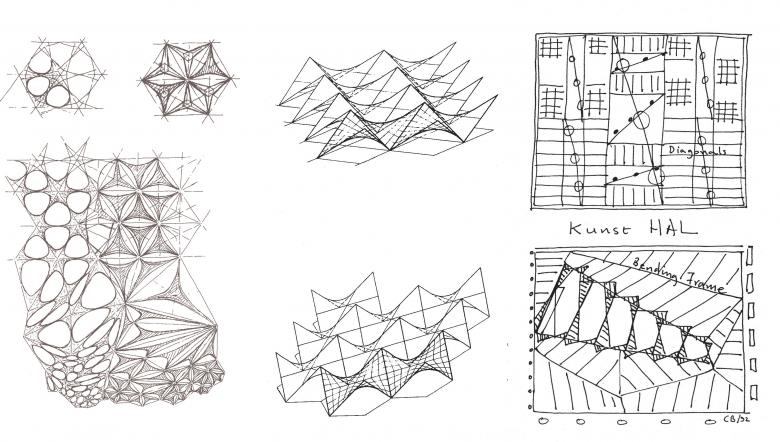
Rather than delivering a verdict on built production—strikingly scarce for Giorgini and Burt, though to a lesser degree with Balmond—each inquiry concludes by probing the dispositional possibilities embedded in the unusual formal universes examined. Whether Giorgini’s topological shells, Burt’s sponge surfaces, or Balmond’s fractal geometries, Aragüez highlights their status as “building embryos” more than their readiness for credible construction. He interprets them as unfinished yet conceptually potent spatial structures—latent arrangements capable of enlarging the field of the architecturally possible. That such potential often went unnoticed or underplayed by the original designers themselves becomes one of the book’s critical wagers—and an implicit challenge to the reader to speculate on how that potential might be successfully realized.
The final chapter distills the lessons drawn from each of the three figures and integrates them into a broader conceptual framework. From Giorgini’s designs emerges the possibility of translating topological thinking into architecture. At once intellectually seductive and operationally risky, this move promises a science-based approach to assessing sameness, singularity, and ultimately invention in spatial organization. The notions of “configurational irreducibility” and “spatial infrastructure” arise out of that move, the latter proposed and developed in a previous book by Aragüez that, in hindsight, comes across as a spin-off of the research behind Dispositional Intelligence. From Burt’s geometric self-absorption, the author extracts a key counter-lesson: for form to be architectural, it must not only possess structural viability but also inhabitability—an intrinsic programmatic charge. Otherwise, it remains mere geometry. This insight yields the idea of the “form-program ensemble,” intended to bypass once and for all the fatigued dualism of form and function. Lastly, Balmond’s work serves chiefly as a platform for staging productive encounters between order and randomness, and for addressing both the criticality and creativity inherent in the reciprocal tensions between process and outcome—here construed through what Aragüez aptly terms “dynamic structuralism.”
By the closing pages, it becomes clear that style is irrelevant to form and belongs instead to the domain of shape. Historically, architecture has engaged far more extensively with variations of shape than with a genuine diversity of forms, the author holds. Interestingly, however, through the notion of “non-referentiality”—introduced in conscious contradistinction to Valerio Olgiati’s related construct—Aragüez adds a further twist, demonstrating that contributions to form can generate singularity at the level of shape.
Although the projects under analysis were conceived primarily from within—their internal logics privileged over external determinants in the generation of form—this is not a plea for “autonomy.” Indeed, autonomy is presented as an impossibility in architecture. While program and load-bearing structure are crucially integrated throughout, to ask about the extent to which, and in what ways, external factors such as context, history, or symbolic and experiential dimensions might mobilize, intersect with, and even give rise to the kind of advanced spatial thinking the book envisions is perhaps too exacting a demand. Another four hundred pages would be needed to persuade us that the enduring schism between autonomy and engagement has been definitively resolved! In any event, to restore form as a central field of inquiry into architecture’s constitutive attributes is—if not without liability—certainly an audacious and timely move at a moment when the subject has become something of a black hole in architectural debate.
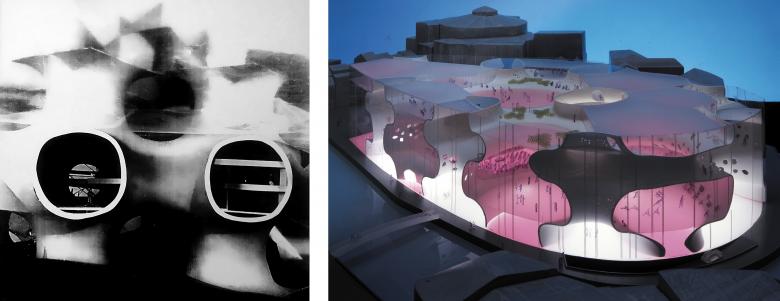
As may be manifest by now, Dispositional Intelligence in Architecture is no easy book. Its descriptive and conceptual density calls for sustained attention, and its technical vocabulary can at times appear knotty. Yet difficulty here is the price of precision: arguments are clarified down to the last detail and supported by an extraordinary graphic apparatus drawn largely from original, unpublished documents. Based on Aragüez’s 2019 doctoral dissertation at Princeton, this volume—expanded and theoretically matured beyond its academic antecedent—reads as the work of a thinker fully fluent in book-length argumentation.
If one final merit deserves emphasis, it is the way history is deployed as a rigorous instrument for theoretical investigation, and the way theory, sharpened by historical grounding, reciprocates. Overshadowed by postmodernist, deconstructivist, and high-tech biases, among others, the three trajectories retrieved in this book delineate a territory that never completely consolidated within architectural history, their schemes suspended like seeds in dormancy. To suggest that such seeds might germinate anew in contemporary thought is, as the author acknowledges, an explicit appeal to Sanford Kwinter’s “radical anamnesis.” At the same time, the project can be viewed as a provocation to revisit the idea of “operative history”—long declared exhausted yet enduring in its reminder of the indivisible bond between theory and practice in architecture. For Aragüez’s discursive recovery of an alternate history does not merely look back; it aims to resonate with the contingencies of present-day architectural production by stimulating new avenues for spatial creativity at the intersection of rationality and imagination. How that agenda might be comprehensively carried out and materialized in contemporary practice remains a question that the book, for all its conclusive texture, pointedly leaves in the reader’s hands.
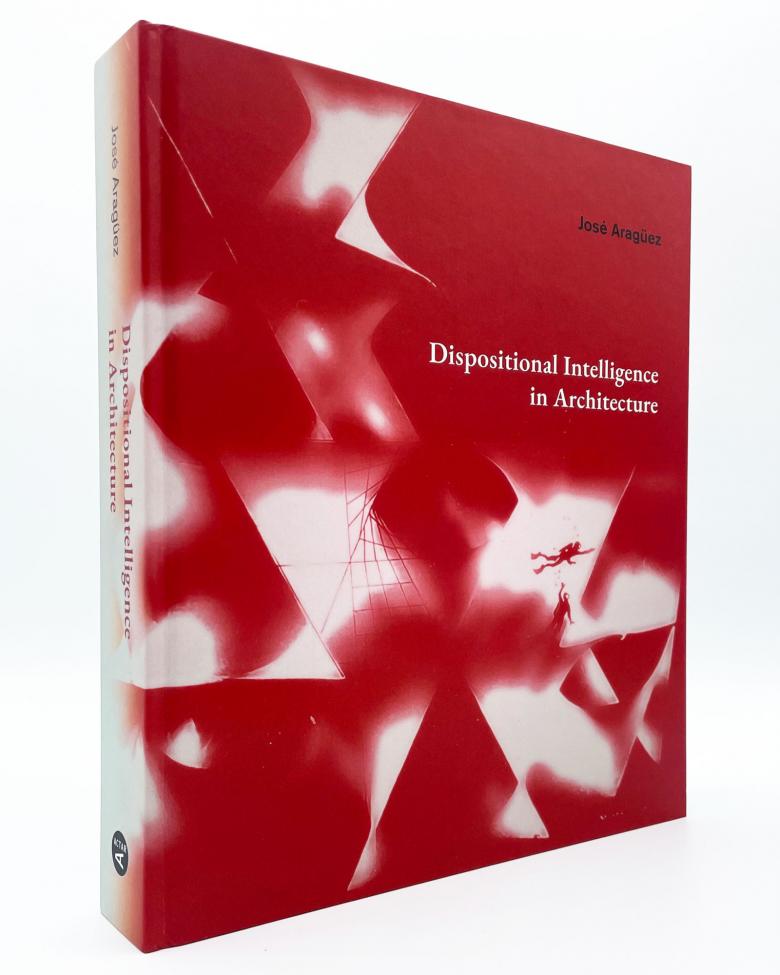

Dispositional Intelligence in Architecture
José Aragüez
19.5 x 23.8 cm
400 Pages
Hardcover
ISBN 9781638401322
Actar
Achat