The OBEL Award, the annual prize founded by the Henrik Frode Obel Foundation in 2019 to honor architectural contributions to human development all over the world, has announced the focus of its eighth cycle: “Systems' Hack.”
In awards that carry a hefty money prize equal or greater to the 100,000 euro OBEL Award—including the Pritzker Prize, the Oberlander Prize, and the Driehaus Prize—the winner is usually selected for a body of work, for the quality of buildings or landscapes they have created over usually lengthy careers. The OBEL Award sets itself apart from the rest by having the jury determine a focus that the “scouting committee” then bases its submissions on, and from which the jury later decides the winner. This focus-based process helps to make the award timely and relevant in regard to contemporary crises; it expands the role of the jury compared to other awards; and it opens the award to a wide spectrum of creations, from buildings and landscapes to technologies, urban concepts, and even political initiatives. This last point is evident in the seven previous winners:
- 2025: Ready-Made — HouseEurope! initiated by bplus.xyz and station.plus
- 2024: Architectures with — 36x36 by Colectivo C733
- 2023: Adaptation — Living Breakwaters by SCAPE Studio
- 2022: Emissions — Seratech’s solution for zero-emissions concrete
- 2021: Cities — The 15-minute city as defined by Professor Carlos Moreno
- 2020: Mending — Anandaloy by Anna Heringer
- 2019: Well-being — Art Biotop Water Garden by Junya Ishigami & Associates
The 2026 OBEL Award focus, as determined by the jury chaired by MVRDV co-founder Nathalie de Vries, is Systems' Hack. This focus “asks how architecture can move beyond conventional problem-solving and instead intervene in the very systems on which society and nature depend.” As further articulated in today's statement from the OBEL Award, “The theme asks whether architecture can become an active part of ecological and social systems, operate within planetary boundaries, and help reshape the networks of production, governance and influence it relies on.”
“Nearly half the buildings that will exist in 2050 have not been built yet. The built environment shapes behaviors, resources, and power relations for decades, effectively locking in futures at a moment when existing systems are already under strain. As infrastructures, housing models, and governance frameworks begin to fracture, the critical question is no longer whether systems will fail, but whether architectures, in all its plurality, chooses to intervene proactively or remains reactive, reinforcing the very conditions driving collapse. Addressing systems in this year’s theme allows us to draw on a collective intelligence.”
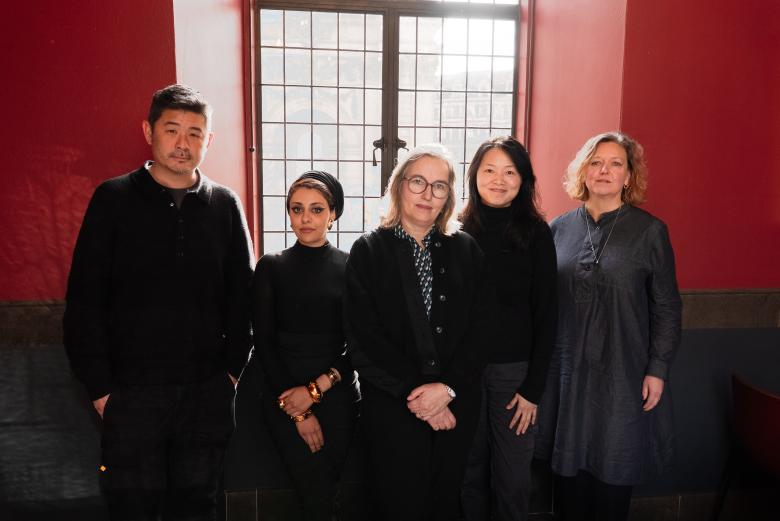
Next, the anonymous scouting committee will submit projects for the jury to assess in relation to the year’s current theme, and the jury will meet later in the year determine the winner, which will be announced in May. Accompanying Nathalie de Vries on the jury at the time Systems' Hack was set as the 2026 focus are Aric Chen (Nieuwe Instituut), Anne Marie Galmstrup of Galmstrup Architects), Xu Tiantian (DnA), and Sumayya Vally (Counterspace).