Spiral Celebrates 40 Years
All photos by Neoplus Sixten Inc.
To celebrate the 40th anniversary of the Spiral building and the 60th anniversary of its architect, Maki and Associates, the cultural center in Tokyo's Aoyama neighborhood is exhibiting Maki Fumihiko and Spiral – A Place Where Art Lives for the first two weeks of October. The Japan-Architects curators visited and took some photographs.
The late Fumihiko Maki (1928–2024) was commissioned to design what was then called the Wacoal Art Center in 1982, giving the Wacoal Corporation, a manufacturer of women's lingerie, a place to hold art exhibitions and other corporate-sponsored cultural activities. The building itself was also meant to be a work of art. Maki's design expresses the various components of the building on its street facade—it includes a café, shops, restaurant, theater, roof garden, and other uses in addition to exhibition spaces—while the naturally lit semicircular space with ramp at the rear of the building lends it the Spiral monicker. The building opened to the public in October 1985, so the Wacoal Corporation, which still owns and operates the building, decided to mount an exhibition of drawings and other documents from Maki and Associates in the building's first-floor gallery exactly forty years later.
Photographs by Neoplus Sixten Inc. are below, accompanied by captions with more information on the building and exhibition. Be sure to visit the original post to see many more photos of Maki Fumihiko and Spiral – A Place Where Art Lives.

Writing in early 1985 when the building was nearing completion, Maki described the street facade as “a collage, arranged in a spiral, of early twentieth-century architectural iconography.” Outside of its now taller neighbor on the right, the glass and aluminum Spiral looks very much like it did when it opened in 1985.
Visitors enter the building beneath the stepped Esplanade that ascends over the parking ramp, leads to the upper floors, and brings some activity from the interior toward the street.
Once inside, visitors see directly through the lobby and café to the spiral ramp at the rear of the building. The steps at right lead to the exhibition as well as the Esplanade.
Maki's design of the facade as a collage is quite literal, as displayed in an early concept sketch that incorporates grid paper, photos of ancient and modern architecture, and artworks.
Large-scale photographs and views of the ramp draw visitors toward the semicircular space at the rear of the building.
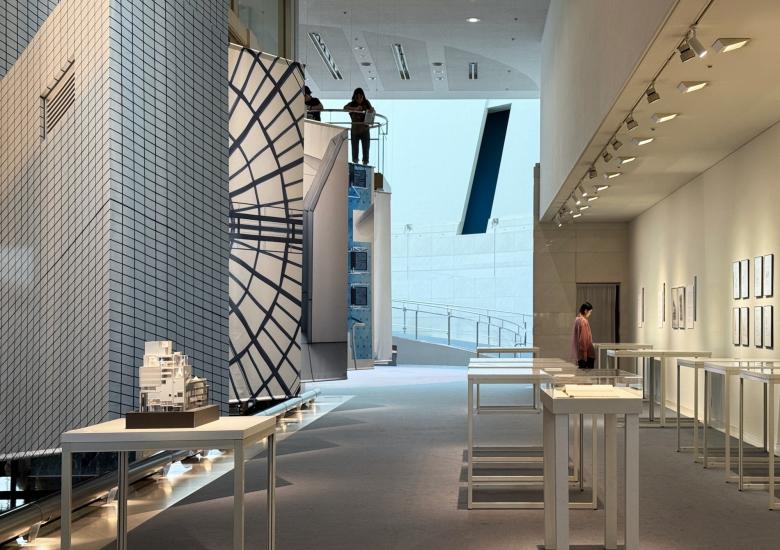
Most of the exhibition consists of drawings, but there is one model on display. In addition to expressing the main facade and its zoning-determined setbacks, the model accentuates the depth of the building on the lower floors, a result of a 20m height restriction at the rear of the lot.
The drawings on display range from concept sketches to ink-on-mylar working drawings.
The quality of the ink drawings from the 1980s is so impressive they resemble printouts of CAD files.
The three-story spiral atrium has been left empty for the exhibition, letting the architecture be the art itself.
The space has been the setting for many works, some of them site-specific. In November 2016, the atrium featured an artwork by Emmanuelle Moureaux, 100 colors no.17 “color mixing,” as part of the exhibition SENSE OF MOTION.
Looking back to the street from the semicircular space, one sees the café and gallery (left) on the first floor and the stores on the second floor. Above the ceiling is the double-height theater on floors three and four.
The top of the ramp just out slightly …
… to give a bird's eye view of the double-height gallery. The steps at the far end of the gallery lead to the Esplanade, where the exhibition continues, and which was visible from the sidewalk.
By leading up the second floor, the Esplanade (here seen with the gallery in at right) functions like the spiral space but with intermittent steps rather than a gentle ramp.
Fittingly, Maki's perspective drawings of the Esplanade are displayed in the space …
… allowing visitors to appreciate how the design moved from rendering to reality.
The Esplanade is a public space where people can sit and take in the activity of Aoyama. It is also a fitting spot to conclude the exhibition celebrating the building's 40th anniversary and Maki and Associates' 60th anniversary.