House in Matsue

Seven Gardens in Dialogue with the Site Environment
Matsue is a castle town that developed around Matsue Castle, and even today its streets retain a strong sense of historical character. The city is also surrounded by diverse waterfronts—such as Lake Shinji, Nakaumi Lagoon, and a network of canals—giving it the qualities of a water-oriented city. The site is located near what was once the outer moat of the Matsue castle town, in an area where the historical parceling of the castle town remains clearly legible.
Long and narrow in the east–west direction, the site has a depth of approximately 60 meters and a frontage of about 15 meters. Compared to the typical three-ken-wide frontage of a Kyoto machiya, it has roughly three times the width, and could be described as a “large eel’s bed,” so to speak. While the center of Matsue was originally composed of generously sized plots, recent years have seen increasing subdivision and densification of housing. This site, too, is surrounded by houses and offices, making it necessary to carefully read and respond to the surrounding context.
We first examined the positions of neighboring gardens and vacant lots, and studied a layout in which gardens could be arranged to share light and airflow with adjacent properties. Traditional machiya made use of their narrow frontage and deep plots by arranging spaces such as mise-no-niwa (front gardens), tooriniwa (passage gardens), tsuboniwa (courtyard gardens), and oku-niwa (rear gardens) in sequence, ingeniously drawing natural light and wind into the interior. Following this precedent, the present project disperses seven gardens—from the alley garden to the east garden—along the edges of the site, aligned with open spaces on neighboring lots.
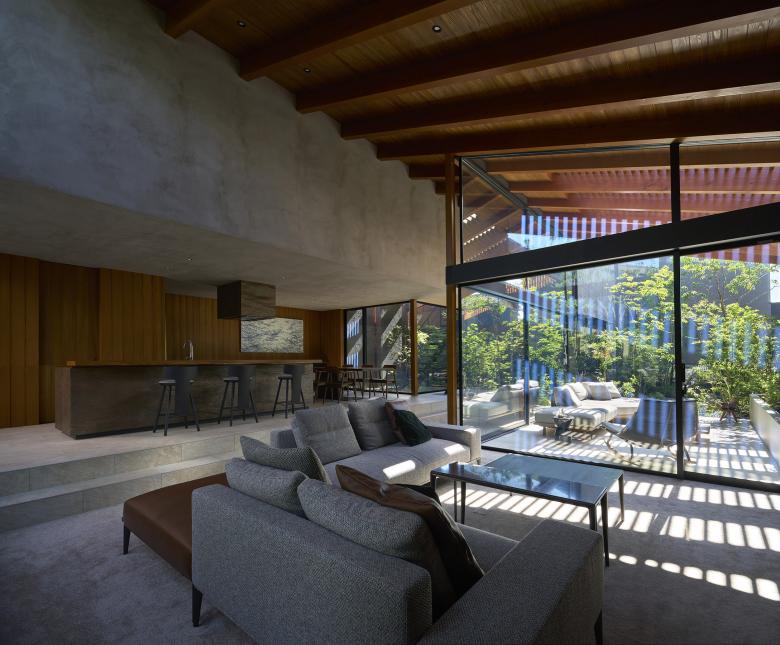
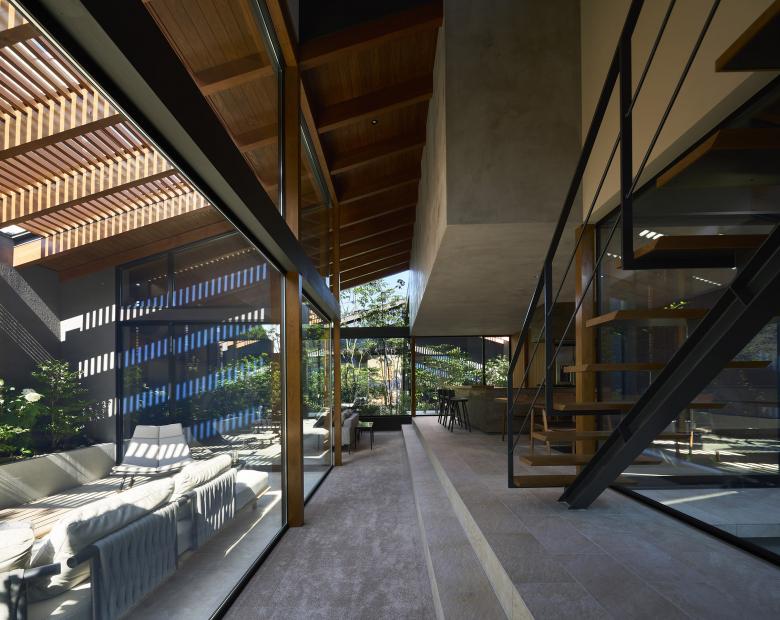
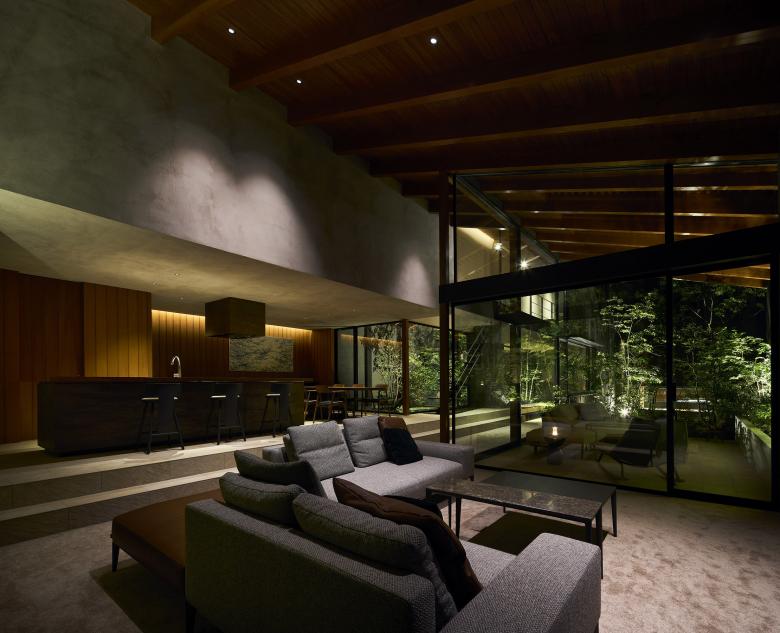
Each of the seven gardens is closely related to adjacent interior spaces and fulfills a distinct role depending on its location. The larger central courtyard and south garden accommodate an outdoor dining area and an outdoor living space, creating a gradational continuity between interior, intermediate, and exterior zones that lends depth to the overall spatial experience. Louvers softly filter views from the surroundings and mitigate direct sunlight, ensuring a comfortable outdoor environment.
The north garden, rear garden, and east garden bring light into the interior and are designed primarily for visual enjoyment, while the alley garden near the entrance and the west garden contribute to the richness of the streetscape. Each garden is planted with a variety of flowers that bloom throughout the seasons, offering changing colors over the course of the year. These garden scenes can be glimpsed from all living spaces, functioning as devices that incorporate the rhythms of nature into everyday life.
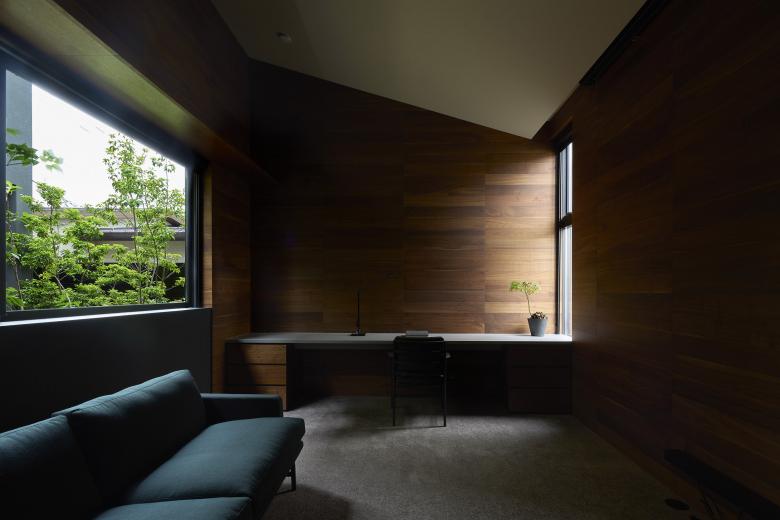
Circulation between rooms was planned with intentionally subdued brightness, creating a contrast with the gardens. The corridor leading from the entrance hall to the living room passes through a dimly lit space illuminated only by low windows, so that the light of the garden ahead is perceived with greater intensity. Similarly, the corridor leading to the study is designed with low windows, aiming for a quiet, cloister-like passage where natural light gently penetrates the darkness.
In traditional machiya, gardens may not have served merely to bring light and wind into the plot, but also to pass them on to the surroundings. On sites like this one—deep and enclosed by many neighboring buildings—we believe it is essential to view the environment from a broader perspective and to reflect relationships with the surrounding context as an integral part of the design.










- Année
- 2024
- Statut du projet+
- Construit