Tonhain
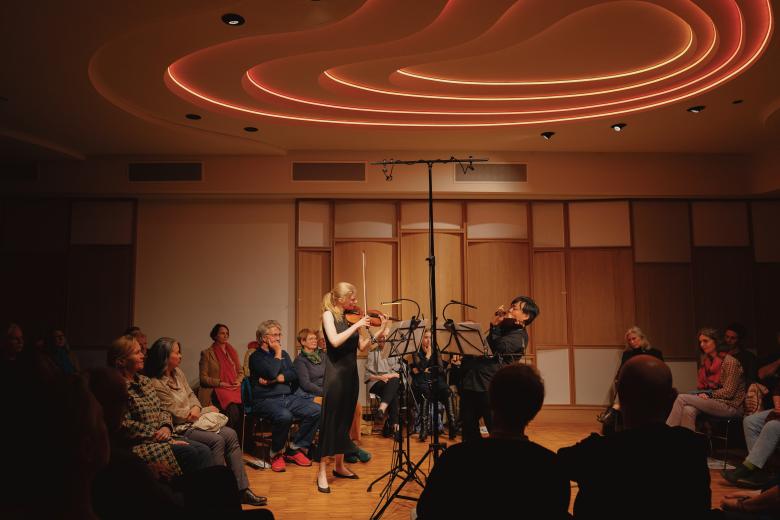
Tonhain: an immersive, identity-defining lighting concept for a music studio in Berlin
Studio De Schutter develops an atmospheric, highly flexible lighting concept for chamber music, recording, and interdisciplinary formats.
With Tonhain, a new intimate venue for chamber music and professional audio recording emerges in Berlin – a hybrid studio concept that connects future and history. Where the “Thorwaldsen-Lichtspiele” once screened films and later housed a sacred space, a concert hall with a state-of-the-art recording studio and seating for up to 99 guests now defines the space.
Studio De Schutter was commissioned to develop an immersive and flexible lighting concept that responds to the specific spatial and acoustic requirements and plays a defining role in shaping Tonhain’s visual identity.
Tonhain brings together professional audio recording, chamber music concerts, masterclasses, rehearsals, and multimedia formats within a single space.
The client brief defined clear ambitions: modern, smart, flexible, distinctive, experimental, and with strong recognizability.
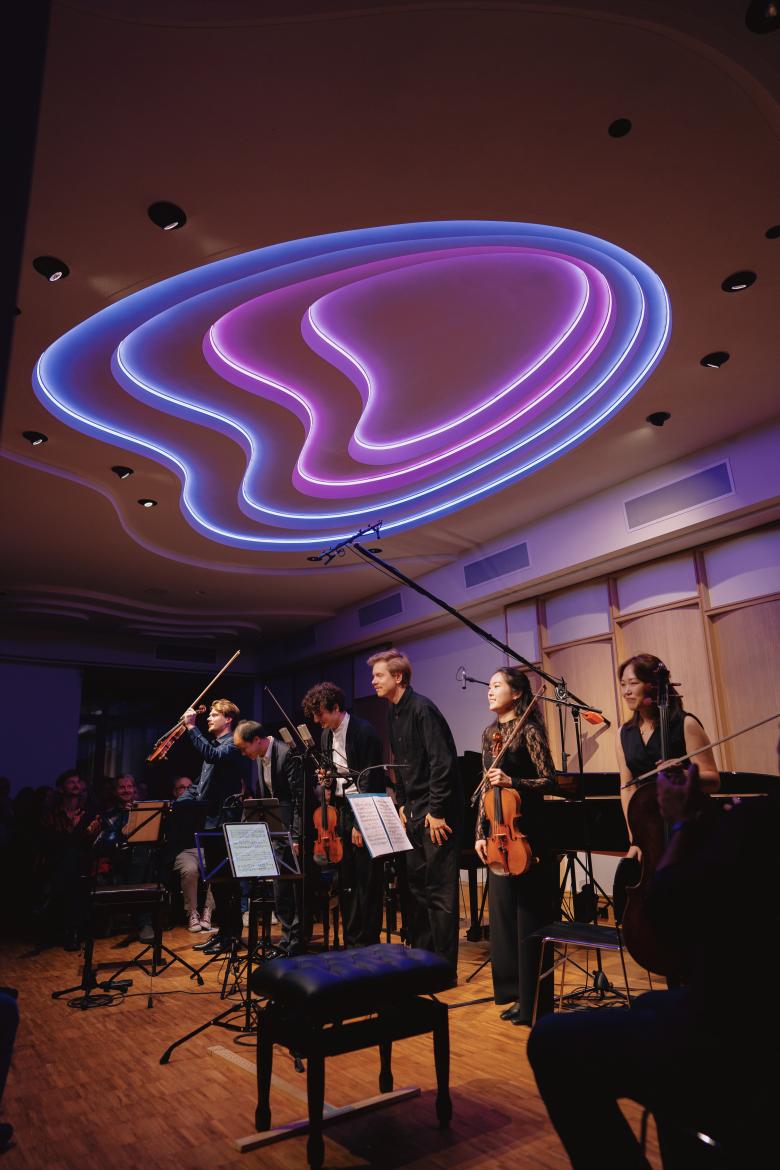
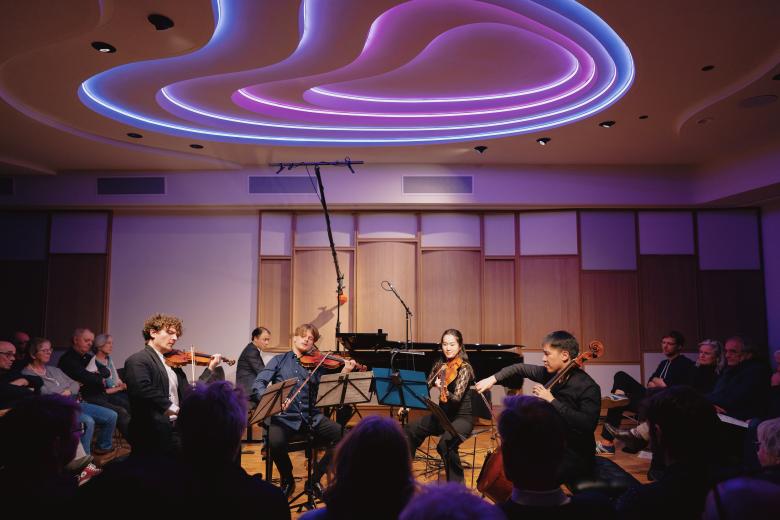
The lighting concept translates this vision into a visual language: the spaces appear warm and atmospheric, yet technically precise and calm. Light staging, ceiling topography, and acoustic performance interact to create a distinctive and recognizable identity.
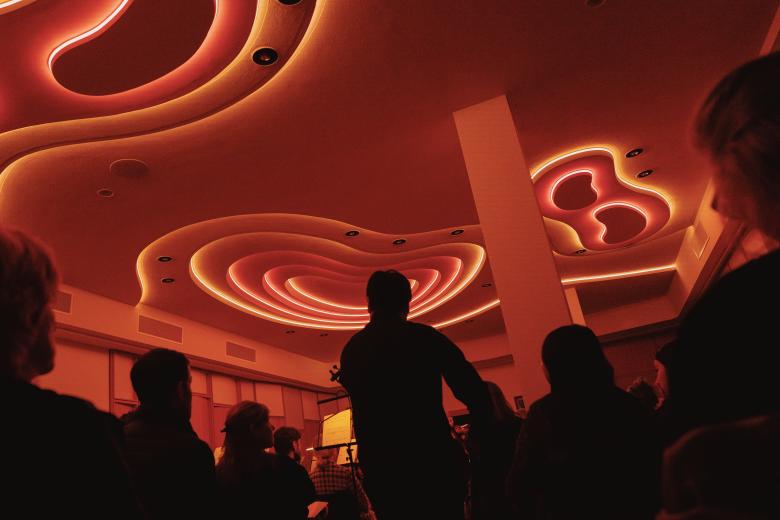
The acoustic ceiling, developed by Tietz & Tietz – Architecture & Design, defines the space. Its organic geometry – a recessed “lake” flanked by two “mountains” – functions both as an acoustic instrument and as a spatial narrative.
This topographical structure defines the conditions for the lighting. Architecture, acoustics, and illumination were conceived together from the outset and tested in a full-scale mock-up. The result is not an additive intervention, but an integrated system in which light becomes part of the architectural logic.
The space requires a high degree of adaptability. Different stage positions, changing formats, and variable ensembles demand a lighting system that can respond precisely to each situation – without visibly intervening in the space.
The solution follows a clear principle: maximum effect with minimal presence. By integrating movable light points into the architecture, conventional stage lighting could be omitted and the number of luminaires reduced.
Combined with precise control, this results in a system that intuitively adapts to different uses while remaining unobtrusive.
The atmospheric layer is created through the integration of lighting into the architecture. Light merges with the space: it reinforces the architectural idea without drawing attention to itself and makes the depth of the space perceptible.
Beyond its spatial quality, sustainability plays a central role in all projects by Studio De Schutter. Replaceable components, energy-efficient technologies, and a reduced level of intervention ensure long-term usability.
The system’s high flexibility enables different scenarios without structural modifications – making adaptability an integral part of the design.
- Any
- 2025
- Estat del projecte
- Construït