Interview with Marta Vall-llossera
An Optimistic President in Search of Consensus
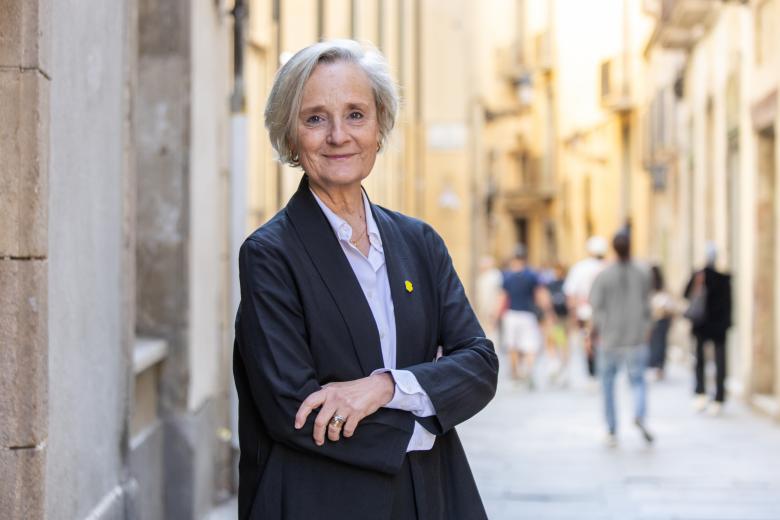
Last month, in Barcelona’s Gothic Quarter, Madeline Beach Carey spoke with Marta Vall-llossera, President of the Higher Council of the Colleges of Architects of Spain (CSCAE), a role she has held since February 2022 and the unexpected passing of then CSCAE president Lluís Comerón.
Marta Vall-llossera Ferran trained at the Barcelona School of Architecture (ETSAB) and has extensive experience in independent professional practice in Spain and Latin America. In 2015, she became dean of the Official College of Architects of the Balearic Islands, a role she combined between 2018 and 2022 with that of First Vice President of the CSCAE. A new electoral process upon Comerón’s death concluded with Vall-llossera’s victory. Since then, she has assumed the Presidency of the CSCAE.
Their conversation has been edited lightly for length and clarity.
Marta Vall-Ilossera Ferran: It’s interesting, because from a very young age I was clear about architecture. I never considered any other option; I never had doubts about another profession. I can’t really tell you exactly why, it's true that I liked observing, I liked drawing, I liked the idea of spaces.
But I can’t pinpoint the exact moment; it was something that gradually settled, and when the time came to make decisions, I didn’t really make one because it was already there. I’ve enjoyed the profession very much.
It was almost destiny!
Within the areas I’ve worked in the most, which have always been small-scale projects, even a lot of interior design, I’ve also collaborated in product design. And the truth is I’ve always liked it, really enjoyed it a lot.
It’s a beautiful profession, not without its difficulties—because they do exist, and professional practice has become much more complex—but it is still a profession with a future.
Many of the changes we are going through will involve changes in architecture and urban planning, so architects will continue to play a key role in this transformation process, with many new professional opportunities. And I think that the kind of training that combines a more humanistic side with a technical one is more important than ever in the face of the changes ahead.
We’re talking about new technologies, artificial intelligence, industrialized construction. We must continue to play a key role to avoid homogenization and globalization, and to preserve that creative aspect that sets us apart. The tools may be the same for everyone, but the difference will come from architects and our creative capacity.
So overall, a positive outlook—I encourage young people to continue pursuing this profession.
A certain balance emerged between the profession and society. It was a time when we were moving into a new democratic phase, with a much more open and participatory approach from people. The change was very significant and, in a way, also exciting, because in all processes of change, enthusiasm plays a big role.
Another important factor is the training, which has always integrated both building and urban planning. These have gone hand in hand in architectural education, and that helped a lot in a process that required consensus. There was a need for immediate changes, but also for medium- and long-term planning.
The agreements that were reached, and the role of the profession, allowed architects to act almost as a hinge—between a public administration eager to implement new ways of working and the training we could provide. I think this created very positive synergies that made all these changes possible.
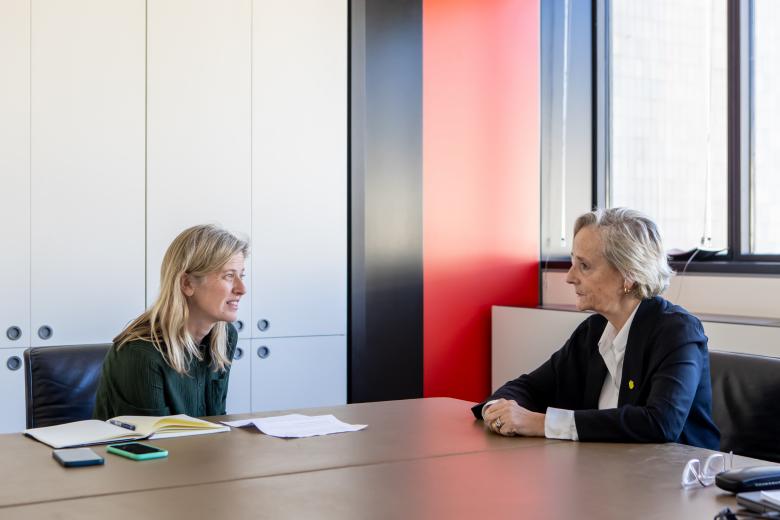
Yes, I think it has to be approached positively, with optimism. Applying sustainability criteria to what we do is crucial because we know buildings and cities are responsible for a large share of energy consumption and greenhouse gas emissions.
It obliges us to become aware and to do things differently. It’s no longer optional; it’s a responsibility for all of us to work in that direction. It directly affects us, and new European directives with very ambitious goals are pushing us along this path. The new energy efficiency directive for buildings will force us to conceive buildings differently and incorporate these criteria from the earliest stages of a project.
But we also have to consider many factors—materials, the resources used to produce them, how they are implemented, the entire construction process, and the full life cycle of the building, even through to demolition and the reuse and recycling of materials.
The entire life cycle of a building.
The entire life cycle—so it’s a completely different way of understanding things. And we’re not only talking about new construction, but also about renovation and the regeneration of neighborhoods. This is one of the key areas where public administrations need to help drive progress, because we have a very old building stock, much of it built before any such regulations existed.
We’re late, but we have to keep working. And this carries significant weight at an international congress, because these are measures that need to be carried out collectively, with policies that are as harmonized as possible across countries.
It’s very complex. There is a clear emergency in terms of housing shortages and access difficulties. The problem is extremely complex, with many dimensions and factors involved.
At the Council, we’ve been working on this for some time. In 2022, a housing forum was organized by the UIA, where significant work was done to identify the barriers to housing access. It’s a multifaceted issue.
In Spain, planning is very complex; many plans are stalled for years over relatively minor issues. There is also a “land” law that has not gained sufficient consensus to be approved, even though there is awareness of its necessity.
We need stable measures over time, especially medium- and long-term strategies. We are at a critical moment, and the urgency requires extraordinary measures. Through the 2030 Observatory, the Council is working on housing and has published a set of proposed measures. They are not immediate or easy solutions, but they represent possible paths forward.
Another area we believe needs attention is territorial balance. Providing infrastructure in certain areas could help relieve pressure elsewhere. There is a lot to be done, but above all, we need a medium- and long-term perspective.
It will be a very intense few days that will generate a wealth of valuable content. We need to capture that legacy and use it as a foundation for continued work.
A catalog is already planned and that will include all the presentations, available during the Congress, along with a digital version that will include the open call contributions and the content developed during the event.
This should serve as a basis for different countries and councils to build upon, adapting and expanding the research according to their own contexts.
The organization is very complex because this is a unique, very ambitious Congress, with multiple venues and a format that includes not only keynote lectures but also debates with opposing viewpoints, which will enrich the discussion.
It involves the International Union of Architects, the Council, which represents all Spanish colleges of architects, and especially the COAC (Architects’ Association of Catalonia), with whom we have worked closely. There’s also the curatorial team selected through an international ideas competition, which was something new.
The logistics are immense, and we’ve had an incredible team whose dedication has been outstanding. But I would especially highlight the commitment of the three public administrations from the very beginning.
From the moment the candidacy was presented in 2019—so we’re talking about many years—this has been a shared effort based on consensus. Each administration has contributed within its scope, and I truly believe it is a fantastic example of full and effective collaboration among all three.