SmithGroup's Philip Merrill Environmental Center
25-Year Award to First Ever LEED Platinum Building
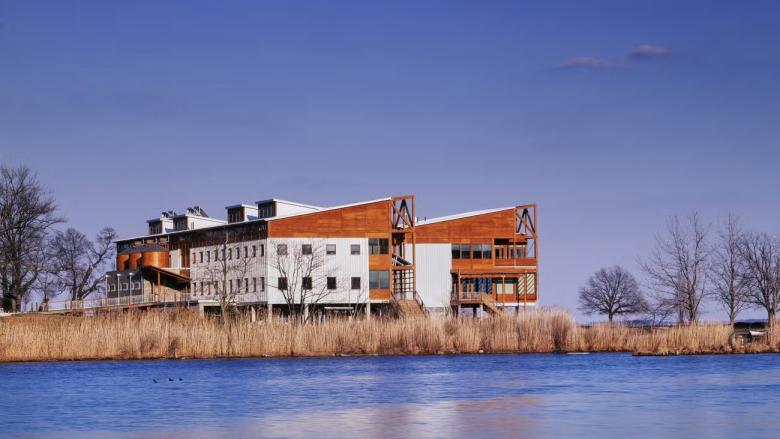
As announced at the annual AIA Conference on Architecture in San Diego, SmithGroup's Philip Merrill Environmental Center—completed in Annapolis, Maryland, in 2000 and notably the world’s first LEED Platinum building—is the 2026 recipient of the American Institute of Architect's Twenty-five Year Award.
After many years of the now biennial Twenty-five Year Award being given to iconic works of architecture outside of the United States—including the Louvre Pyramid in 2017, the Sainsbury Wing in 2019, the Guggenheim Museum Bilbao in 2023, and the Tokyo International Forum in 2024—or not being awarded at all, the AIA is acknowledging the shift to sustainable architecture that took place in architectural practice around the turn of the century. The Philip Merrill Environmental Center, designed by SmithGroup for the Chesapeake Bay Foundation, is notable as the first building to be certified LEED Platinum, the highest designation of the US Green Building Council's Leadership in Energy and Environmental Design program. The Foundation asserts that its building uses 50% less energy than a comparable office building and 80% less water than a conventional building.
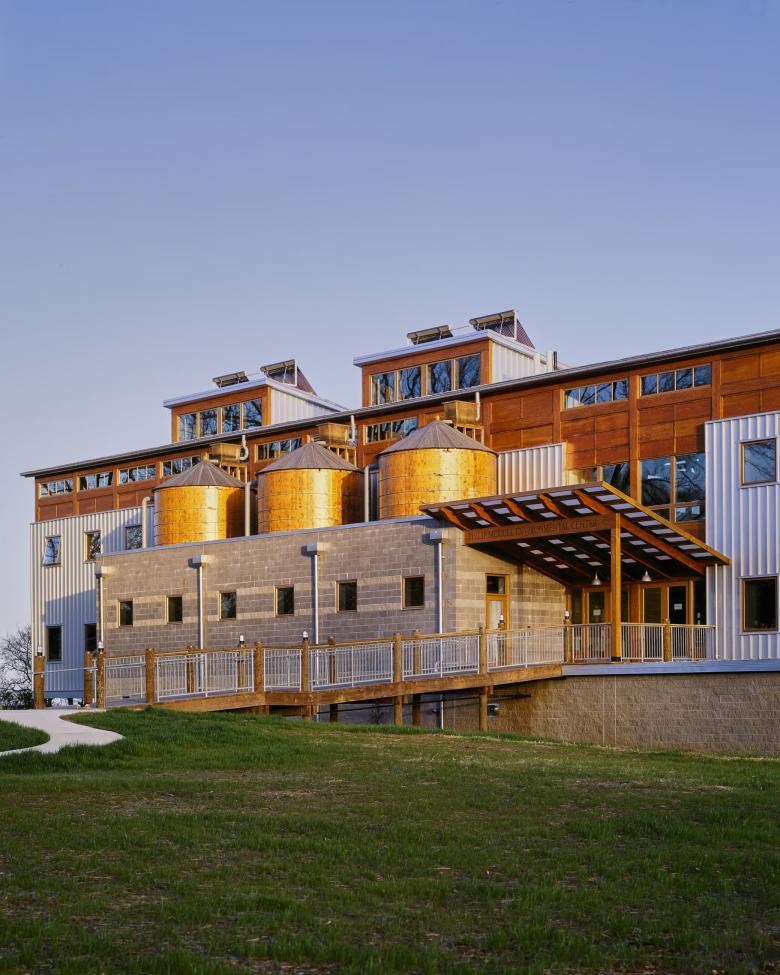
The Philip Merrill Environmental Center, the headquarters for the Chesapeake Bay Foundation, is a deeply sustainable building that incorporates numerous passive strategies, restores the ecology of its site, and employs a number of innovative but now standard green building features. The 32,000-square-foot building sits on a 31-acre waterfront site along the Chesapeake Bay. The building takes on a narrow, elongated form to maximize daylight and take advantage of prevailing breezes. Following from this, passive strategies include daylighting, solar shading, and cross ventilation—the last finding air movement “driven through a combination of low inlet openings and higher outlet vents,” per a statement from the AIA, “enabling effective natural ventilation throughout the interior spaces.”
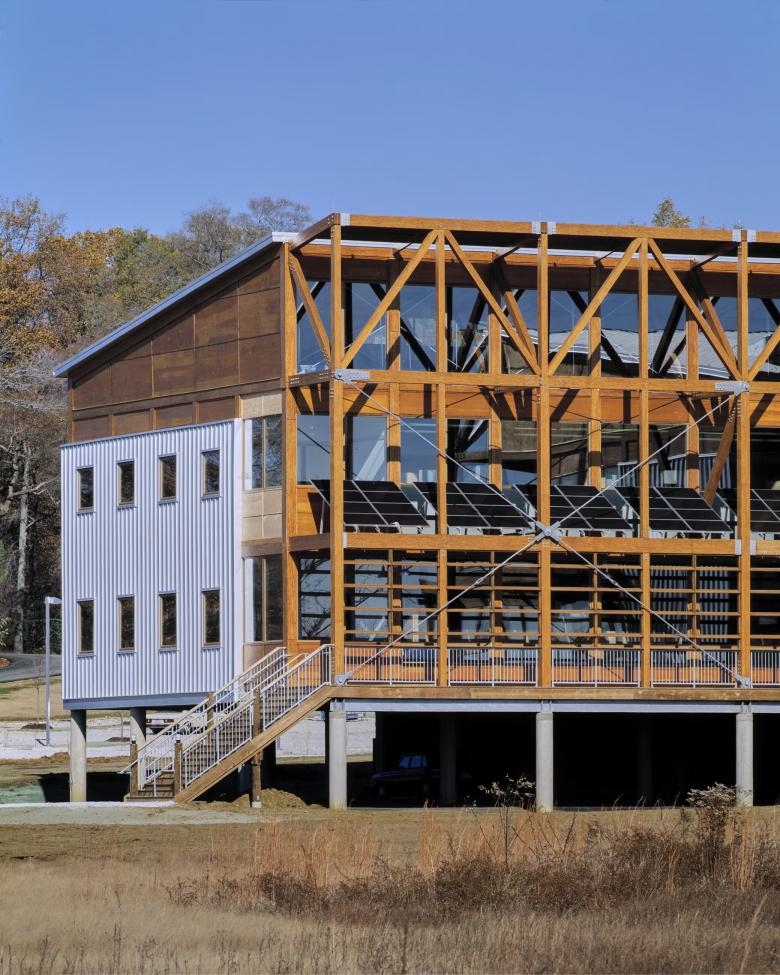
Innovations in materials and systems are too many to list. The structure is comprised of mass timber and structurally insulated panels. Finishes include bamboo flooring and reclaimed wood. The sunshades incorporate photovoltaic panels, and geothermal wells provide heating and cooling. Given the waterfront site, rainwater harvesting is integral (expressed in large cisterns for collecting and storing water for reuse, as seen above) as is on-site water management via composting toilets and other technologies. Site-wise, the project returned most of the previously developed site to nature, including wetlands, meadows, and shoreline habitats. The building itself sits on and reuses the foundation from an old pool and incorporates parking into its lower level to minimize surface parking.
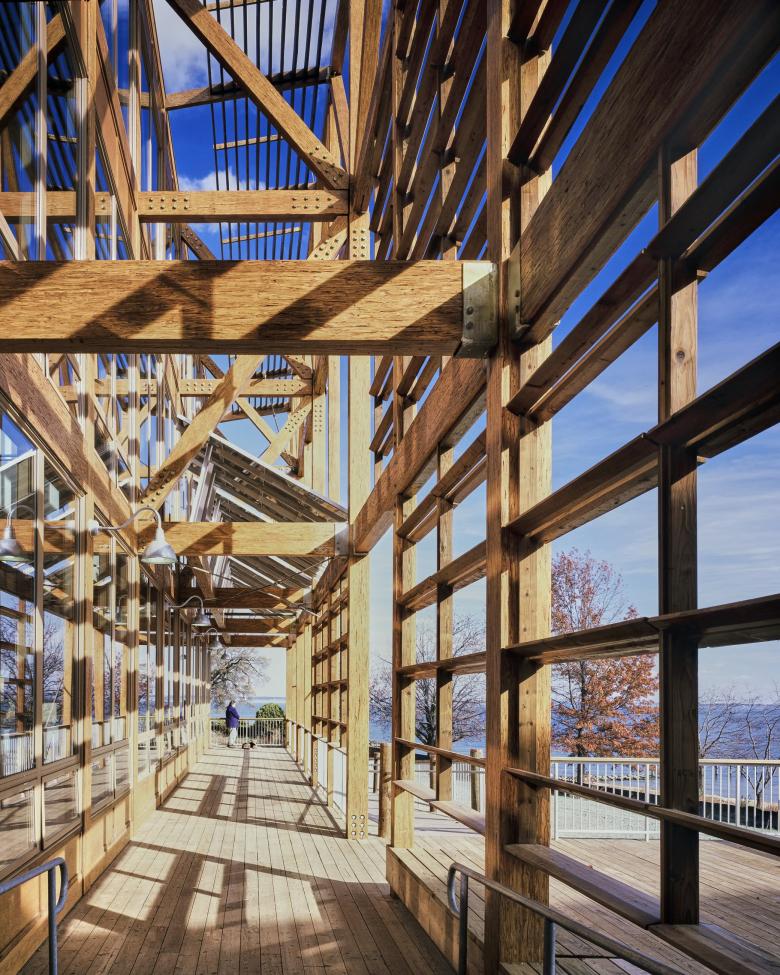
What about the building today, 25 years after it opened and was certified LEED Platinum? An article in Architect magazine on the building's 10th anniversary expounded the many benefits of the design of the office environment, though it also pointed out the difficulties the workers had in moving from private offices to shared open space and highlighted some issues with the mass timber, particularly the members exposed to the elements. Regardless of the fact the exterior mass timber framing had to be replaced and involved a lawsuit that dragged out until 2015, the AIA's Twenty-five Year Award statement says “the Merrill Center has proven both durable and adaptable.” The open office environment has been particularly flexible, meaning changes require minimal adaptations, while the PV technology has been upgraded with advances over time, and the sharing of operational data has allowed the building to inform subsequent sustainable design.
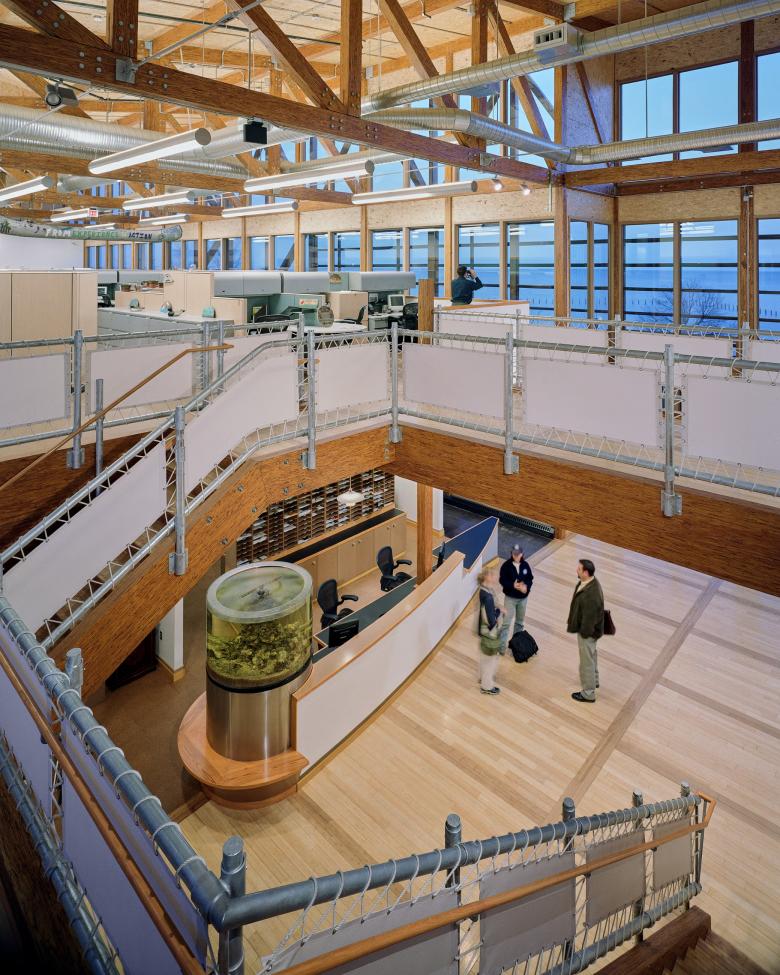
The willingness of the Chesapeake Bay Foundation to open the building to students, professionals, and community members since opening in 2001 has turned the building's environmental features into a learning tool. As summarized by the AIA, “Today, the Philip Merrill Environmental Center stands as a touchstone for the profession. Its legacy lies not only in its early adoption of sustainable strategies but in its enduring influence—proving that architecture, when guided by ecological principles and human values, can serve as a catalyst for lasting environmental and social change.”