Refined But Hardly Revised
Commission of Fine Arts Gives Final Approval for Trump's Triumphal Arch
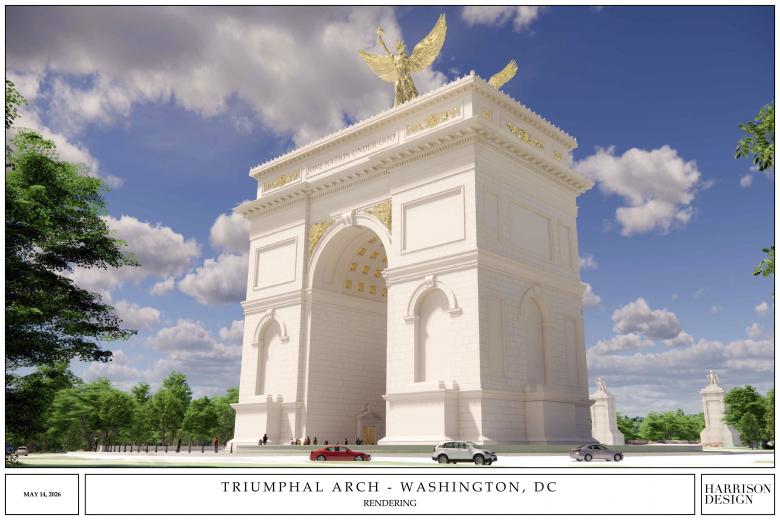
One month after giving it preliminary approval with requests for revisions, the Commission of Fine Arts granted final approval for US President Donald Trump's 250-foot-tall arch proposed for Memorial Circle near Arlington National Cemetery—with most of the requests ignored by Trump and his architect.
Did anyone expect major changes to Trump's triumphal arch based on last month's input of the Commission of Fine Arts (CFA), a group of loyalists the president appointed after the start of his second, non-consecutive term as president? After all, Trump bulldozed the East Wing of the White House without any approval from Congress for its replacement, much less for its demolition. Would the same president remove rooftop sculptures from atop his proposed arch—the same sculptures that bring its height to 250 feet, aligned with the US semiquincentennial this year? The answer, revealed last week in the CFA's second review of the triumphal arch, is no: the rooftop sculptures remain, as do other features the commission wanted revised. But the CFA unanimously approved the design by Harrison Design anyways.
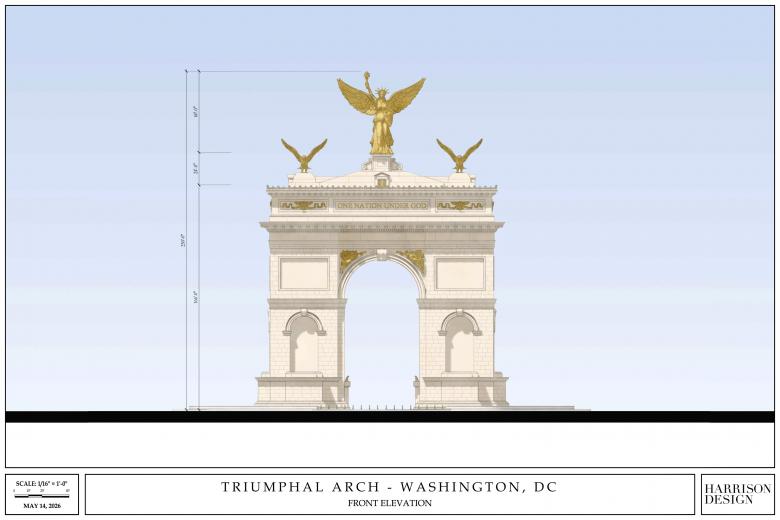
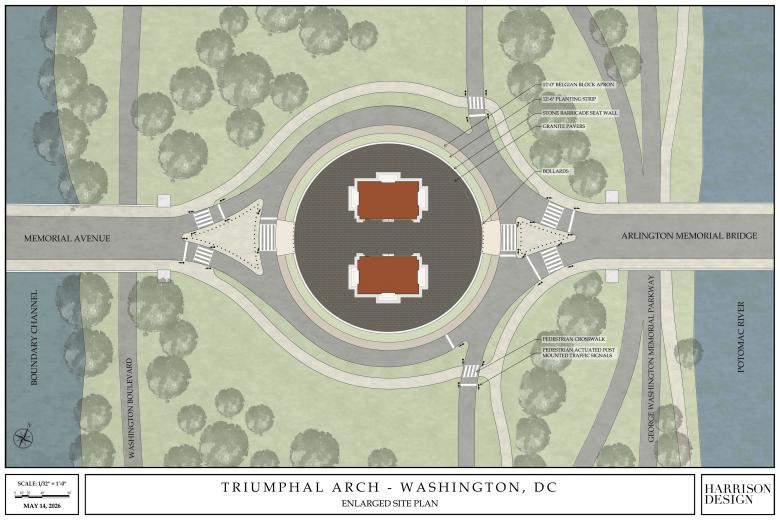
This is not to say that the second submission to the CFA did not include any revisions. There are three that are immediately evident, all at the base of the arch: the two pairs of lion statues sitting astride the arch are gone; the elevated plinth the arch would sit upon in Memorial Circle has been reduced in height; and the subterranean entry to the circle has been removed in favor of crosswalks—eight crosswalks, per the latest submission:
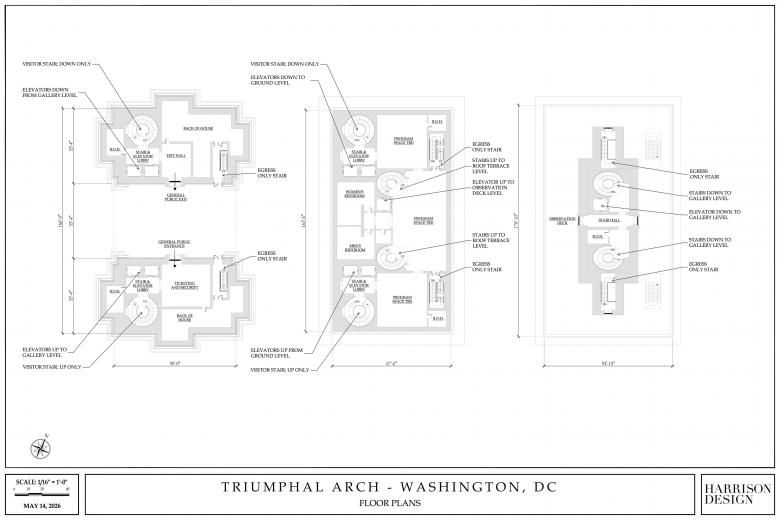
One comment in last month's review of the arch's design that was ignored is the opening up of the legs of the arch, à la the Arc de Triomphe in Paris, which has smaller arched openings that effectively turn that monument's two legs into four. As can be seen in the rendering atop this article, the short sides of the arch remain closed. Nicolas Charbonneau, principal of Harrison Design, explained that these sides would be used for “narrative sculptures,” their forms still to be determined. The reasoning also seems to relate to the secure entry, the exit, and back-of-house areas at grade, which can be seen in the ground floor plan below. Also apparent in the plans are the locations of elevators and stairs, some sort of program space in the upper floor (most likely a cafe, gift shop, and exhibit), and access to the observation deck atop the arch.
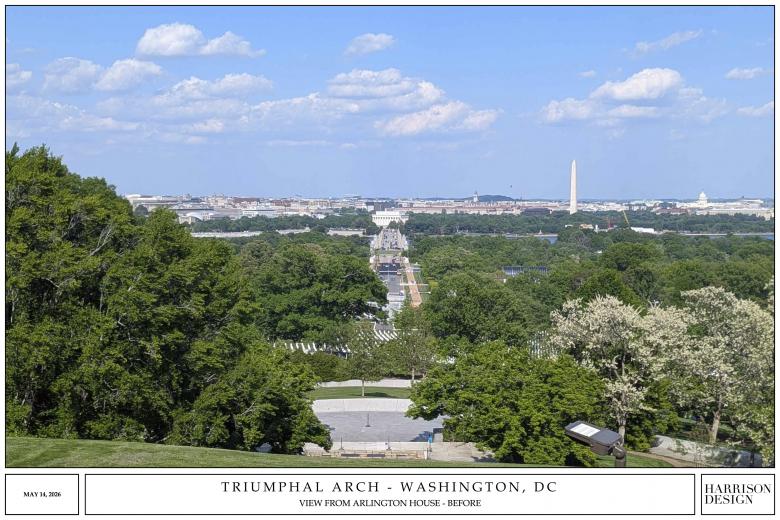
Another request Trump's CFA appointees had last month was seeing the effect of the triumphal arch on certain vistas, particularly the one from Arlington National Cemetery toward the Lincoln Memorial. Accordingly, Harrison Design provided numerous before-and-after views in their presentation, as well as cardinal views from the rooftop observation deck. The before and after views toward the Lincoln Memorial are seen above and below, but the clear fact the proposed arch would greatly obstruct the view of the memorial was barely addressed by the commissioners during last week's meeting.
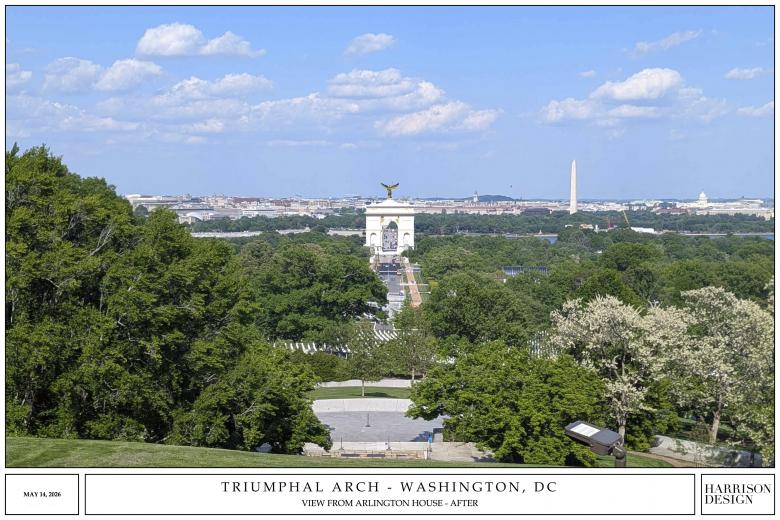
While the commissioners didn't take concern with the obstruction of existing views by the 250-foot-tall arch, nearly half of the roughly 600 messages sent to the CFA since last month's meeting took issue with this aspect of the project. All told, 99.5% of the messages sent in opposed the arch, with just three testimonies in favor—two of them for the arch but only with significant changes made to its design. Outside of its largeness blocking sightlines, comments in opposition called the arch a waste of taxpayer money and said the design is gaudy, that it reflects political vanity rather than national commemoration, it has been carried out in an improper manner without Congressional authorization, and it is a pedestrian hazard.
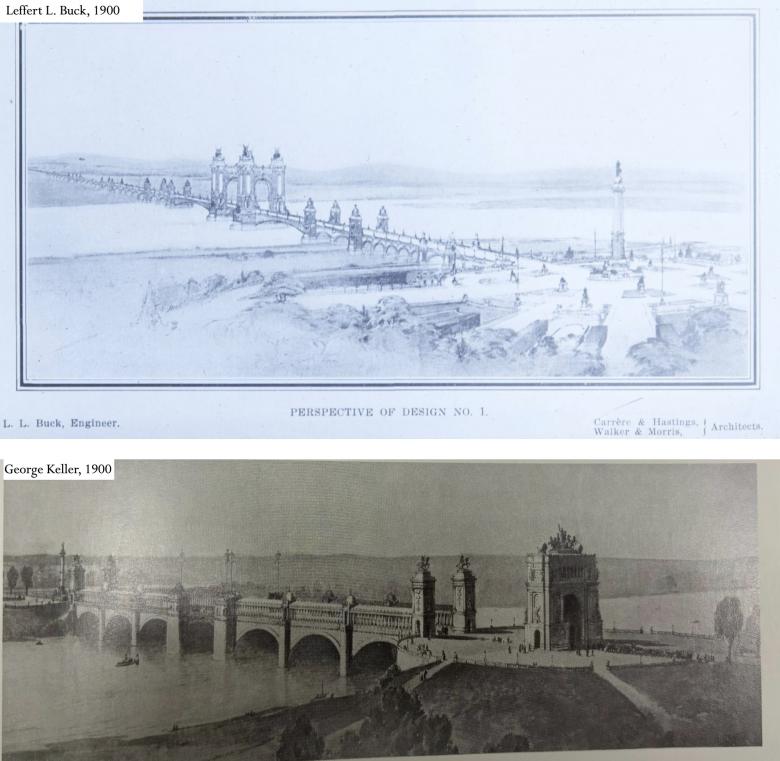
Before hearing live testimony from the National Trust for Historic Preservation, a couple other institutions, and a few individuals—all but one opposed to the project—the commissioners discussed the many precedents for memorial markers on the bridge and/or at the location of Trump's proposed arch, most from a hundred or more years ago. (A packet was not submitted before the meeting so the precedents were not visible during it, but the images were uploaded to the CFA website.) These proposals (two of them are shown above) were used by the commissioners to justify the proposed arch, just as the Trump administration has argued that columns and statues planned for the site in the 1920s but never built provide “the statutory authority” for them to erect the arch to their wishes.
In the end, the seven-member Commission of Fine Arts gave final approval for the triumphal arch, even though the design was submitted for revised concept approval, which would have necessitated another review. Although the final approval means the CFA is done with the project, the triumphal arch still needs approval from the National Capital Planning Commission, which is also filled with Trump allies, as well as approval from the Federal Aviation Administration, since it is over 200 feet tall and is just two miles from Reagan National Airport, before it can be built. Furthermore, a group of Vietnam War veterans has sued to stop construction of the arch, citing a 2002 prohibition passed by Congress on new construction “on any reservation, park or public grounds of the federal government in the District of Columbia without express authority of Congress.”