The Obama Presidential Center in Photos
Photo: Angie McMonigal, courtesy of the Obama Foundation
A decade in the making, the $850 million Obama Presidential Center opens to the public on Chicago's South Side on June 19—Juneteenth, the federal holiday commemorating the end of slavery in the United States. The project celebrates the accomplishments of Barack Obama, the country's first African American president, and aims to serve as “a global hub for inspiring, empowering, and connecting people to make change.”
Precisely, it was ten years and three months ago when the Obama Foundation revealed that New York's Tod Williams Billie Tsien Architects (TWBTA), working with local architecture firm Interactive Design Architects (IDEA), would be designing the Obama Presidential Center—this was even before the project site had been selected. Intentionally omitted from its name even at that stage was “library,” because unlike previous presidential libraries, Obama's would not store the official records from his two terms as president (2008–2016). Those documents would be digitized and made available to the public online, leaving the OPC to provide a museum on President Barack Obama's historic presidency and other components important to him and First Lady Michelle Obama: a community and civic “forum,” a branch of the Chicago Public Library, athletic facilities, a fruit and vegetable garden, a playground, and parkland.
With the project finally opening to the public in Jackson Park on Friday, reviews of the project by architecture critics have been clogging our news feeds for a couple weeks. Overall, the reviews are mixed, befitting the ambitious and multifaceted nature of the project as well as the solidity and iconicity of the 225-foot-tall tower that houses the museum and creates the public image for the project. Lee Bey, writing in the Chicago Sun-Times, calls the grouping of buildings that make up the OPC “one of the best urban spaces in the city, maybe second only to Millennium Park.” Similarly, Michael Kimmelman at the New York Times appreciates the landscape (by Michael Van Valkenburgh Associates) but not so much the tower, which he describes as “cold and forbidding” from certain angles. Another early review, filed by Oliver Wainwright at the Guardian, hones in on the museum tower and throws around monickers such as Obamalisk, Obamausoleum, and Obamarama to describe its exterior and interiors. Consistent across the many reviews, architectural and otherwise, is that, while the OPC is forward-thinking in its ambition to be a civic space for inspiring and empowering tomorrow's leaders, it harkens back to a pre-Trump America when hope wasn't so hard to come by, and before the signature programs of Obama's presidency weren't being systematically dismantled by the current administration.
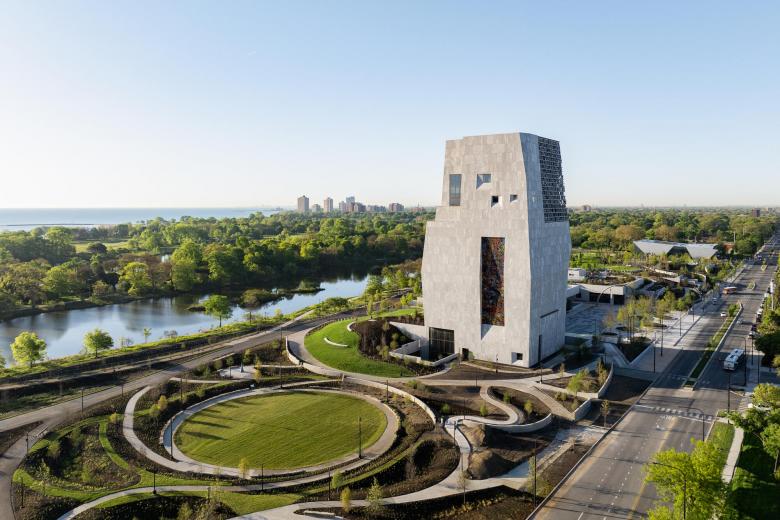
In lieu of a review (World-Architects is planning a visit to the OPC this summer), below is a tour through the Obama Presidential Center in photos, moving from aerial views to the building facades, the artworks on the tower, and the interiors of the museum and other buildings that make up the 19.3-acre campus.
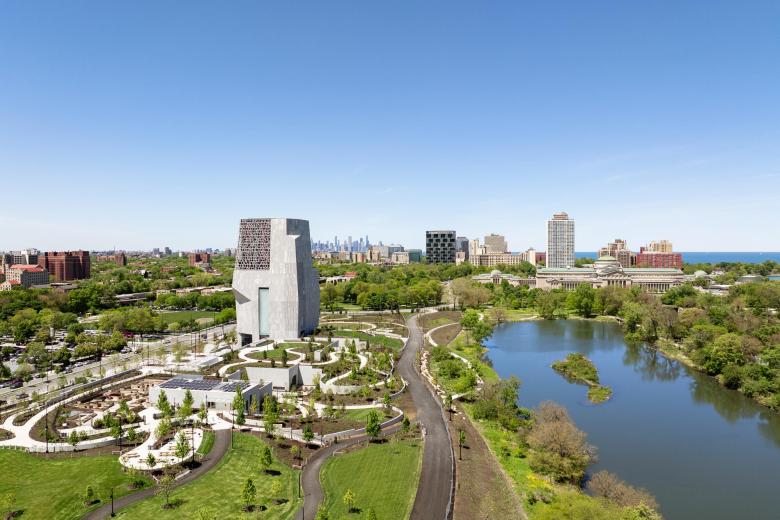
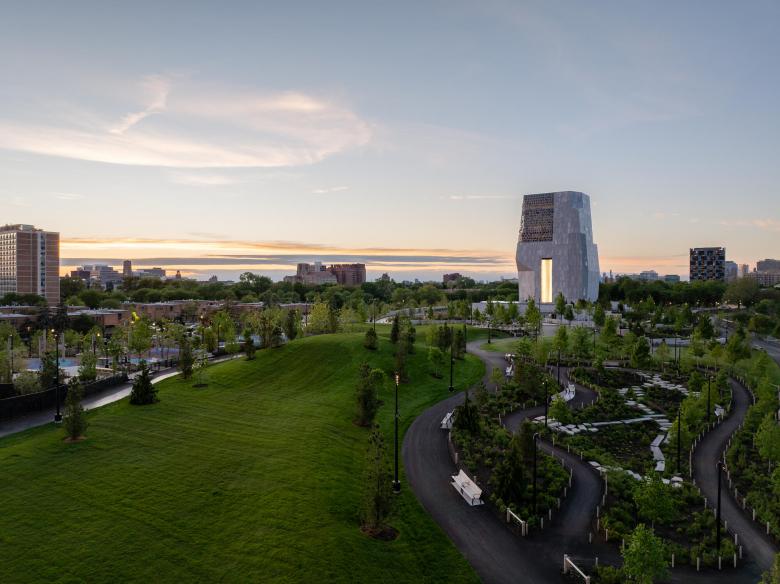
The aerial at top is looking at the OPC from the north, but here we are looking at it from the south. The Forum and Chicago Public Library that sit south of the Museum Tower are almost invisible, integrated as they are into the reconfigured landscape of Jackson Park. (Photo: Angie McMonigal, courtesy of the Obama Foundation)
The OPC campus extends even farther south, toward the Great Lawn, Wetland Park, and Playground that are seen here in the foreground. (Photo: Angie McMonigal, courtesy of the Obama Foundation)
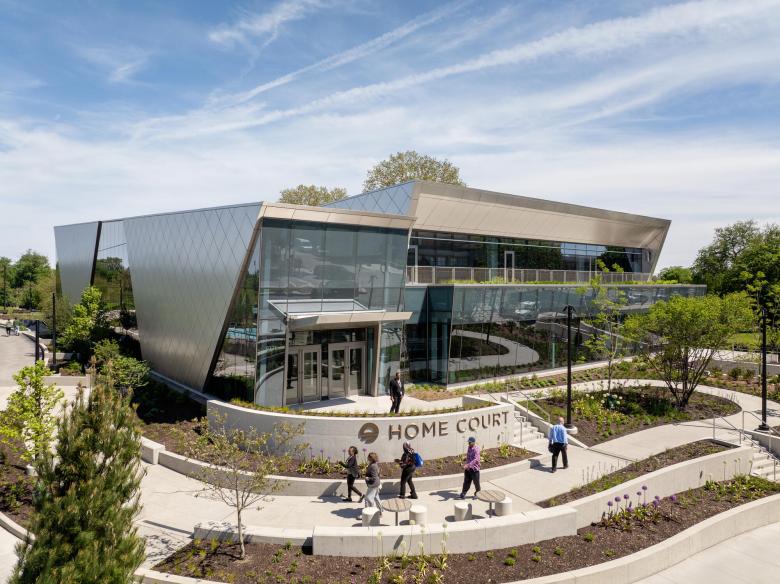
The southernmost piece of the campus, just south of the Playground, is Home Court, a 60,000-square-foot athletic and events space designed by Moody Nolan, the largest Black-owned architecture firm in the United States. (Photo: Angie McMonigal, courtesy of the Obama Foundation)
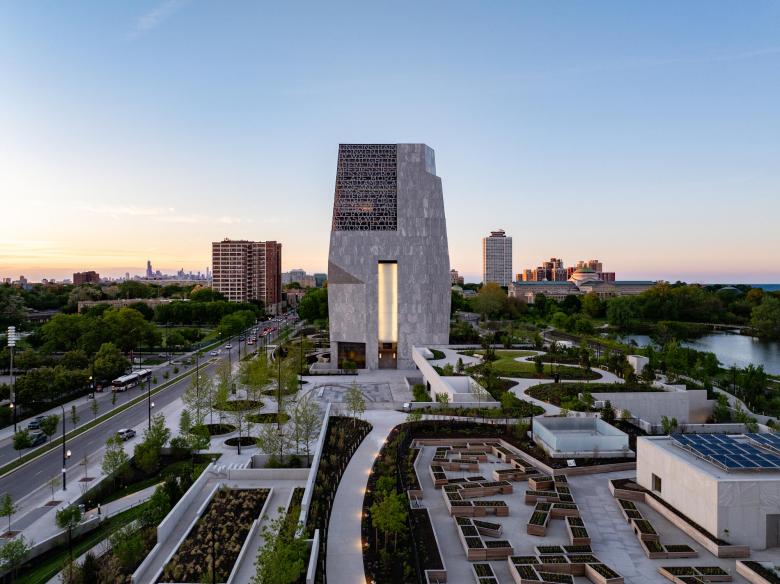
Moving closer to the OPC and Museum Building, we can see the Eleanor Roosevelt Fruit and Vegetable Garden in the foreground. It consists of dozens of garden beds with local plants and native vegetables, alongside a garden classroom. (Photo: Angie McMonigal, courtesy of the Obama Foundation)
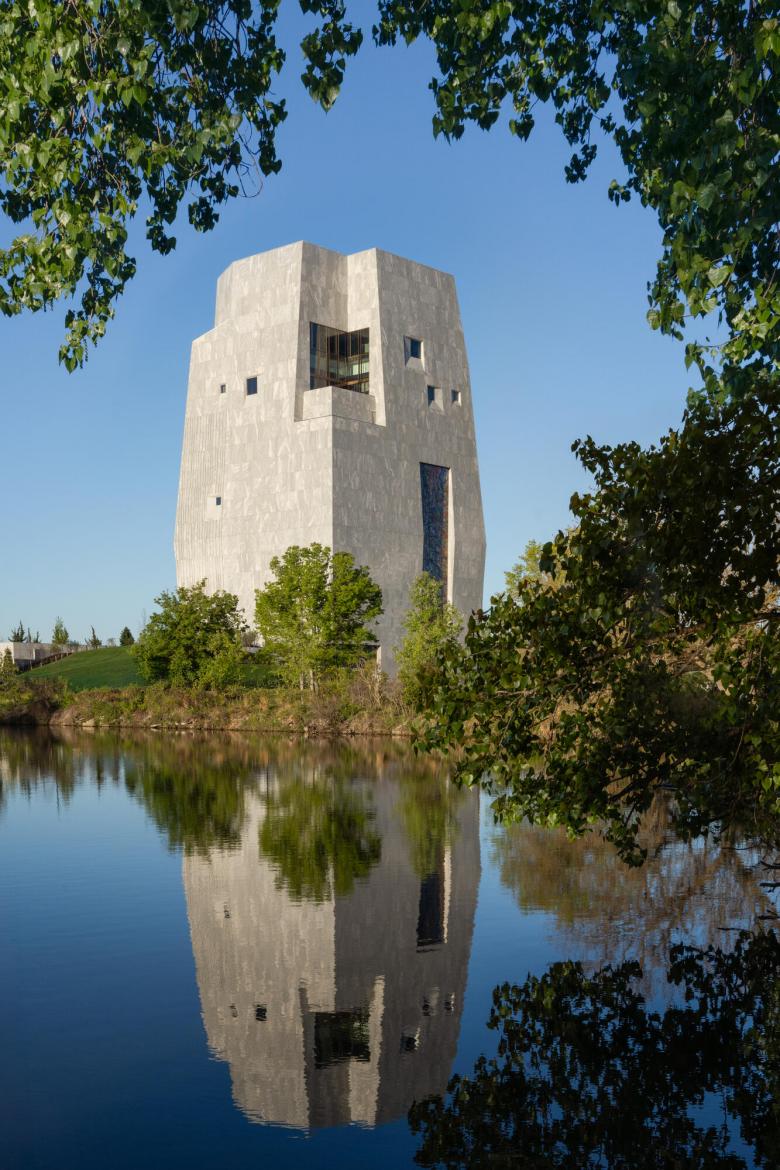
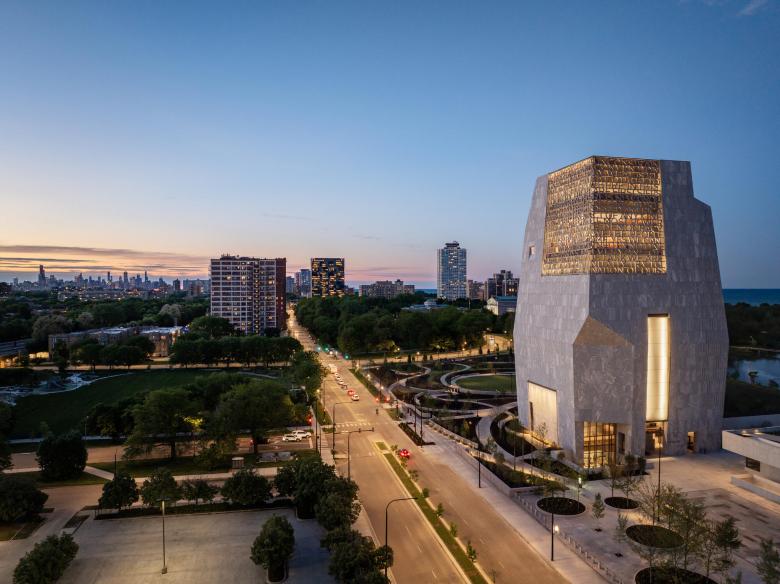
Much of the attention to the Center's architecture has focused on the form of the Museum Tower, dubbed the “Obamalisk” by many. (Photo: Angie McMonigal, courtesy of the Obama Foundation)
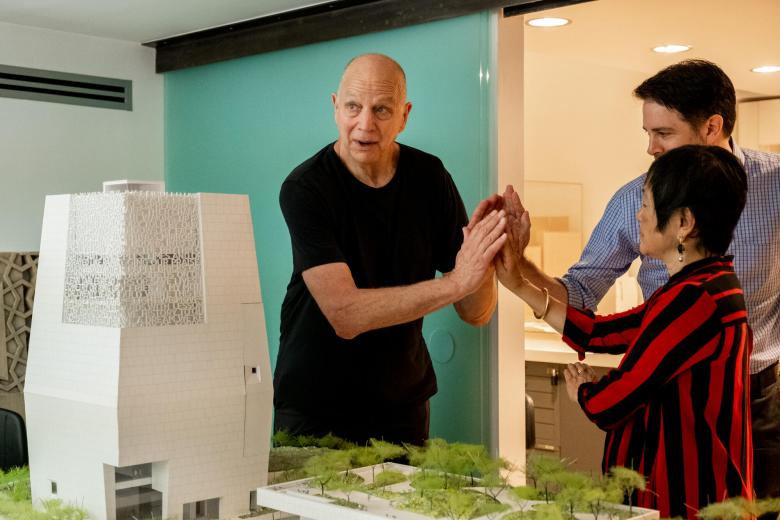
The conceptual idea behind the Museum Building's angular walls is “four hands come together,” as demonstrated by Tod Williams, Paul Schulhof, and Billie Tsien at the office of TWBTA in 2019. (Photo: Elias Williams, courtesy of the Obama Foundation)
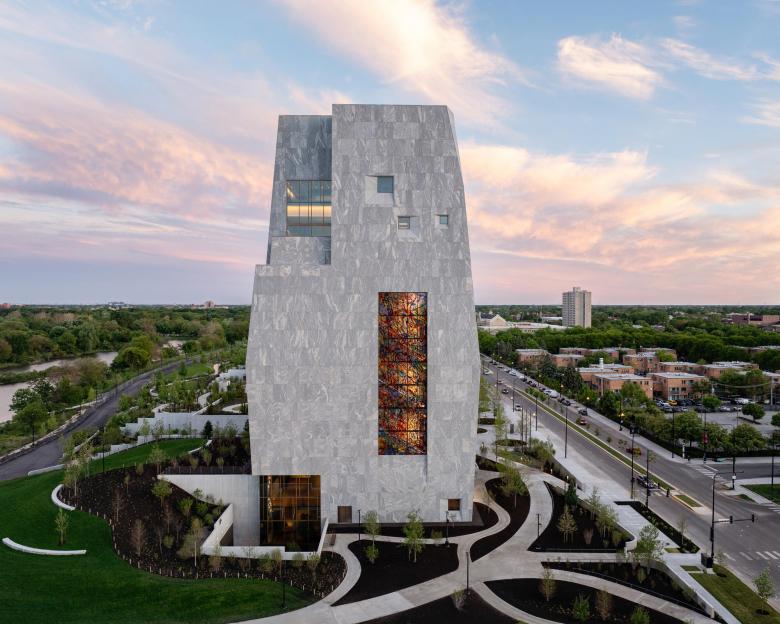
Although it is primarily solid to eliminate daylight entering the museum's exhibition spaces, the tower is pierced by openings that integrate some of the 28 commissioned artworks. The colorful vertical rectangle set into the north facade is Uprising of the Sun by Julie Mehretu. (Photo: Angie McMonigal, courtesy of the Obama Foundation)
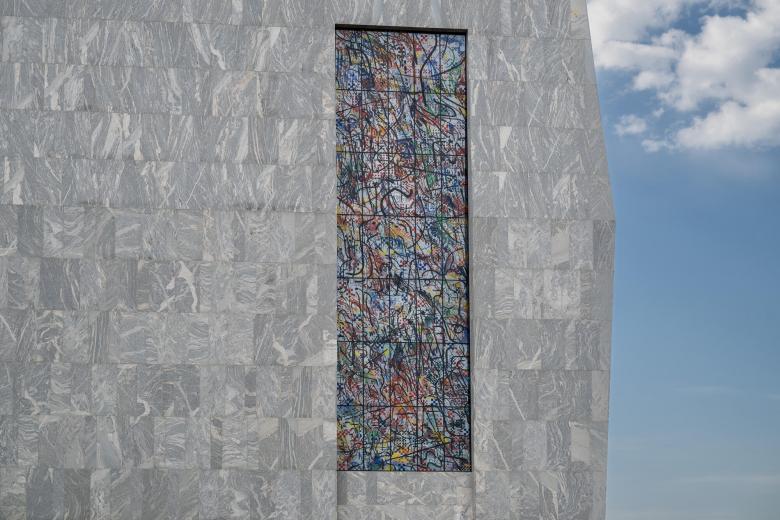
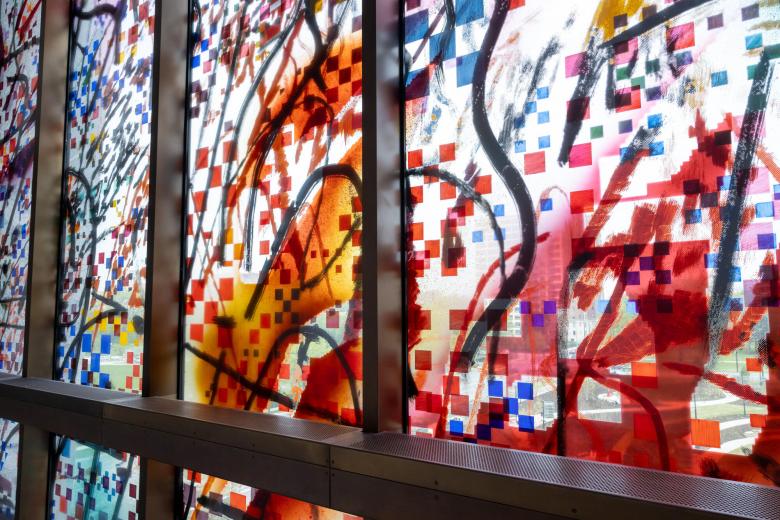
A closer view of Mehretu's monumental Uprising of the Sun. (Photo: Christopher Dilts, courtesy of the Obama Foundation)
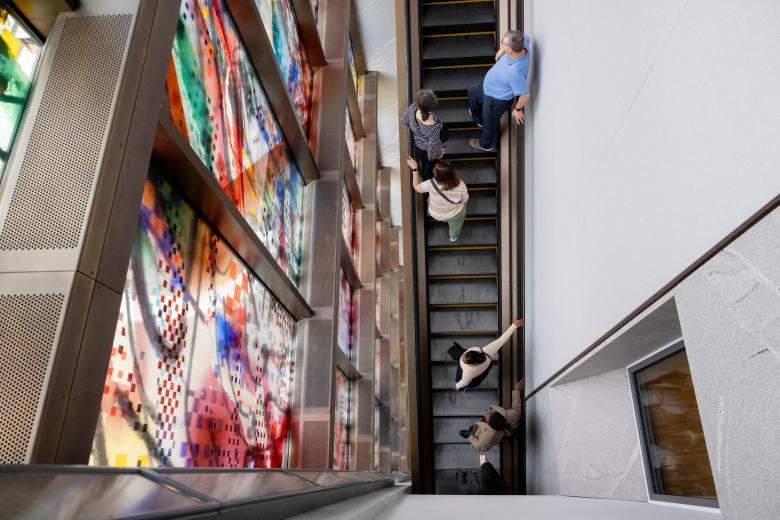
An escalator ascends behind the stained glass panels of Mehretu's Uprising of the Sun inside the Museum Tower. (Photo: Taylor Glascock, courtesy of the Obama Foundation)
Uprising of the Sun is Mehretu's response to President Obama’s “You Are America” speech given in 2015, on the 50th anniversary of Martin Luther King's Selma to Montgomery marches. (Photo: Taylor Glascock, courtesy of the Obama Foundation)
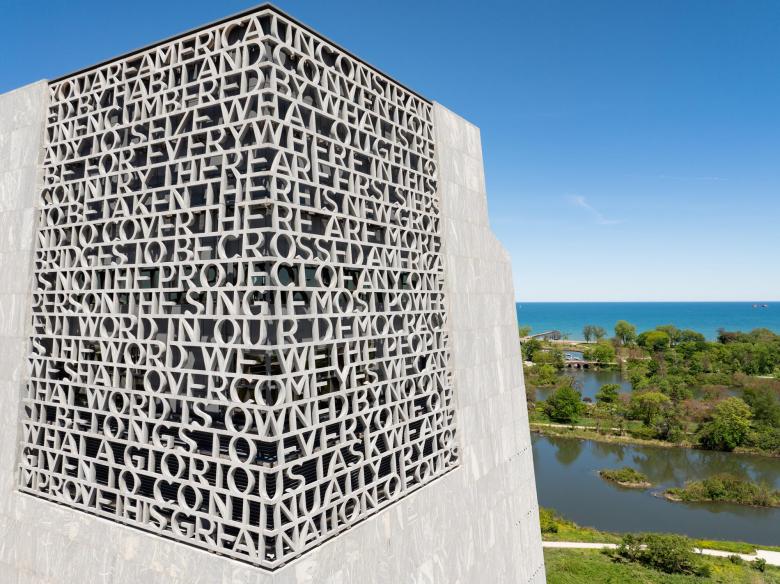
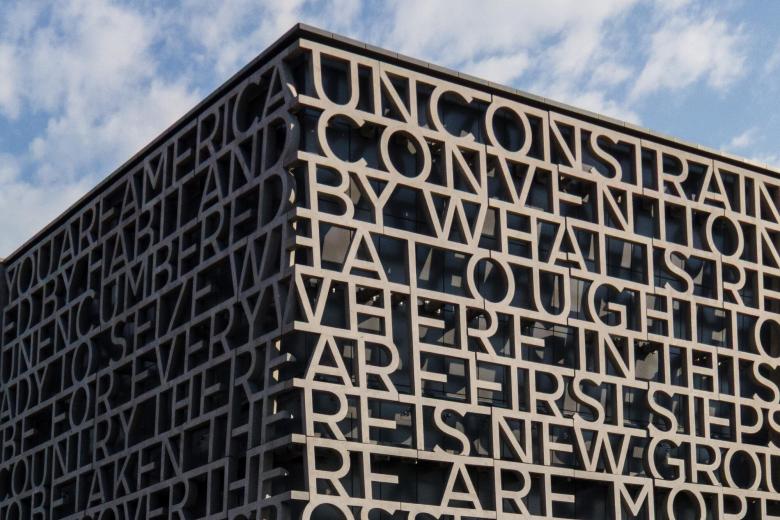
The most attention-getting installation on the exterior of the Museum Building is the “You are America” text that wraps the top third of the southwest corner. (Photo: Angie McMonigal, courtesy of the Obama Foundation)
Featuring an adapted Gotham font that Obama used in his 2008 presidential campaign, each letter is approximately five feet tall and one foot deep. The essence of the speech is meant to be grasped in words or small phrases rather than read in its entirety. (Photo: Angie McMonigal, courtesy of the Obama Foundation)
The seams between the larger panels—20–30' tall, 9–15' wide—are visible in this close-up. The letters are made of concrete, so each panel weighs from 11,000 to 20,000 pounds. (Photo: Angie McMonigal, courtesy of the Obama Foundation)
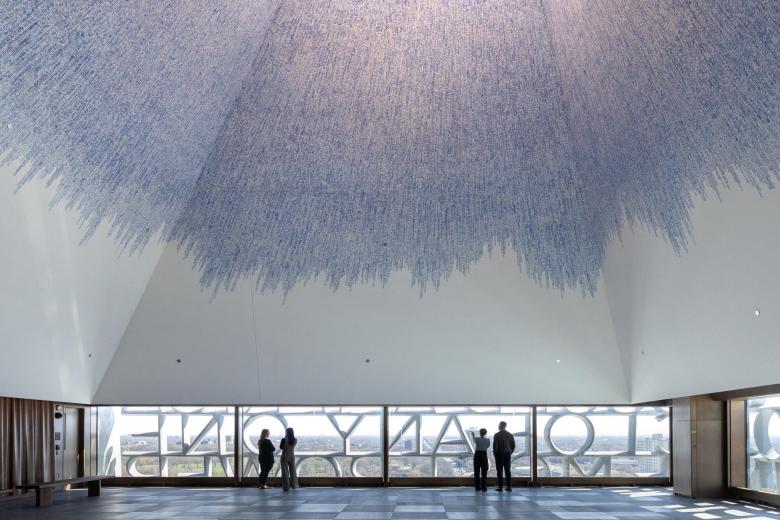
The uppermost level of the tower is the Nelson Mandela Sky Room, whose ceiling features Idris Khan’s Sky of Hope, a painting that overlaps thousands of hand-stamped words from a speech President Obama gave honoring Civil Rights leaders. (Photo: Angie McMonigal, courtesy of the Obama Foundation)
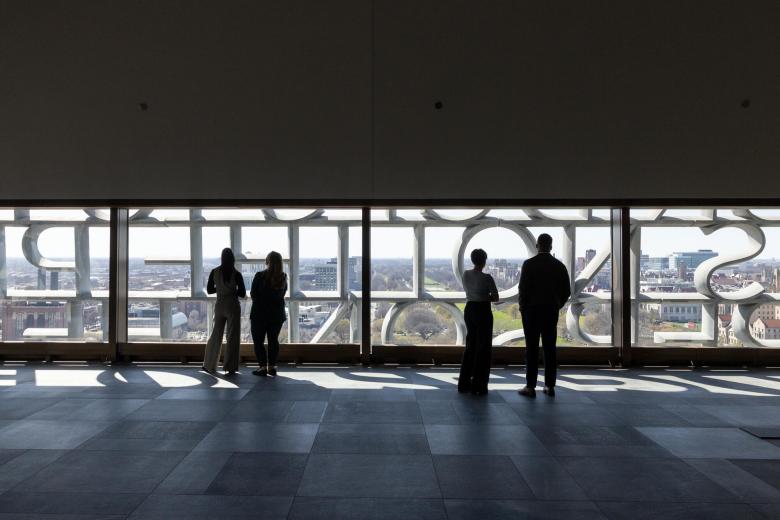
Visitors in the Sky Room can look at a panorama of Chicago's South Side through the letters of Obama's “You are America” speech. (Photo: Taylor Glascock, courtesy of the Obama Foundation)
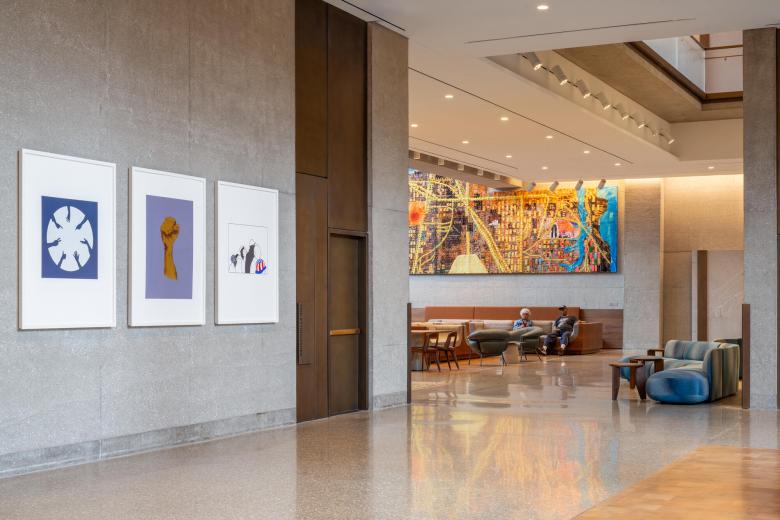
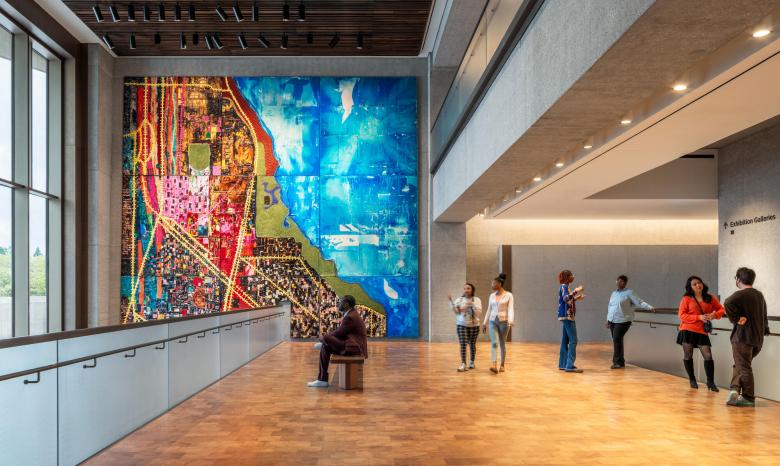
The Hope and Change Lobby at the Museum, with an artwork by Mark Bradford in the distance. (Photo: Angie McMonigal, courtesy of the Obama Foundation)
City of the Big Shoulders by Mark Bradford in the Our Story Atrium at the Museum. (Photo: Angie McMonigal, courtesy of the Obama Foundation)
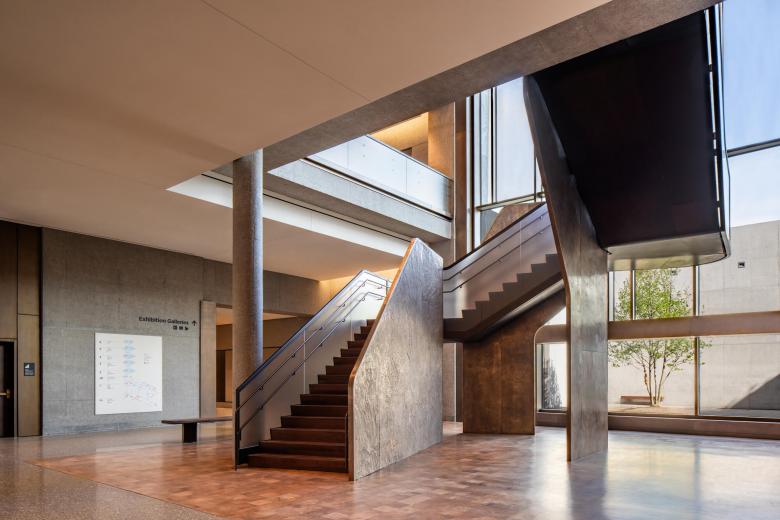
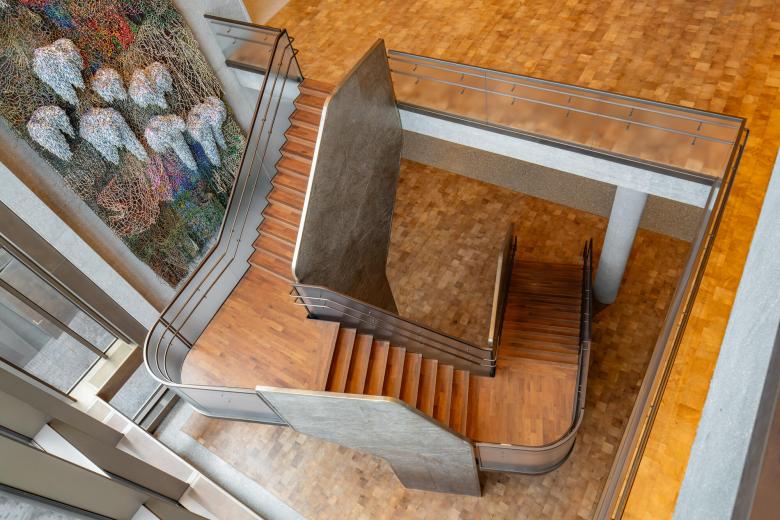
Staircase in the Hope and Change Lobby at the Museum. (Photo: Angie McMonigal, courtesy of the Obama Foundation)
Another view of the stair in the Museum's Hope and Change Lobby, with This Land, Shared Sky by Marie Watt in collaboration with Nick Cave on the wall. (Photo: Taylor Glascock, courtesy of the Obama Foundation)
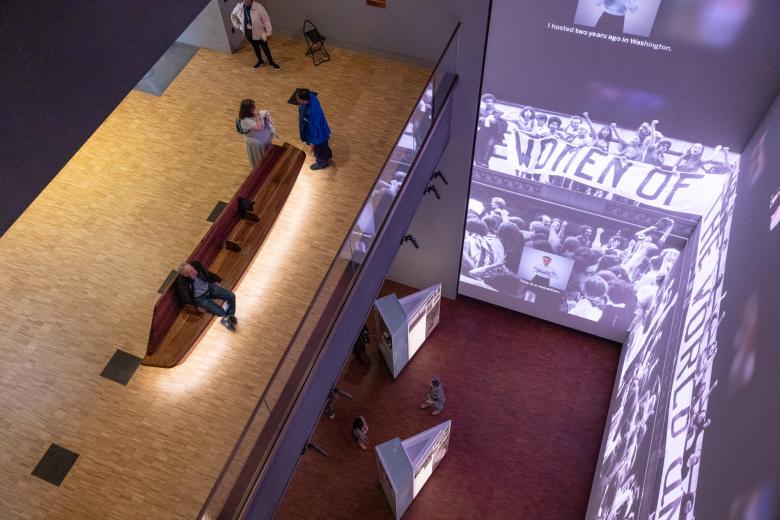
The exhibition design in the museum was led by Ralph Appelbaum Associates. (Photo: Taylor Glascock, courtesy of the Obama Foundation)
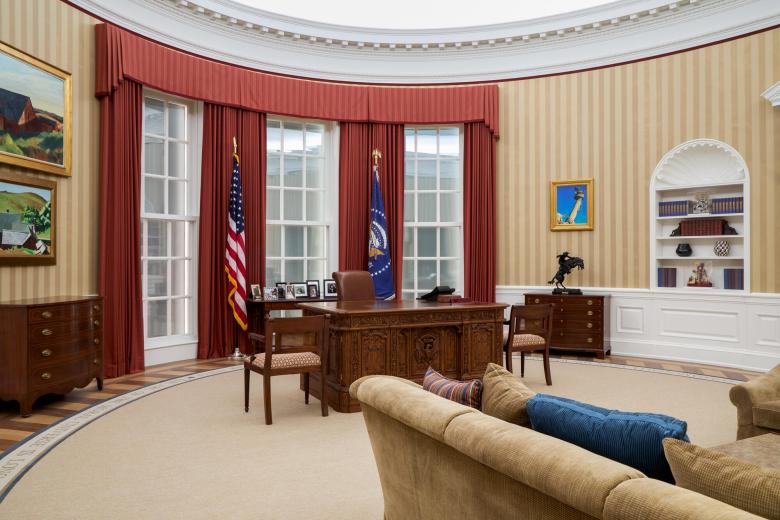
Like other presidential libraries, the OPC features a historical recreation of the Oval Office. Visitors will be able to have their picture taken while sitting at the Resolute desk. (Photo courtesy of the Obama Foundation)
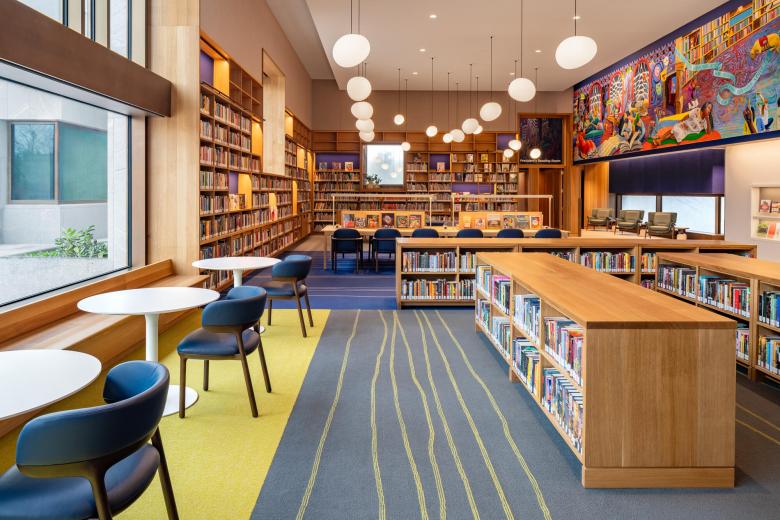
The public library at the OPC is the 82nd branch in the Chicago Public Library system. It includes the President’s Reading Room, which consists of more than 3,500 books selected by the Obamas. (Photo: Angie McMonigal, courtesy of the Obama Foundation)
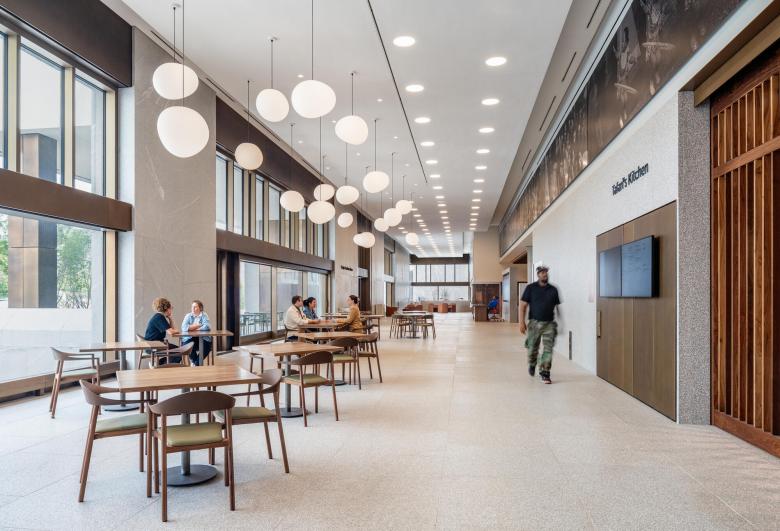
The Hadiya Pendleton Atrium provides access to the auditorium, Tafari's Kitchen, and other spaces in the Forum building. (Photo: Angie McMonigal, courtesy of the Obama Foundation)
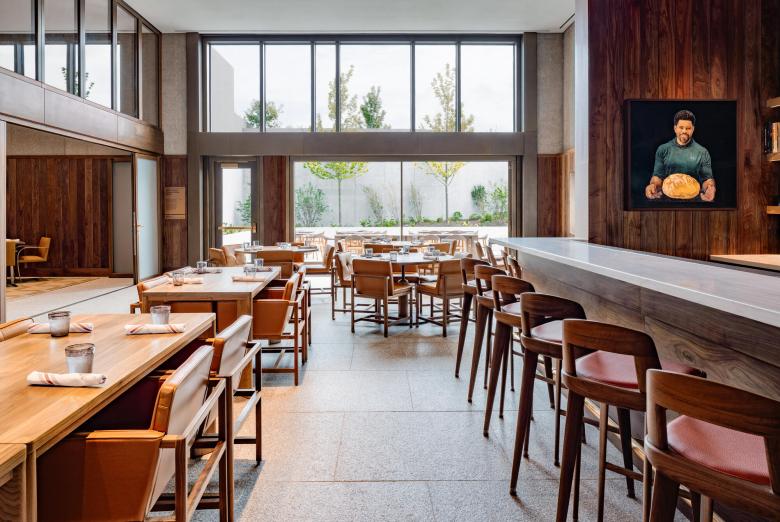
Tafari's Kitchen is just one of the dining spaces that should make the OPC a place for residents of Hyde Park and Woodlawn, not just a destination for tourists. (Photo: Angie McMonigal, courtesy of the Obama Foundation)
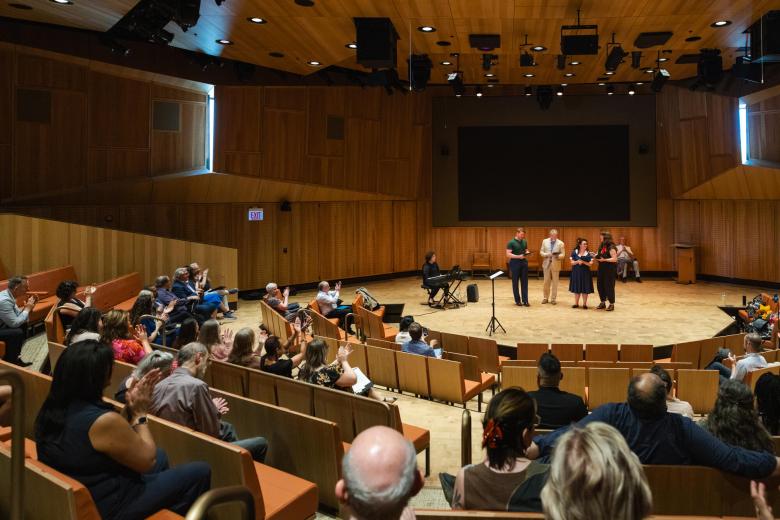
Lyric Opera performing in the auditorium. (Photo: Taylor Glascock, courtesy of the Obama Foundation)