Saint Joseph’s Oratory of Mount Royal Welcome Pavilion
A Humble Welcoming
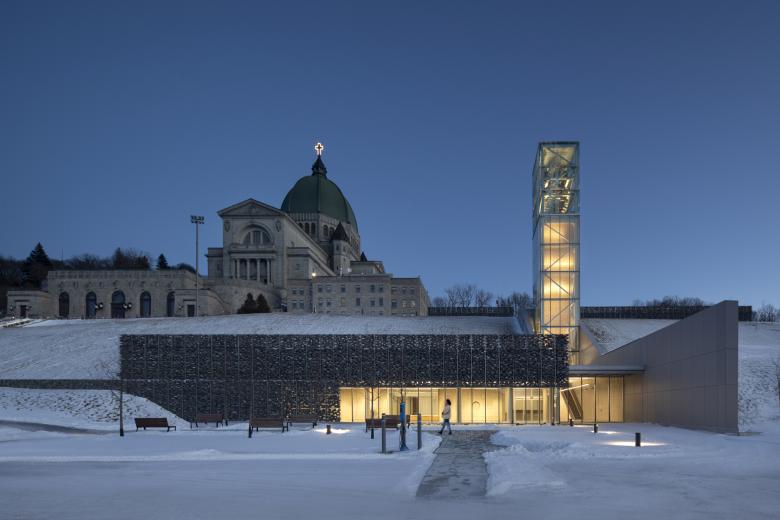
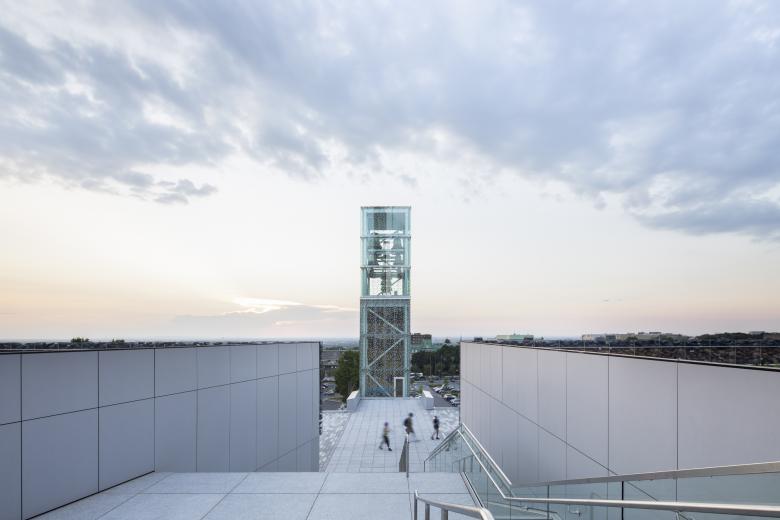
Lemay describes their approach to the design of the Saint Joseph’s Oratory of Mount Royal Welcome Pavilion as one of “humility rather than assertion.” Situated at the base of the highest building in Montreal, the new building embeds itself into the landscape and signals its presence via an illuminated carillon. The architects answered a few questions about the project.
What were the circumstances of receiving this commission?The commission was awarded through a conventional public procurement process in response to a Request for Proposals (RFP).
The selection process focused on the team’s relevant experience, proposed methodology, understanding of the site’s historical and topographical context, and ability to address complex programmatic, accessibility, and environmental requirements. Lemay was selected based on the strength of its transdisciplinary approach and its demonstrated capacity to deliver a sensitive architectural intervention within a highly significant heritage setting
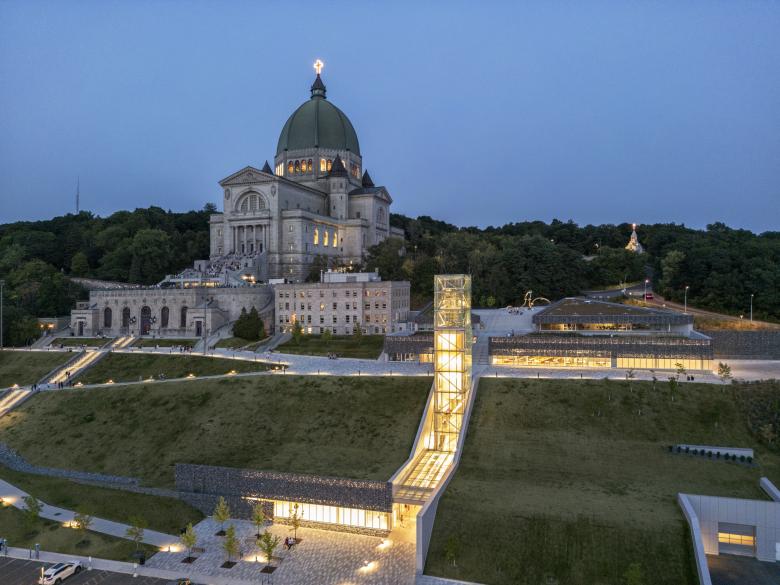
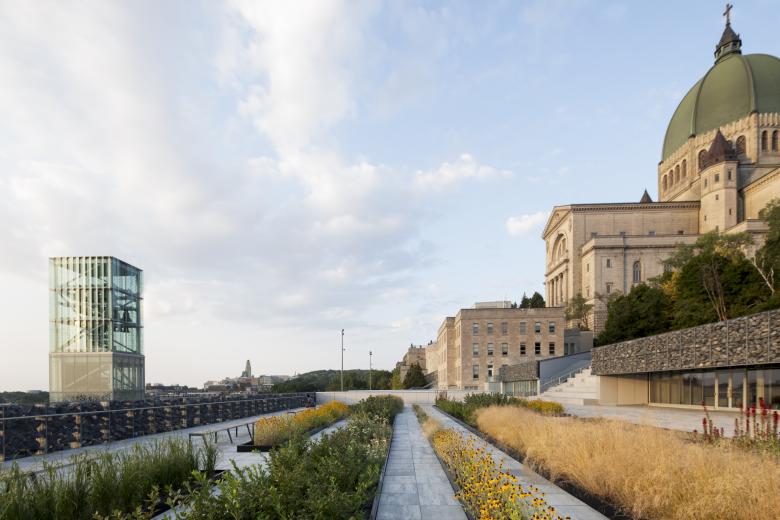
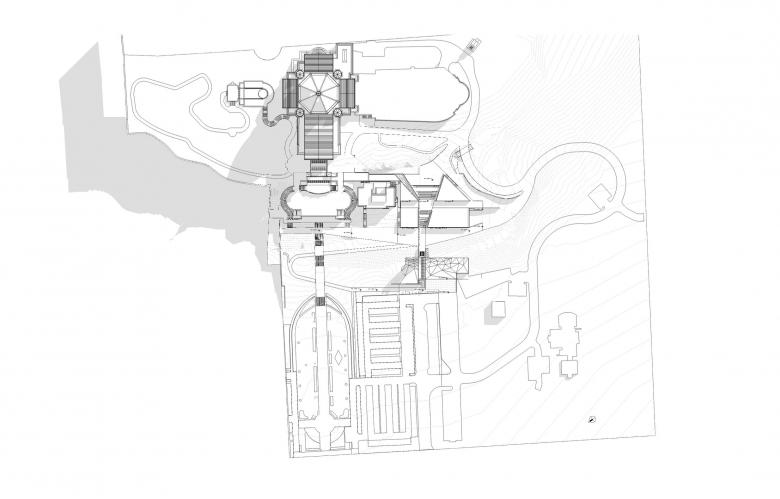
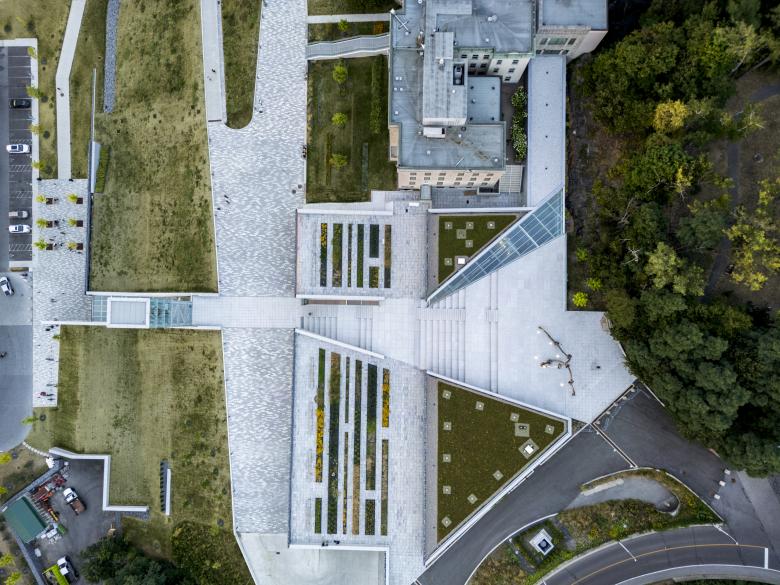
What distinguishes this project is its approach of humility rather than assertion. The pavilion embeds itself into Mount Royal, allowing the program to exist within the mountain rather than rising above it. Stratified plateaus topped with green roofs extend the natural landscape, ensuring the intervention reveals the historic basilica rather than competing with it. The architecture frames views of the dome, the bells, and the mountain, holding space for the Oratory’s grandeur instead of asserting its own presence.
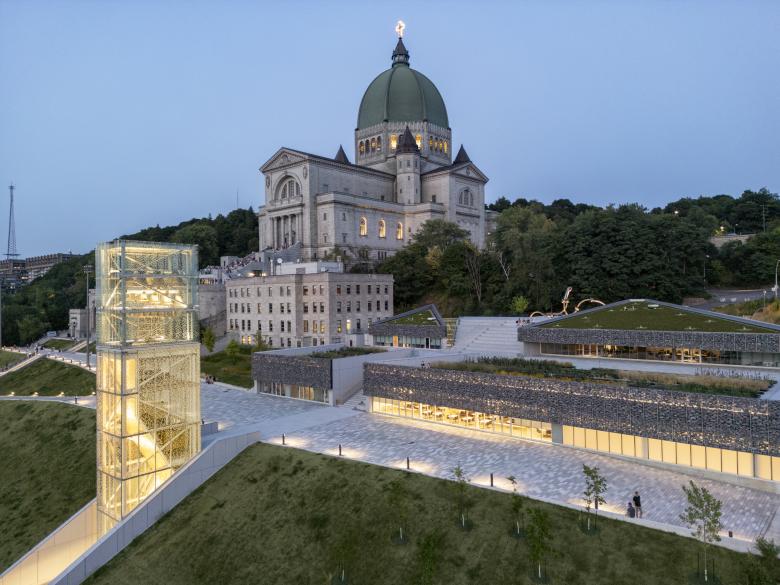
A defining aspect of the project is the rare opportunity to integrate a carillon as a central architectural and experiential element. Designing around a 62-bell instrument, both technically and symbolically, transformed the project into a once-in-a-lifetime collaboration between architecture, music, and heritage. The carillon is not treated as an isolated object, but as a generator of spatial, acoustic, and experiential qualities that shape how visitors move through, perceive, and inhabit the site.
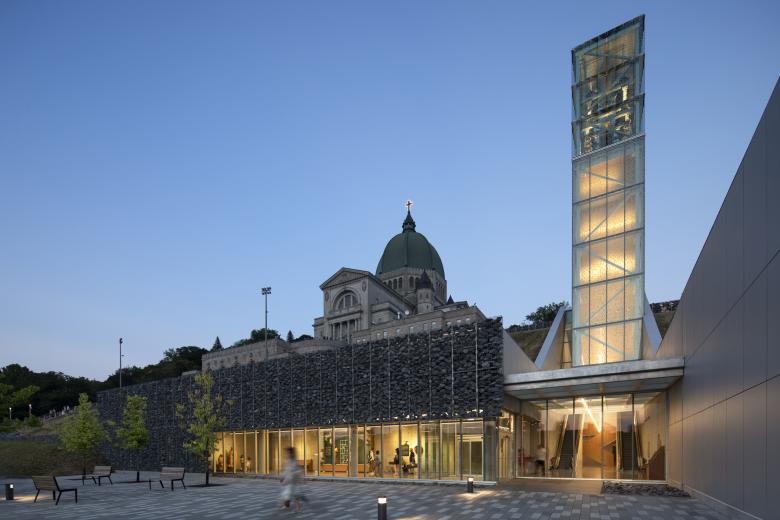
Another unique dimension of the project is the reuse of stone excavated directly from the site within the gabion walls that mark each level of the building. These walls filter daylight in a way that reinterprets the role of stained glass in ecclesiastical architecture. At night, interior lighting shimmers through the stone as visitors move past the building, evoking the flicker of candlelight within the sanctuary and reinforcing the project’s spiritual and sensory depth.

The design is inspired by the intention to offer a renewed architectural vision for a deeply established icon of Montreal, a vision that is contemporary yet profoundly respectful of both the Oratory and Mount Royal. Rather than asserting a new presence, the project is guided by the intention to honor the site’s geology, topography, and spiritual significance through a sober and restrained architectural intervention that integrates seamlessly into the landscape.
The carillon plays a central role in the project’s inspiration, conceived not only as a musical instrument but as a guiding element and a new urban landmark. Its sound, light, and material expression shape a sequence of discovery and contemplation, leading visitors toward the Oratory.
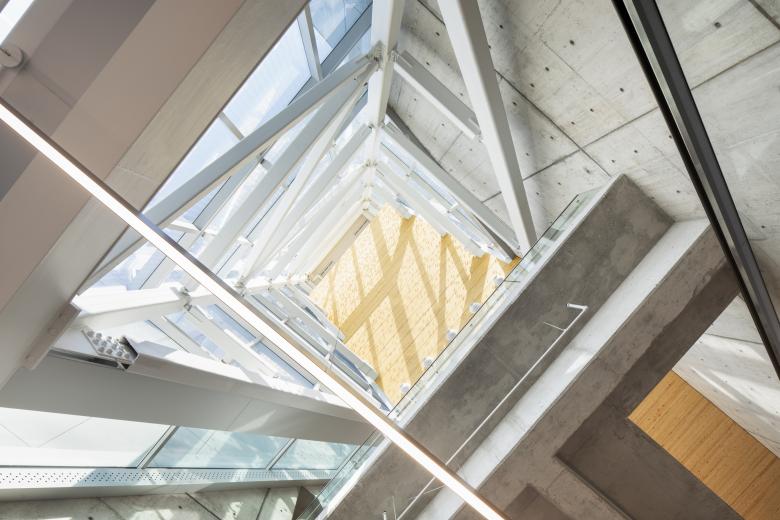
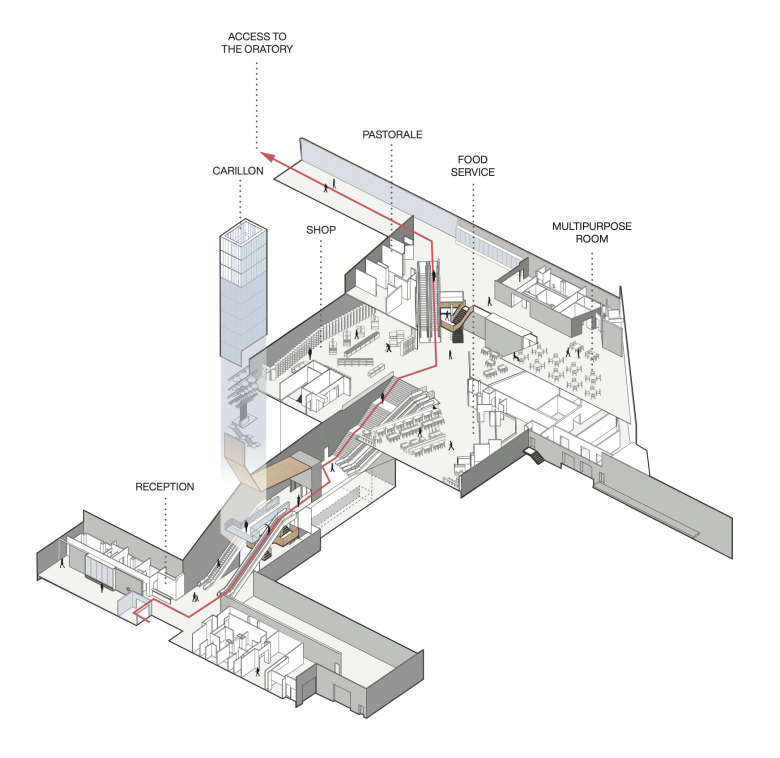
Another key intention lies in minimizing impact on the site’s topography while enhancing the visitor experience. This is articulated through the concept of a “Rift” a concrete incision carved into the slope of Mount Royal that houses the carillon and interior spaces while structuring a fully accessible and experiential circulation path. The gesture creates moments of pause, framed views, and a continuous dialogue between interior and exterior spaces.
The intention to preserve the site’s natural character is reflected in the building’s material and topographic expression. The pavilions emerge as stratified extensions of the mountain, with excavated rock reused in gabion walls that define each level. These stone assemblies reveal the essence of Mount Royal while reinforcing the project’s material authenticity, environmental responsibility, and sensory depth.
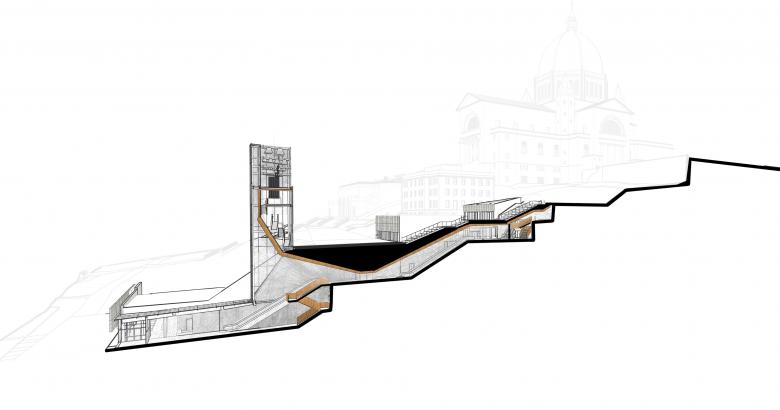
The steep mountainside determined the structural approach. Concrete shear walls function as retaining structures, anchoring the building into the slope and allowing the program to be carved into the mountain. This geotechnical condition became a conceptual foundation, the building nestles into the terrain rather than sitting upon it, maintaining a low profile that preserves the basilica’s visual dominance.
Universal accessibility was a central requirement and priority for the client. The design establishes a fully accessible interior circulation path that allows all visitors to experience the complete spiritual journey, and addresses a significant topographic challenge, including an elevation difference of approximately 21 meters from the entrance level to the client’s desired connection level to the basilica. This commitment to inclusion shaped spatial organization, with back-of-house operations separated from public areas to accommodate commercial functions, visitor amenities, retail, dining, for 2 million annual visitors while preserving the contemplative atmosphere, transforming circulation into a continuous, inclusive architectural experience.
The client’s strong environmental values closely aligned with our own, guiding the project’s pursuit of LEED Silver certification through strategies such as geothermal systems and extensive green roofs, reinforcing a shared commitment to long-term performance, environmental responsibility, and integration with the natural landscape.
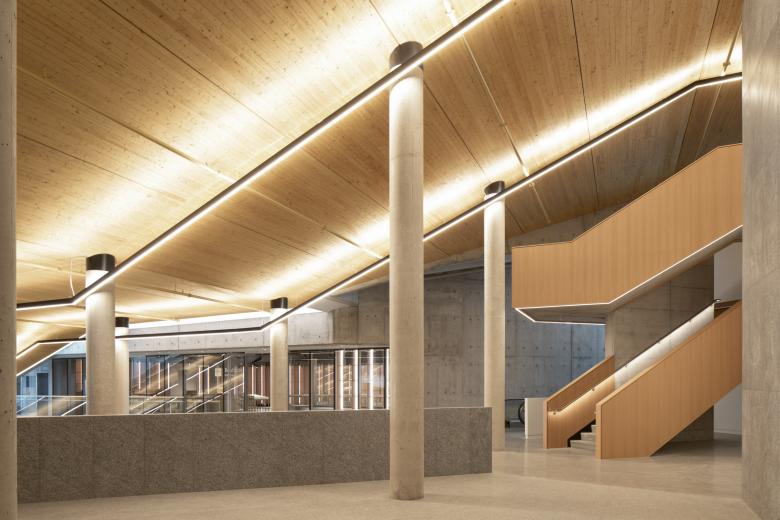
The project relates closely to other work at Lemay through its emphasis on innovation, contextual responsiveness, and user experience. It exemplifies the firm's NET POSITIVE™ approach, guiding the team toward sustainable solutions that contribute positively to their context. For the welcome pavilion, this translated into strategies like geothermal systems, increased permeable surfaces, and the use of 100% site-excavated stone for gabion walls. The use of these gabion walls is an example of a broader practice within the office of transforming constraints into architectural opportunities. Beyond performance and sustainability, this contributes to the creation of spaces that resonate with users, shaping tactile, sensory, and meaningful experiences, an ambition that is central to Lemay's design culture.
Email interview conducted by John Hill.
Location: Montreal, QC, Canada
Client: Oratoire Saint-Joseph du Mont-Royal
Architect: Lemay, Montreal
- Project Team: Yanick Casault (project director, principal), Pierre E. Leclerc (design principal), Andrew King (design principal), Ricardo Serrano (design director), Ramzi Bosha (design director, interiors), Myriam Perreault (project coordinator)
Mechanical and Electrical Engineering: BPA
Civil Engineering: MHA
Landscape Architect: Version Paysage
Interior Designer: Lemay
Contractor: Pomerleau
Vertical Transportation Consultant: KJA
Carillon Consultant: Patrick Macoska
Building Area: 62,100 sf
Related articles
-
-
Allied Music Centre/Massey Hall Renovation and Expansion
KPMB Architects | 01.12.2025 -