Revisiting the Architettura Series
“The arts are not isolated,” John Cage shortly before his death in 1992, “but engage in dialogue.” He happened to be referring to music and architecture, the latter occasionally referred to as “frozen music.” Here we explore the relationship between these two arts, spurred by a forthcoming series of events organized by World-Architects.
My mind has been mulling over the relationship between architecture and music in recent months, since before World-Architects recently announced Architecture Studio Sessions, an official program of the Barcelona 2026 World Capital of Architecture that will open ten architecture studios in the city to the public over the course of the year. The music angle comes from the way we curated the events: Each session will include, following a presentation and guided tour, playlists and DJ sessions selected by the architects themselves. In addition to seeing the studios in person and engaging with the architects there, one of the most appealing aspects of the series will be listening to the music the architects select and considering how it relates to their own architecture.
When mentioning architecture and music in the same breath, the go-to phrase is “architecture is frozen music,” usually attributed to Johann Wolfgang von Goethe, who also described music is liquid architecture, but also articulated by fellow German thinker Friedrich Wilhelm Joseph von Schelling, who similarly called architecture “concrete music.” While the enticing metaphor of architecture as frozen or concrete music has remained intact as it has been carried down to the present over hundreds of years, its formalism was rooted in the Baroque and Rococo eras so it only finds direct application in our contemporary world in similarly curvaceous projects like Frank Gehry's Guggenheim Bilbao and Walt Disney Concert Hall—a piece of architecture that exists explicitly for music, it goes without saying, and which just hosted “Music for Frank,” a remembrance of its architect—or in the parametric architecture of Zaha Hadid Architects, MAD Architects, and the like.
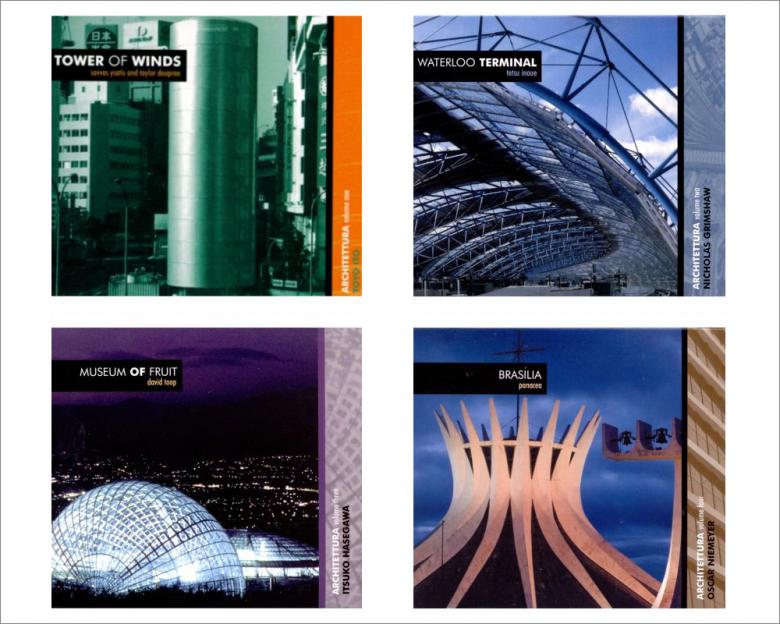
A series of albums now more than 25 years old looked at architecture's impact on music and is worth revisiting now. What kind of music arises from architecture being the subject of a song or album? Or of architecture being even the medium itself? Caipirihna Music released four albums in the Architettura series between 1998 and 2000, in which each album paired electronic musicians with architectural works: Savvas Ysatis and Taylor Deupree with Toyo Ito's Tower of Winds in Yokohama; Tetsu Inoue with Nicholas Grimshaw's Waterloo International Terminal in London; David Toop with Itsuko Hasegawa's Museum of Fruit in Yamanashi, Japan; and Panacea with Brasilia, the Brazilian capital planned by Lúcio Costa and featuring numerous buildings by Oscar Niemeyer. The series also led to four corresponding short films directed by Caipirihna Productions founder Iona Lee.
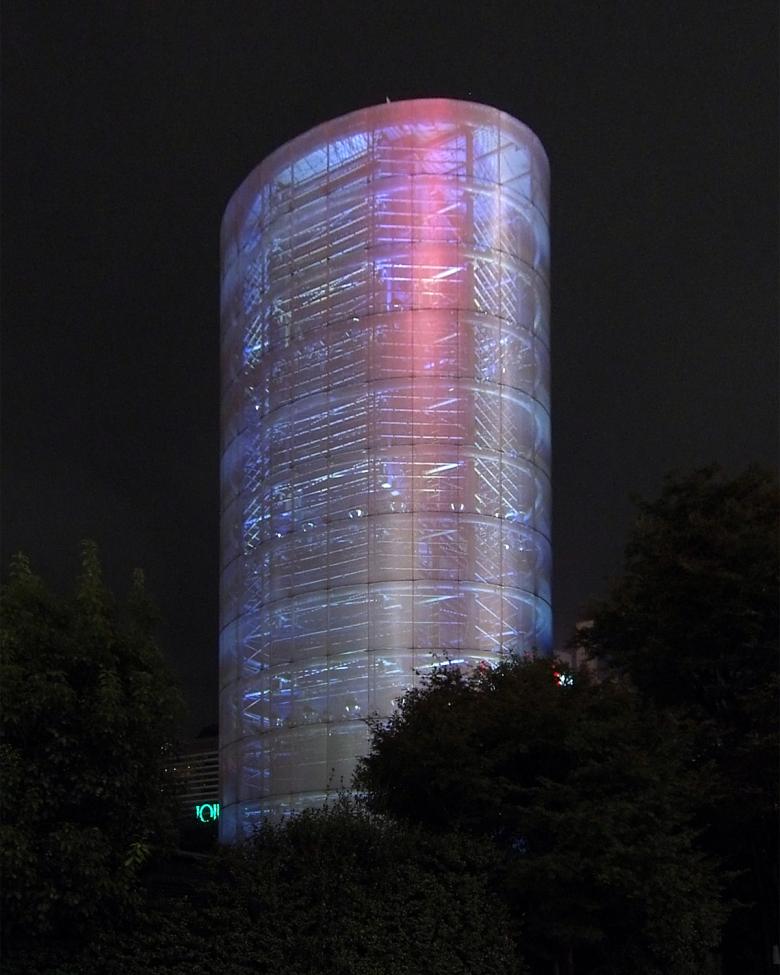
Toyo Ito's Tower of Winds, completed in 1986, was an appropriate starting point for the series. Sited in a traffic circle near Yokohama Station, the aluminum-clad elliptical cylinder—a covering for a water tank—sits mute and gray during the day, but a combination of approximately 1,300 lamps, twelve neon rings, and thirty flood lights animate the structure at night. Not static or repetitive, the computer-controlled lights are activated by environmental stimuli, such as wind forces, traffic, and the seasons. Effectively, Tower of Winds is “architecture as ambient music,” the “music” being the various environmental inputs.
In the hands of musicians Savvas Ysatis and Taylor Deupree, their Tower of Winds is a bit like a soundtrack of its namesake. The musicians developed a production technique that accepted environmental inputs in much the same way the tower reinterprets the sounds of the city. Over the course of 61 minutes, the eleven tracks rise and fall with layers of sounds and rhythms corresponding to particular days and times, with the tracks explicitly indicating when they were recorded—or should that be generated? For instance, the title of the longest track, the 9-minute “End Begin,” is prefaced by the timestamp of “Aug. 31 11pm-Sept. 1 8:40am.” It's not hard to put on headphones, listen to Tower of Winds, and see Toyo Ito's kaleidoscope of colors come alive with the music.
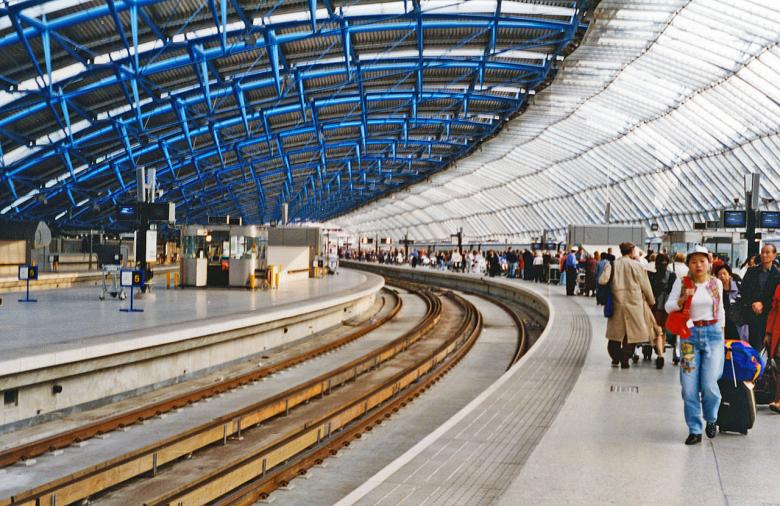
Whereas Ysatis and Deupree's process parallels in sound the unique lighting process embedded within the Tower of Winds, musician Tetsu Inoue took a different approach with Waterloo Terminal, the second installment in the Architettura series. The subject of his album, released in fall 1998, is the Waterloo International Terminal, designed by Nicholas Grimshaw as the London terminus of the Eurostar trains that started to travel through the Channel Tunnel, or “chunnel,” connecting England to France and the rest of Europe shortly after completion of the terminal in 1993. Grimshaw's design is marked by the snaking plan and the gently arcing glazed roof structure.
Inoue scanned more than one thousand photographs of the terminal, like the one above, into his computer and used the MetaSynth sound design software to convert the images into sounds. He then composed the sounds into eight tracks with occasionally telling titles such as “Room FX,” “DSP Terminal,” and “Arc Texture.” While it's hard to grasp how the stuttering static, hums, and other bits of music correspond to the terminal's architecture, the ambient train station sounds that appear in the middle of the first track, “Room FX,” ready listeners for imagining themselves in that environment for the remainder of the album's 46 minutes.
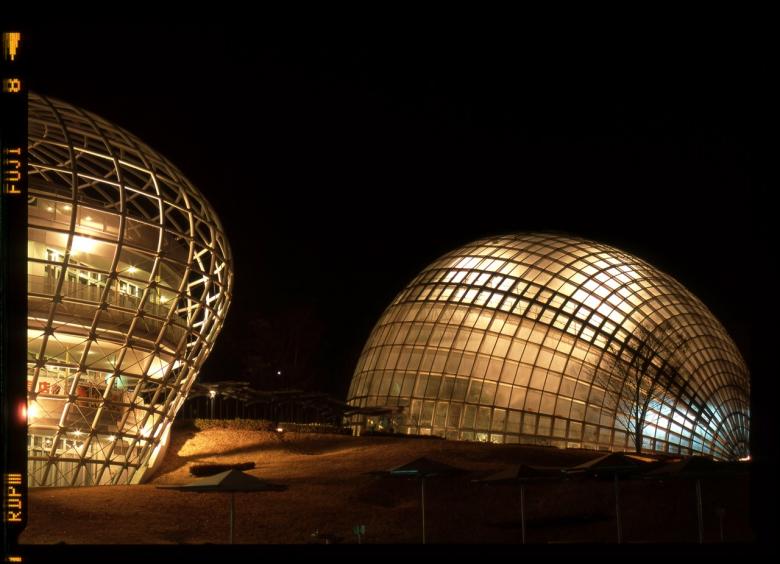
Although the first two albums in the Architettura series used different forms of architectural media to create sonic soundtracks for their architectural subjects, it seems that last two installments—David Toop's Museum of Fruit (1999) and Panacea's Brasilia (2000)—are more tangential in their approaches. Toop was inspired less by the domed architecture of Itsuko Hasegawa's Yamanashi Fruits Museum than its contents: He incorporated “bioelectric recordings of fruit” by musician Michael Prime into his atmospheric soundscapes. Likewise, Panacea (musician Mathis Mootz) created “20 impressionistic pieces of abstract techno music,” per a review at AllMusic, “designed to invoke the feelings of spiritual void and modernistic bleakness inspired by the city of Brasilia.” (This quote is used here because the album, unlike the three previous releases, cannot be readily listened to via the usual streaming services.) Panacea's contribution would be the last album in the series, while Caipirinha Music itself would wrap in 2003, having released 35 albums in various genres over five years.
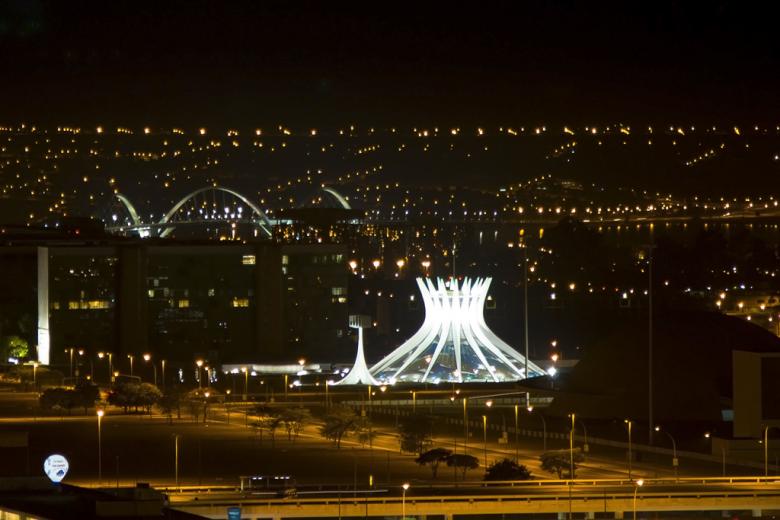
The Architettura series raises numerous questions about the relationship between architecture and music, but one that jumps to the forefront of my mind is related to genre: Is electronic music most appropriate for expressing architecture in sound? One band that has embraced a certain type of architecture in recent years is The Black Dog, the electronic group founded in Sheffield, England, in 1989 by the late Ken Downie. Across nearly ten albums and EPs over the last few years, The Black Dog explored brutalist architecture—it is prevalent in Sheffield, hardly a coincidence—from a musical perspective. My Brutal Life (2023), for instance, "delve[s] into the aesthetic and human facets of brutalism," while its sequel, My Brutal Life 2 (2024) was inspired by photographs of brutalist architecture the group had been compiling for a book.
The Black Dog has also embedded itself into brutalist buildings, quite literally. In 2023, the band held a ten-day residency at the Moore Street Electricity Substation, designed by Jefferson Sheard & Partners in 1968 in a brutalist manner. Critic Owen Hatherley has described the concrete structure as “an explosion in reinforced concrete, a bunker built with an aesthete's attention to detail.” For The Black Dog, the “industrial cathedral inspired a musical odyssey,” per the liner notes for the Nybrutalist EP documenting their residency there. “The profound influence of one of our favorite buildings resonates, intricately woven into the fabric of each composition.” Listeners can only imagine how the ambient tracks—gentle at times but building in intensity in other moments—would have sounded in situ.
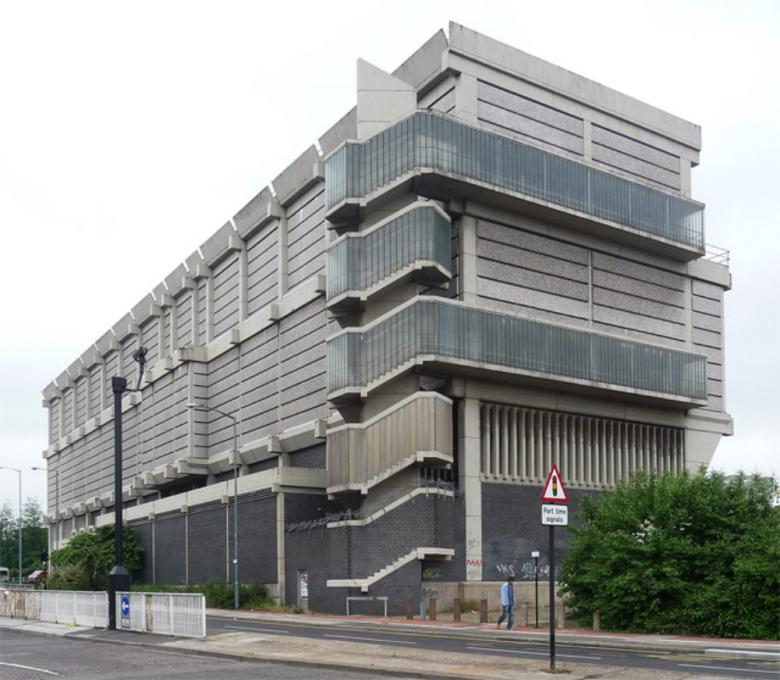
Though not as widely known as the Tower of Winds, Waterloo Terminal, Museum of Fruit, and Brasilia, the Moore Street Electricity Substation illustrates how a work of architecture doesn't need to be iconic or famous to be inspirational to musicians or have a direct influence upon music. Materiality, memories, and a myriad of other qualities sometimes bring the two arts into alignment. If anything, the Architettura series from Caipirinha Music and the Brutal Life series from The Black Dog show how rarely that relationship is explicitly expressed. As such, the broader synergies between music and architecture—rooted in shared qualities like structure, rhythm, and harmony—are more subtle, bubbling below the surface rather than rising to the top.